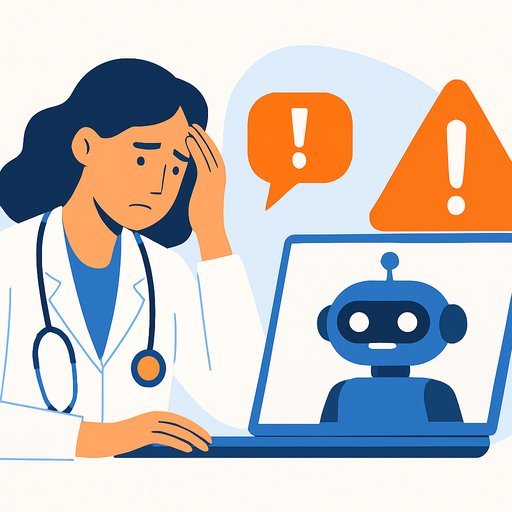
AI chatbots for medical advice: new study flags patient risk
Using large language models to guide health decisions can be dangerous, according to a study led by the Oxford Internet Institute and the Nuffield Department of Primary Care Health Sciences. Published in Nature Medicine, the work highlights a consistent problem: LLMs mix accurate facts with errors, and users struggle to tell the difference.
As one co-author, Dr Rebecca Payne, put it, "despite all the hype, AI just isn't ready to take on the role of the physician." She added that asking a chatbot about symptoms can produce wrong diagnoses and miss urgent red flags.
What the researchers did
Nearly 1,300 participants were asked to assess potential conditions and next steps across varied scenarios. Some used LLM chatbots for a suggested diagnosis and action plan; others used more traditional routes, including consulting a GP.
The team then scored decision quality and user outcomes. Their conclusion: even strong models can mislead in real-life symptom checking, where ambiguity and context matter. For broader context on evaluation protocols and deployment studies, see AI Research.
Key findings
- LLMs delivered a mix of good and bad information in the same response.
- Participants had difficulty separating reliable advice from errors.
- Models that score highly on medical knowledge tests can still fail with real users and messy symptom narratives.
- Interacting with humans remains a challenge for current systems, according to lead author Andrew Bean.
Why this matters for science and product teams
Benchmarks aren't enough. Test scores on clean questions don't translate to safe guidance under uncertainty, shifting goals, and incomplete patient histories.
Risk isn't just about accuracy; it's about calibration, triage sensitivity, and the cost of being confidently wrong. A single missed escalation outweighs many correct low-stakes answers.
Practical guardrails for health-adjacent LLM work
- Prioritize risk-stratified design: detect and escalate potential emergencies; avoid speculative diagnoses.
- Force uncertainty expression: require confidence ranges and highlight low-evidence steps.
- Ground claims: cite up-to-date clinical guidelines and show sources inline.
- Red-team for failure modes: ambiguous symptoms, conflicting signals, rare but critical conditions.
- Limit scope: drafting and summarization for clinicians beats autonomous triage for patients.
- Human-in-the-loop by default: no treatment or urgency recommendations without clinician review.
- Log decisions and rationales for audit, reproducibility, and post-hoc analysis.
What safer integration could look like
- Assist clinicians with note summaries, guideline lookups, and patient education after a confirmed diagnosis.
- Pre-visit intake drafts that flag possible red-flag terms for clinician assessment, without final advice to patients.
- Research sandboxes that simulate noisy, real-world narratives rather than clean Q&A prompts.
Bottom line
Current LLMs can appear knowledgeable yet misjudge risk in ways that matter. Until systems reliably identify uncertainty and escalate danger, they shouldn't stand in for clinicians.
The study is a useful stress test-and a blueprint. Build for ambiguity, verify against real use, and keep a qualified human in control.
Sources
For teams improving LLM safety
If you're building or evaluating clinical-adjacent tools, structured prompt-testing and failure analysis help. See our prompt-engineering resources for practical tactics that reduce risk:
Your membership also unlocks: