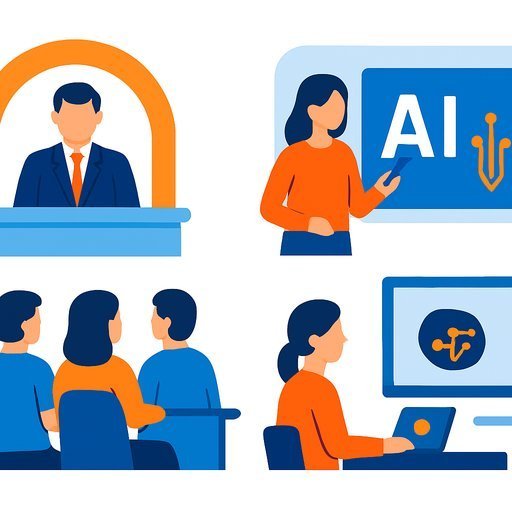
AI transforming education: Innovation meets the classroom
December 1, 2025
AI has moved from buzzword to everyday utility. The core shift: teachers spend less time on repetitive tasks and more time working with students. Districts move faster when they treat AI like a co-worker-clear job descriptions, clear guardrails, measurable outcomes.
Across cities like Pittsburgh, advocacy groups and young entrepreneurs are partnering with schools to test practical tools: tutoring assistants after school, bilingual supports, and faster feedback loops. The point isn't fancy tech. It's better learning time.
What AI actually changes in day-to-day teaching
- Planning: Generate draft lesson outlines aligned to your standards, then add your voice.
- Differentiation: Adapt texts to multiple reading levels and languages in minutes.
- Formative assessment: Create exit tickets, quick quizzes, and misconception checks on demand.
- Feedback: Produce first-pass comments using your rubric, then personalize the final message.
- Admin work: Draft emails, permission slips, and newsletters without starting from a blank page.
- Data sense-making: Summarize patterns from student responses to guide next-day instruction.
Guardrails that protect students and your job
- Privacy first: Don't put personally identifiable information into tools that store data without district approval.
- Transparency: Tell students when AI helped create materials and model ethical use.
- Bias checks: Review outputs with attention to culture, language, and accessibility.
- Academic integrity: Teach citation, provide process logs, and assess thinking, not just final answers.
- Model choice: Prefer district-approved tools with clear data retention policies.
For policy and pedagogy guidance, see the U.S. Department of Education's report on AI and teaching (ed.gov) and ISTE's standards for responsible use (iste.org).
A simple 30-60-90 day plan
- Days 1-30: Pick two use cases: lesson planning and exit tickets. Run a small pilot with three teachers. Collect before/after samples and time spent.
- Days 31-60: Write a one-page policy (privacy, acceptable use, academic honesty). Host a hands-on PD with real curriculum, not generic demos.
- Days 61-90: Expand to a grade band or department. Add feedback and differentiation. Share wins and failures in a 30-minute staff huddle.
Case snapshot: Making Pittsburgh stronger with AI and advocacy
Community partners and young entrepreneurs teamed up with local educators to test small, high-impact ideas. One group launched an after-school tutoring assistant to help students review class notes and practice with teacher-approved prompts.
Another project focused on multilingual learners: teachers converted reading passages to multiple levels and languages, then paired them with short, targeted checks for understanding. The throughline: small pilots, clear metrics, teacher control.
Quick-start prompts you can use today
- "Create a 45-minute lesson outline on [topic] for [grade], aligned to [state/standards]. Include a warm-up, mini-lesson, practice, and an exit ticket."
- "Using this rubric [paste], generate formative feedback for this student response [paste]. Keep it encouraging and actionable in 3-4 sentences."
- "Rewrite this text at three reading levels (approx. 3rd, 6th, 9th). Keep key ideas intact and flag tricky vocabulary."
- "Draft five exit ticket questions that surface common misconceptions about [concept]. Label the misconception each question targets."
- "Write a brief family update about our unit on [topic]. Include what we learned, how to help at home, and one question to ask your student."
- "Suggest accommodations for a student with [need] during a lesson on [topic]. Keep suggestions practical and classroom-ready."
Choosing tools that fit your constraints
- Check data policies: storage, retention, training on your data, and opt-out options.
- Look for LMS integrations and SSO to reduce login friction.
- Favor tools that export clean text or CSV so you're not locked in.
- Prioritize accessibility: screen reader support, captions, keyboard navigation.
- Involve teachers in selection-weekly feedback beats a year-long rollout that nobody uses.
Professional development that actually sticks
- Short, repeated sessions over one-off workshops.
- Peer show-and-tells with real student work (anonymized).
- A shared prompt library tied to your curriculum maps.
- Micro-goals: "save 20 minutes on planning" beats "learn AI."
If you want structured learning paths and certifications, explore role-based options here: Courses by Job and the latest program updates here: Latest AI Courses.
Advocacy that keeps momentum
- Student voice panels to review tools and share how they use them.
- Family nights explaining benefits, limits, and privacy choices.
- Local partnerships with colleges and startups for mentorships and internships.
AI isn't a silver bullet. It's a set of assistants that make space for the work that matters: feedback, relationships, and thinking. Start small, measure what changes, and keep what helps students learn.
Your membership also unlocks: