AI councils beat solo models on USMLE-style questions
AI in healthcare earns trust through results, not hype. A new study in PLOS Medicine shows that multiple AI models "thinking together" outperform a single model on medical exam questions.
Researchers tested a council of five GPT-4-based models on 325 publicly available questions from the three steps of the USMLE. The council hit 97% on Step 1, 93% on Step 2, and 94% on Step 3-better than a solo model across the board.
How the council works
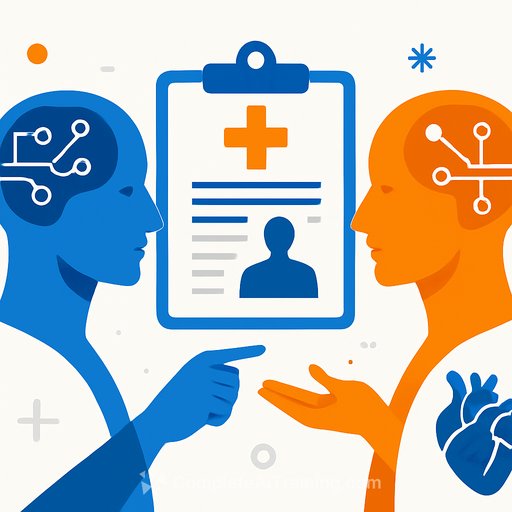
AI models often produce different answers to the same prompt. Instead of treating that variability as a flaw, the team used it as a strength.
A facilitator program had the models discuss their reasoning, compare answers, and try again if they disagreed. When the models initially conflicted, the back-and-forth landed on the correct answer 83% of the time and fixed more than half of the errors a simple majority vote would have missed.
Why this matters for healthcare professionals
Single-model tools can look confident and still be wrong. A council setup adds a built-in second opinion, plus a mechanism to self-correct before an answer is accepted.
For clinicians and leaders, this points to a practical path: pair AI diversity with structured debate and oversight. The outcome is fewer blind spots and clearer reasoning trails you can audit.
Key numbers at a glance
- Dataset: 325 publicly available USMLE questions (Steps 1-3)
- Council size: Five GPT-4-based models
- Accuracy: 97% (Step 1), 93% (Step 2), 94% (Step 3)
- Disagreement recovery: 83% correct after discussion
- Error correction: Fixed over half of mistakes missed by majority vote
Where it could help first
Education and exam prep: generating rationales, contrasting options, and teaching clinical reasoning. Decision support sandboxes: triage suggestions, guideline lookups, and differential checklists that still route final decisions to clinicians.
Quality and safety teams could use a council to surface edge cases, highlight disagreement, and log reasoning for review.
What this doesn't mean (yet)
This was not tested in live clinical settings. No patient data, no workflow constraints, and no real-world consequences were in play.
Before clinical use, expect rigorous validation, governance, bias checks, and clear escalation rules. Human oversight remains non-negotiable - see AI Research Resources for methods and evidence standards relevant to deployment.
Practical next steps for your organization
- Run a pilot in a non-clinical sandbox (education, policy checks, or retrospective case review).
- Log model rationales, disagreements, and final answers; measure error types, not just accuracy.
- Set thresholds: if models disagree beyond a set margin, require human review or withhold an answer.
- Evaluate against your guidelines and local context; document limits and intended use.
- Train teams on prompt consistency, documenting decisions, and recognizing uncertainty signals.
Bottom line
Diversity plus debate makes AI more trustworthy. A well-facilitated council can reduce wrong answers and expose reasoning, which is exactly what clinical teams need from decision support-transparency, not magic.
If you're exploring team upskilling for AI-assisted workflows, see the AI Learning Path for Training & Development Managers for structured, role-focused guidance.
Your membership also unlocks: