As Iran and Israel Clashed, AI Failed to Deliver Reliable Facts
Accurate information during wartime has always been hard to come by. Now, artificial intelligence tools add a new layer of difficulty as social platforms become flooded with fake videos and images that look incredibly real.
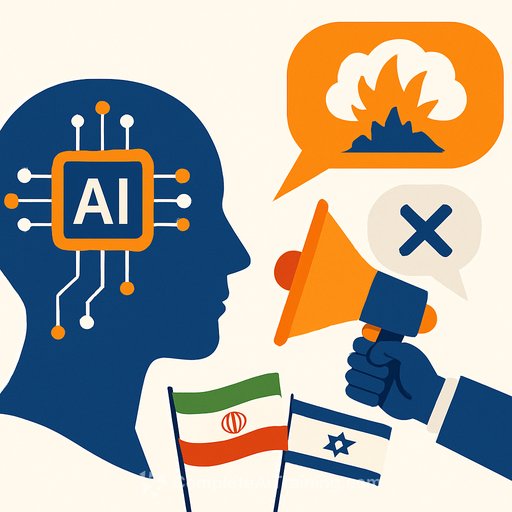
Right after Israeli military airstrikes on Iran, a video surfaced on X (formerly Twitter) showing what appeared to be drone footage of a bombed airport in Israel. The narration was in Azeri, mimicking a news broadcast. But this video was entirely AI-generated, not real footage.
Despite its falsehood, the video racked up nearly 7 million views. Users in the comments tried to confirm its authenticity by asking Grok, X’s integrated AI chatbot. This highlights a growing trend: people turn to AI chatbots for answers during conflicts, hoping for clarity.
AI as a New Medium of War Information
Emerson Brooking from the Digital Forensic Research Lab explains that AI is now shaping how people experience warfare. Traditional mass media has long influenced public opinion on war and politics. Now, hyperrealistic AI content and chatbots add complexity to these dynamics.
People are drawn to AI chatbots because they offer an endlessly patient conversational partner. You can ask about different sides of a conflict or what really happened. But having access to this technology doesn’t guarantee accurate information.
Why AI Chatbots Can’t Be Trusted for War Facts
Hany Farid, a media forensics expert at UC Berkeley, points out that chatbots are not built to verify the authenticity of images or videos. They can produce convincing but false information, and users often receive contradictory answers when asking AI to fact-check wartime content.
Tests by NPR showed that AI chatbots from major companies sometimes correctly identified fake content but also made mistakes. Some chatbots even admitted they couldn’t verify the authenticity of images.
Farid stresses that while chatbots can be helpful tools, they must be used cautiously and their outputs double-checked. Without understanding a chatbot’s limitations, users risk being misled.
The Role of AI in Propaganda and Misinformation
State actors like China, Iran, and Russia have long used digital tools for propaganda. Clemson University’s Darren Linvill notes that AI doesn’t change their tactics but amplifies them by enabling faster, larger-scale disinformation campaigns.
Generative AI can create false narratives, memes, and even entire fake news sites in hours, drastically speeding up influence operations that once took years to develop.
Still, the most effective way false messages spread is through influential figures or paid promoters who amplify these narratives to a broader audience.
Confirmation Bias Fuels the Spread of False Information
Whether it’s propaganda or people seeking facts during uncertain times, the most persuasive messages often confirm existing beliefs. This makes it even harder to separate truth from fiction when AI-generated content floods social media.
As AI becomes more accessible, it’s crucial to approach wartime information skeptically, verify sources, and understand that AI can both help and hinder the search for truth.
For professionals working with AI or digital media, building skills in media forensics and critical evaluation of AI outputs is essential. Resources like Complete AI Training offer courses that can help develop a better grasp of AI capabilities and limitations.
Your membership also unlocks: