
AI news ·
AI notetakers risk lawyer-client privilege
Two 2026 federal rulings show AI notetakers risk destroying lawyer-client privilege. Lawyers warn these tools expose confidential data to third-party vendors.
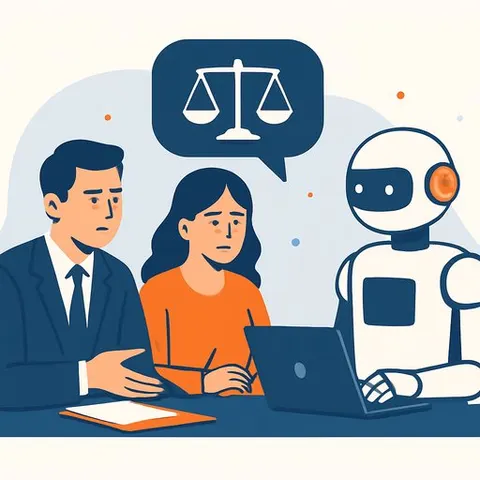
AI notetakers in virtual meetings are putting lawyer-client privilege and confidentiality at risk, as two recent US federal court rulings illustrate. The decisions, handed down in February 2026, reached opposite conclusions on whether documents created with public AI chatbots are protected by work product doctrine or must be handed over in discovery. The split signals an unsettled area of law that high-net-worth clients and their advisors can no longer ignore.
Courts split on AI-generated work product protection
On February 10, the US District Court for the Eastern District of Michigan in Warner v. Gilbarco, Inc denied a motion to compel production of documents a self-represented litigant prepared using a public AI chatbot. The court found that work product protection applied. One week later, on February 17, the US District Court for the Southern District of New York in United States vs. Heppner ordered a criminal defendant to produce documents he generated using another public AI chatbot while seeking legal advice.
The contradictory results highlight the danger of relying on AI-generated notes or summaries without understanding how the technology processes and stores data. Cloud-based processing and third-party vendor data access can eliminate the legal expectation of confidentiality, a point stressed during a recent media webinar hosted by law firm ArentFox Schiff.
Sarah Severson, a partner at the firm, said notes taken via AI could be "discoverable." Automated transcripts and summaries, she explained, are digital documents that opposing counsel can subpoena in civil or criminal cases. Severson told attendees that lawyers should always disclose their use of AI to clients in their engagement letters. "AI does not owe clients a duty of confidentiality or accountability," she said.
Global risks and the UK's first privilege ruling
The issue is not confined to US courts. In the UK, the Upper Tribunal (Immigration and Asylum Chamber) issued its first decision directly addressing legal professional privilege risks tied to AI. The case, UK v Secretary of State for the Home Department [2026] UKUT 81 (Hamid), examined what happens when confidential and privileged material is uploaded to open-source AI tools. The tribunal's ruling reinforces that privilege can be lost when clients or lawyers use public AI platforms.
Singapore and other common law jurisdictions that share traditions with the UK and US are likely to encounter similar challenges as case law accumulates. The global spread of AI adoption in legal and wealth management settings makes the confidentiality threat a cross-border concern for family offices, private banks, and professional advisors.
Practical safeguards: disclosure and 'off' switches
While AI offers clear efficiency gains - capturing meeting summaries, collecting data, and replacing routine tasks once done by junior lawyers - its public architecture is a weakness. Large language models often rely on vast public data sets, and fine-tuning with user inputs can weaken claims of secrecy. Lawyers and clients handling sensitive discussions must treat AI recording tools with the same caution they apply to email or cloud storage.
Some fintechs are responding with privacy-first hardware. In early June 2026, Swiss startup Custodia launched Sentinel, a physical AI appliance that ingests only local documents and grounds answers in that private knowledge, avoiding internet data and model training. While such tools promise higher confidentiality, the safest approach remains straightforward: turn off the AI recording gizmo before any privileged conversation, or at minimum, disclose its use clearly so all parties can refuse.
Legal professionals can find focused training on AI for Legal to better understand the risks and implement compliant practices. The recent rulings make clear that good intentions are no substitute for strict data controls.
Why this matters for Legal professionals
For lawyers, in-house counsel, and private client advisors, the message is blunt: AI notetaking can silently destroy the very privilege that protects client communications. Verify where transcripts are stored, who can access them, and whether model training is enabled. Insert clear AI disclosures in engagement letters. When in doubt, disable the feature. A single discoverable AI summary can unravel a case or expose a family office's most guarded financial structures.