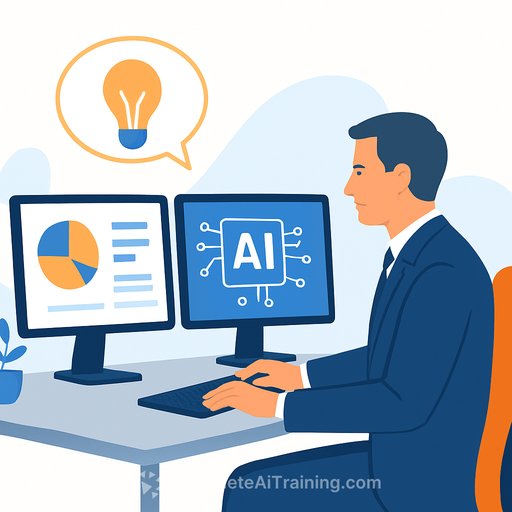
The AI-Augmented CEO: How Top Leaders Are Expanding Their Cognitive Bandwidth
The boardroom has a new silent partner: generative AI. It doesn't ask for equity, and it doesn't sleep. For Tim Cook, it's already in daily use, summarizing the flood of information that hits his desk. This isn't a gadget-it's a structural shift in how leaders process reality.
The old picture of the CEO making calls on instinct is being upgraded. By offloading synthesis to large language models, executives are freeing up attention for strategy, judgment, and moves that actually move the business. Think of it as a tireless chief of staff-one that reads everything and forgets nothing.
How the C-suite is using AI right now
- Tim Cook (Apple): Uses generative AI daily to compress vast inputs into usable summaries-reducing noise and protecting focus.
- Sundar Pichai (Google/Alphabet): Uses Gemini to learn complex topics and debug code, closing the gap between leadership and engineering depth.
- Sam Altman (OpenAI): Treats ChatGPT as a brainstorming partner. Hallucinations become lateral prompts-useful for exploring ideas fast.
- Vinod Khosla (Khosla Ventures): Applies AI to analyze medical records and write code-supporting a thesis that many primary care tasks will be automated.
- Satya Nadella (Microsoft): Runs on Copilot to summarize meetings, triage communication, and cut "digital debt." See Microsoft's Work Trend Index for the thesis behind the shift.
- Jensen Huang (Nvidia): Prefers Perplexity for research-answers over blue links-using it to probe areas like computer-aided drug discovery.
- Sebastian Siemiatkowski (Klarna): Deployed an AI assistant handling the workload of 700 FTEs with a forecasted $40M profit lift in 2024. Source: Klarna press release.
- Jamie Dimon (JPMorgan Chase): Greenlit AI across 400+ use cases-from fraud detection to hedging-framed in his annual letter as a shift on par with historic inventions. Reference: Shareholder letter.
- Dario Amodei (Anthropic): Uses Claude for long-form synthesis and document-heavy work, turning reading into an interactive query process.
- Mark Zuckerberg (Meta): Writes code again with Llama-dogfooding the product and resetting the company's engineering tempo from the top.
What this means for your operating system
Executives aren't using AI as a toy. They're using it to expand their cognitive ceiling and compress time to clarity. The constraint is no longer access to information-it's how fast you can turn information into action. Your edge is the quality of your prompts, your workflows, and your governance.
The executive stack: practical implementations
- Daily Briefing Agent: Feed it inbox, docs, and dashboards. Get one page: key shifts, risks, decisions pending, and who's on point. Ask for "disconfirming evidence" to reduce bias.
- Decision Dossier: For major calls, have AI produce options, trade-offs, risk scenarios, and second-order effects. Require sources and confidence scores.
- Engineering Bridge: Use an LLM to explain architecture, review snippets, and translate product claims into exec-level clarity. Ask for "what would break" under scale or compliance constraints.
- Meeting Compression: Summaries with action items, owners, deadlines, and unresolved issues. Push it to your task system automatically.
- Market Intelligence: Use answer engines for synthesized takes. Pair with a human review on high-stakes calls to protect against false certainty.
Operating leverage: where AI already pays
- Customer Ops: Disputes, tier-1 support, and KYC checks. Klarna's numbers show the cost curve bending hard.
- Risk and Compliance: Policy checks, anomaly detection, surveillance-fast filters that route edge cases to humans.
- Finance and Trading: Pattern recognition and hedging assistance with strict guardrails and audit trails.
- Legal and Procurement: Clause comparison, redlines, and supplier due diligence with source-linked summaries.
Guardrails that keep you out of trouble
- Source-first summaries: Every claim needs citations, timestamps, and links to originals.
- Human-in-the-loop on material decisions: Thresholds by dollar amount, legal risk, or reputational exposure.
- Data governance: Segmented environments, strict PII handling, and contract terms for vendor models.
- Adversarial testing: Prompt-injection, jailbreaks, and red-teaming as a recurring ritual.
- Model portfolio: Use multiple models for cross-checking. Treat them like analysts with different strengths.
Metrics that matter
- Cycle time: From intake to decision. Track the delta after introducing AI summaries.
- Quality of decision: Win rate on bets, variance vs. plan, incidents avoided.
- Cost per outcome: Support tickets resolved, contracts reviewed, or features shipped per dollar.
- Adoption depth: % of teams using the stack weekly, prompts/templates reused, and agent uptime.
- Error taxonomy: Hallucinations, missed context, or wrong source. Fix the root cause, not just the symptom.
Talent and culture
The leaders above send a clear signal: proximity to the product matters again. Coding or at least reading code with AI, review docs with AI, and pressure-test claims with AI. It compresses hierarchy and speeds truth.
If your team sees you using the tools daily, they will follow. If not, adoption stalls and you burn political capital pushing change top-down.
Next steps (a simple 30-day plan)
- Week 1: Stand up a secure AI workspace. Ship a one-page policy on acceptable use and data handling.
- Week 2: Deploy meeting and inbox summarization. Pilot with your staff and one line function (support, finance, or sales ops).
- Week 3: Launch decision dossiers for two high-stakes projects. Require sources and dissenting viewpoints.
- Week 4: Review metrics, kill what doesn't work, double down on what does. Add a second model for cross-checking.
Resources
- Microsoft's research on digital debt and AI productivity: Work Trend Index
- Klarna's quantified ROI on AI in customer service: press release
- Build role-specific skills and playbooks: AI courses by job and popular certifications
The bottom line
The advantage is shifting to leaders who treat AI as an extension of their thinking-summarizing, probing, and stress-testing the inputs that drive real decisions. The risk is over-trusting summaries without sources or letting speed outrun governance. Get the stack right, and you expand your capacity without expanding headcount. Get it wrong, and you scale mistakes.
Your job hasn't changed: set direction, make calls, and build teams that win. You'll just do it with an always-on analyst at your side.
Your membership also unlocks: