AI in Indian Courts: Pilot phase, policy pending
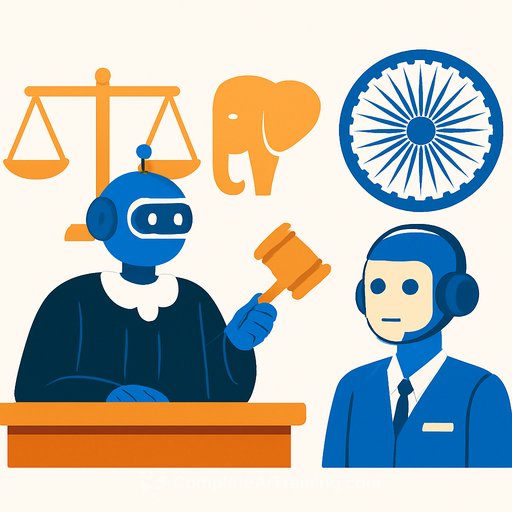
The government told the Lok Sabha that AI for Legal tools are being tested under the eCourts Mission Mode Project Phase-III, but there is no formal policy or guideline for AI use in judicial processes yet. Adoption remains limited to controlled pilots approved in the Detailed Project Report (DPR).
Where the money is going
₹7,210 crore has been allocated under Phase-III to upgrade ICT infrastructure across the judiciary. The goal: improve productivity, widen access, reduce costs, and build trust in service delivery.
Within this, ₹53.57 crore is set aside for "Future Technological Advancements" such as AI and blockchain. Any AI use is restricted to DPR-approved areas and is currently in pilot mode only.
Oversight and governance
The Supreme Court has set up an Artificial Intelligence Committee to explore AI in the judicial domain. Operational frameworks for AI use will be governed by the Rules of Business and policies issued by respective High Courts.
The judiciary has flagged key risks and limits that must be managed:
- Algorithmic bias and fairness
- Language and translation accuracy, especially across Indian languages
- Data privacy and security
- Need for manual verification of AI outputs
To address these, the eCommittee of the Supreme Court formed a sub-committee with six High Court judges and technical experts. The group is tasked with recommending secure connectivity, authentication, and stronger data security measures for eCourts.
What's being piloted
- LegRAA: an AI-based Legal Research Analysis Assistant to support judges in research and document analysis.
- Digital Courts 2.1: a single-window interface for case information management.
- ASR-SHRUTI: Speech-To-Text to help with order and judgment dictation.
- PANINI: Translation support across languages.
According to the eCommittee, there have been no reported instances of systemic bias, unintended content, or other issues during pilot use so far.
What this means for government teams
- Plan AI use strictly within DPR-approved areas and align with upcoming High Court policies.
- Define clear, narrow use cases (research assistance, transcription, translation) with human-in-the-loop checks.
- Run bias, accuracy, and security testing before any wider rollout; document results.
- Set data governance rules: access controls, logging, encryption, anonymization where feasible, retention timelines.
- Use strong identity and authentication standards for all AI-enabled workflows.
- Maintain audit trails and versioning for AI-assisted drafts, notes, and final outputs.
- Address language coverage and quality thresholds for translation and speech-to-text.
- Include incident reporting, fallback procedures, and manual verification as mandatory steps.
- Ensure contracts cover data residency, IP, vendor lock-in risks, and exit options.
- Invest in user training for judges and registry staff; keep guidance concise and scenario-based.
- Define evaluation metrics (accuracy, time saved, error rates) and review them quarterly.
The official word
The information was shared in a written reply in the Lok Sabha by the Minister of State (Independent Charge) for Law and Justice and Minister of State for Parliamentary Affairs, Arjun Ram Meghwal.
Resources
- eCourts Project (official)
- eCommittee, Supreme Court of India
- Practical AI courses by job role (for upskilling teams)
Your membership also unlocks: