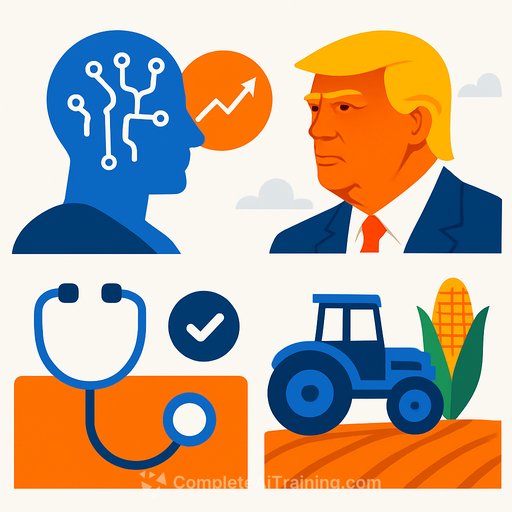
Insiders nervous as AI set to transform farming and healthcare
Business Sunday, 11 January 2026
A roundup of the latest news in the business world
Why this matters for healthcare product teams
AI is flush with capital in consumer tech, slower in health, and now sitting under a policy cloud. That mix creates both pricing pressure and opportunity for teams who can ship validated products, not demos. Below is the signal you need, plus a practical plan for the next 12 months (see AI Learning Path for Training & Development Managers for guidance on leading AI initiatives in your organisation).
Policy shock: "Trump Risk" moves the goalposts
The past week brought a flurry of White House moves: seizing Venezuelan oil and pulling in major oil CEOs, threatening to yank Pentagon contracts from Raytheon, and banning private equity purchases of single-family homes. Big oil wants Treasury guarantees before investing in Venezuela's broken energy system. Raytheon took heat for buybacks, and housing policy remains a debate over cause versus cure.
For healthcare, the lesson is simple: government priorities can swing fast. Procurement, grants, and reviews can turn on a dime, and the next administration may flip the script again. Even donation optics are risky; JP Morgan publicly kept its distance from a White House ballroom fundraiser, citing legal and reputational exposure if the Department of Justice views it differently later.
Investor pulse: CES optimism, JP Morgan Healthcare caution
CES was bullish on AI paired with hardware-self-driving systems, humanoid robots, even reactive Lego bricks. Across the bay in San Francisco, the JP Morgan Healthcare crowd expects a cooler take. AI in drug discovery, devices, and care ops has delivered uneven results, venture returns have been hit, and biotech has had a rough patch.
There is a bright spot: M&A is ticking up and a few IPOs could crack the window open. Still, regulation looks erratic under health secretary Robert F Kennedy and federal research cuts are biting. Some investors even fear a correction in the big AI platforms while healthcare quietly enters a better part of its cycle.
Farming's AI debate is a useful mirror for health
At the Oxford Farming Conference, attendees debated: "In the next 90 years, farming will become a one day a week job." Elliot Grant and Kate Russell argued that AI can strip out the worst tasks and boost productivity, with farmers paid for ecosystem services. Sue Pritchard and Tracey Roan pushed back, saying human experience with land and livestock is irreplaceable and warning that further distancing people from production can fuel unhealthy trends like ultra-processed foods.
The motion failed 228-136. The takeaway for healthcare: keep humans at the center, measure what matters, and avoid proxy metrics that degrade outcomes. AI should remove drudgery and improve safety, while clinicians own judgment calls.
Playbook for healthcare product leaders (next 12 months)
- Commit to a clear ROI thesis: tie AI to time-to-decision, cost-to-serve, or a validated clinical endpoint. Kill features that don't move those needles.
- Run a data audit: provenance, consent, diversity, drift risk, and gaps. Budget for data acquisition like you would for a core component.
- Validate like a regulator is in the room: external validation, prospective studies where feasible, and tight post-market monitoring. Align with FDA thinking on AI/ML-enabled devices.
- Build real-world evidence early: partner with IDNs and payers for coverage-grade outcomes and cost data. Pre-negotiate data rights and publication plans. See AI Research Courses for methods on external validation and evidence generation.
- Bias and safety: document known failure modes, add guardrails, and require a human review step for high-risk decisions.
- Regulatory engagement: schedule pre-sub meetings, maintain a change protocol for model updates, and keep audit-ready traceability across the ML lifecycle.
- Security and privacy: manage an SBOM, threat-model your pipeline, and formalize a vulnerability response process. HIPAA is the floor, not the ceiling.
- Commercial model: consider risk-sharing tied to hard outcomes, and prep health economic dossiers for value committees under budget pressure.
- M&A and partnerships: keep a shortlist of targets to plug data, workflow, or channel gaps. Plan for data/IP integration from day one.
- Policy scenarios: draft go/no-go triggers for procurement and reimbursement swings. Set a company-wide policy on political contributions and engagement.
Execution metrics to watch
- FDA submissions and clearances for AI-enabled devices (trend and review timelines).
- Payer coverage decisions for AI-assisted diagnostics and care pathways.
- M&A volume and IPO activity in biotech/medtech vs. platform AI names.
- Federal research budgets and grant awards that touch your indication.
- Compute costs, GPU availability, and cloud credits that affect unit economics.
Risk brief for C-suite and boards
- Policy volatility: dual-track plans for procurement, pricing, and grants under competing federal priorities.
- Concentration risk: avoid over-reliance on a single model provider or data broker; maintain switching paths.
- Reputational risk: clear rules on donations and public partnerships; assume discovery by future regulators.
Resources
Your membership also unlocks: