Scientists Replayed Evolution With AI - and the Results Upend Predictability
A new study in the Proceedings of the National Academy of Sciences used large-scale simulations to replay evolution hundreds of times. Researchers from the University of Vermont and the University of Cambridge tested 105 environmental programs across thousands of generations of digital organisms. The headline result: the path of adaptation isn't a straight climb. It depends on the type, order, and tempo of environmental change.
What the Simulations Tested
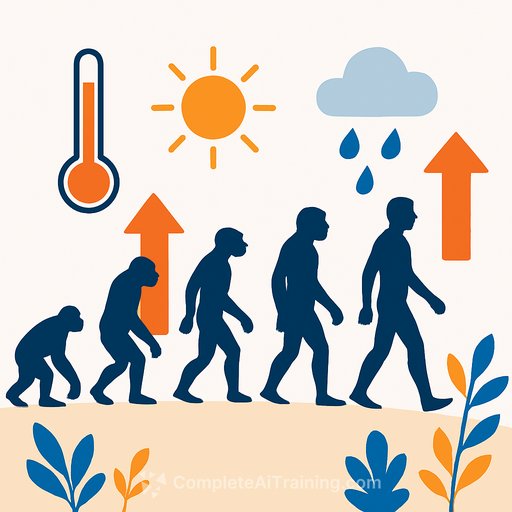
The team exposed digital populations to realistic fluctuations such as temperature swings and alternating drought-rain cycles. They compared outcomes in variable environments against static ones, tracking both maximum and average fitness over time. Sometimes variability pushed populations to higher fitness peaks; other times it stalled progress or forced resets.
Across the 105 pairs of fitness landscapes, environmental variability tended to boost average fitness while leaving effects on maximum fitness centered around zero. In short: variability often lifted the baseline but didn't guarantee higher peaks. That nuance matters for how we interpret "success" in evolving systems.
Why Variability Can Help - or Stall - Adaptation
Some fluctuations act like practice, exposing populations to diverse challenges that lead to broadly useful traits. Other sequences create dead ends. The timing and order of stressors can trigger repeated restarts, wiping out gains before they consolidate.
As one author put it, temperature swings might improve tolerance for both cold and heat, while a dry-wet-dry cycle can erode drought tolerance each time the rains return. Flexibility isn't free. If selection pressures flip too quickly or in the wrong sequence, adaptation keeps getting reset.
A Wider Lens for Evolutionary Research
Most long-term experiments track one population in one condition. This study flips that script. "We picked an array of environments and see how the specifics of each one influence the trajectory of many populations," said Lapo Frati.
The takeaway: no single population stands in for an entire species. Two Drosophila melanogaster populations can face entirely different seasonal programs - winter-summer in the U.S., drought-rain in Kenya - and thus develop different adaptive paths. Forecasts that ignore local variability miss the real picture. For related methods and perspectives on experimental variation and study design, see Research.
What This Means for Your Research and Modeling
- Treat environmental history as a first-class variable, not just intensity or frequency. Order and timing change outcomes.
- Report both average and maximum fitness. Variability may lift one and leave the other flat.
- Test multiple switching schedules (periodic, random, clustered). Don't assume one flavor of variability generalizes.
- Run many replicates across many environments. One curve in one condition isn't a reference truth.
- Measure consolidation time: how long until beneficial traits stick after a switch?
Implications for Climate Adaptation and Conservation
Local environments differ, even within species. Management plans built on a single "typical" population will overfit to the wrong conditions. Expect divergence by condition - and build strategies that work across multiple environmental programs, not just averages.
Watch for cases where variability lifts average performance but masks reduced peak capacity. Survival under extremes often depends on peaks, not means.
Lessons for AI, Continual Learning, and Meta-Learning
The authors draw clear parallels to AI systems that learn sequentially and struggle with forgetting. Volatile task schedules can either build general skills or erase them. The curriculum - its order, tempo, and revisitation pattern - decides which outcome you get.
- Evaluate on distributions, not single benchmarks. One task can't prove general capability.
- Design switch schedules that allow consolidation before introducing new tasks.
- Use rehearsal or regularization to protect prior "traits," just as stable periods protect biological gains.
If you're building or auditing AI training programs, this study is a reminder to test multiple curricula and measure retention, transfer, and reacquisition - not just final task scores. For structured options to explore AI learning paths and certifications, see the AI Learning Path for Training & Development Managers and the AI Learning Path for Teachers.
Methods Snapshot
The team evolved digital organisms across paired fitness landscapes, with targets generated by the same cellular automata rules but different initial conditions. They compared static runs (each environment alone) with variable runs (switching between environments). Results were summarized via scatter plots of differences in maximum and average fitness, and example time-series from selected landscape pairs.
Big Picture: Evolution as History
"We replayed evolution hundreds of times," noted Melissa Pespeni. That repetition exposed how starting conditions and early challenges set the course for what comes later. Evolution is path-dependent.
For scientists and research leaders, the message is straightforward: design experiments and models that respect history, sequence, and context. If you want stronger predictions - in biology or AI - test many paths, not just one.
Study reference: Proceedings of the National Academy of Sciences (PNAS).
Your membership also unlocks: