Health New Zealand rolls out AI scribe tools across all emergency departments
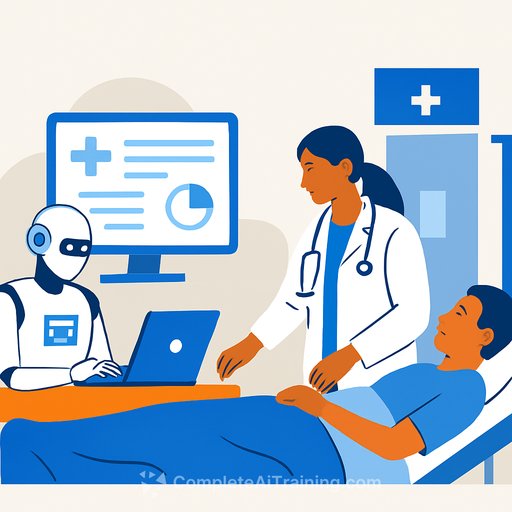
14 Mar 2026 - Health New Zealand has switched on AI scribe tools in every hospital emergency department, aiming to cut documentation time and free up clinicians for patient care. These tools capture and structure notes from consultations in real time, then sync with electronic medical record systems.
The national rollout follows a pilot last year that indicated doctors could see, on average, one additional patient per shift due to time saved. According to Health Minister Simeon Brown, "AI scribe technology is now live in all emergency departments across New Zealand, with the rapid rollout to 1,250 ED doctors and frontline staff complete - 250 more than originally announced following a successful pilot last year."
Brown added, "This places New Zealand among the fastest health systems in the world to move from pilot to nationwide frontline AI use in emergency departments, helping clinicians spend more time with patients and less time on paperwork." The agency will also approve 1,000 additional licences for mental health teams. "AI will never replace clinical skill or judgement, but it will play an increasingly important role in supporting frontline healthcare staff and helping patients access care faster and more efficiently."
How the tech works
AI scribe tools blend speech recognition with large language models to create draft clinical notes during the encounter. The output is then reviewed and signed off by the clinician before it's committed to the record. Integrations with EMRs reduce copy-paste and duplicate entry, which helps with accuracy and consistency.
Early impact and why it matters
The pilot's lift-one more patient per shift-sounds small, but scaled across a full ED roster it adds measurable capacity without adding headcount. Faster, cleaner documentation supports safer handovers, improves coding quality, and can reduce claim friction for insurers.
For ED leaders, this is a chance to convert after-hours charting into more bedside time. For payers, it's an opening to improve documentation completeness and auditability, which can lower denials and shorten time-to-pay.
What providers should do now
- Define clinical governance: set clear policies for when to use AI scribes, required human review, and documentation standards.
- Tighten consent workflows: make sure patients understand audio capture, retention, and opt-out options.
- Lock down data handling: confirm PHI encryption in transit/at rest, data residency, and vendor access controls.
- Measure accuracy: track word error rate, clinical concept capture, and add specialty-specific templates for ED and mental health.
- Train for edge cases: non-English speakers, high-noise environments, critical events where speed trumps detail.
- Align with revenue cycle: ensure outputs support ICD/ACHI coding, medical necessity, and discharge summaries.
What insurers should watch
- Documentation richness: more complete HPI, ROS, and clinical decision-making should translate into cleaner claims.
- Consistent coding signals: structured notes can reduce variability and support faster straight-through processing.
- Fraud and abuse safeguards: verify that AI-generated notes reflect actual services; invest in anomaly detection tuned for AI-authored text.
- Privacy and consent compliance: confirm that provider partners meet contractual and regulatory requirements around audio capture and storage.
Risks and guardrails
- Hallucinations and omissions: mandate clinician verification and document attestation prior to final save.
- Acoustic challenges: ED noise can degrade accuracy; use high-quality mics and room-specific tuning.
- Bias and translation gaps: evaluate performance across accents and languages common to your population.
- Medico-legal exposure: keep clear audit trails of edits, timestamps, and user attribution.
Mental health expansion
With 1,000 licences moving to mental health teams next, privacy expectations tighten further. Sessions often include sensitive content, so informed consent, selective redaction, and stricter access controls are non-negotiable. Teams should pilot with carefully designed prompts/templates that avoid over-documentation of subjective statements.
Metrics that signal success
- Throughput: patients seen per shift and door-to-doc time.
- Clinician time: minutes saved per note and after-hours charting reduction.
- Quality: note completeness scores, coding accuracy, and handover safety events.
- Financials: denial rate, time-to-first-pass payment, and addendum frequency.
- Experience: clinician burnout indicators and patient satisfaction related to perceived attention.
Context: broader EHR momentum
Elsewhere, HCA Healthcare implemented MEDITECH's Expanse EHR across 43 hospitals earlier this year, signaling continued investment in core clinical platforms that AI tools rely on. Strong EMR foundations make deployments like AI scribes faster and safer. Learn more about Expanse from the vendor's overview here.
Bottom line
New Zealand's ED rollout shows that AI scribes can move from pilot to practice at national scale. If you lead clinical operations or manage claims, treat this as a prompt to firm up your AI documentation strategy-governance first, metrics second, tooling third.
For practical frameworks and training on clinical AI deployments and EHR-integrated workflows, explore AI for Healthcare. For teams optimizing transcription accuracy and workflows, see Speech-To-Text.
Your membership also unlocks: