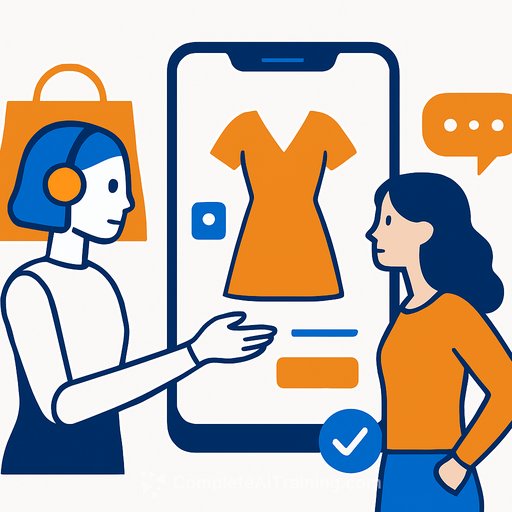
AI Shopping Will Upend Fashion Advertising: What Marketers Need To Do Now
AI shopping is moving from concept to checkout. Shopify and Google just introduced the Universal Commerce Protocol (UCP), letting brands sell directly inside Google's AI Mode with integrated checkout - no site visit required.
Any US brand can opt into Shopify's "Agentic plan" to sell through AI channels, even if their site isn't on Shopify. The UCP supports discount codes, loyalty, and flexible billing, signaling a future where AI agents from Google, OpenAI, and others transact across the open web.
As Shopify's president put it: "This isn't like social commerce… commerce will be offline, online and agentic." Shopify already hosts roughly 12% of US e-commerce, with brands like Skims, Victoria Beckham, and Loewe using the platform.
Why this matters
Agentic AI will handle more of the shopping workflow: research, comparison, and purchase. Morgan Stanley projects up to $385B of US e-commerce could flow through agentic shoppers by 2030. The platforms want that spend - and they'll monetize it with in-chat ads and hosted checkouts.
Google, OpenAI, and Perplexity are racing to build shopping-native chat features. Google now supports integrated checkout in AI Mode and brand "business agents." Amazon introduced sponsored prompts in Rufus. OpenAI is testing ad formats. Most early integrations run through Shopify.
The ad model is changing - merit beats pure spend
AI agents aim to recommend the best fit, not the highest bidder. That makes ad dollars work differently. Expect fewer traditional placements and more "direct offers," sponsored follow-ups, and branded agents that answer questions in your voice.
As Harley Finkelstein argues, agents work best when they're unbiased. Smaller DTC brands with strong product-market fit and clear positioning could see outsized gains if they structure their data and storytelling well.
Discovery shifts to AIO (AI optimization)
SEO rules aren't gone, but AI answer engines favor richer context. Give models something to work with.
- Product detail depth: long-form PDPs with use cases, materials, sizing notes, fit guidance, and care.
- FAQ layers: objections, comparisons, alternatives, warranties, shipping/returns.
- Multimodal assets: diverse imagery (angles, on-body, scale), short clips, alt text with real descriptions.
- Data hygiene: clean titles, GTIN/UPC, variant structure, inventory freshness, price clarity.
- Trust signals: ratings, verified reviews, UGC. Generative systems lean on real customer feedback to judge quality.
As one strategist put it: "The brands that stand out won't be the loudest - they'll have the most coherent narratives." Consistency across site, social, email, and PR gives the model a single, strong signal.
What to pilot now in AI chat
- Business agents: Define your brand voice and guardrails; preload product knowledge, policies, fit logic, and care.
- Direct offers: Test personalized incentives within AI Mode. Track net lift vs. on-site promos.
- Sponsored follow-ups: Bid on high-intent prompts (e.g., "What's the difference between X and Y?") with comparison-ready answers.
- Loyalty and identity: Make it easy for AI to recognize members, apply perks, and surface relevant bundles.
Data and checkout readiness
- Product feed: Accuracy beats volume. Keep attributes complete and consistent across channels.
- Pricing and promos: Codify stack rules so agents don't conflict with sitewide deals.
- Inventory and fulfillment: Real-time stock, delivery windows, return logic exposed to agents.
- Compliance: Consent for remembered chats, data retention windows, and opt-outs clearly handled.
Measurement and attribution
- Define "agentic orders": Tag orders originating from chat flows and compare AOV, return rate, and LTV.
- New mid-funnel: Treat agent conversations like high-intent search. Model incrementality, not just last click; lean on rigorous analytics and Research to validate lifts.
- Creative analytics: Test message blocks (benefit, proof, offer, risk reversal) inside chat responses.
Brand story is now a ranking factor
AI systems look for aligned signals across your footprint. If your positioning is muddy, you'll get buried. If it's clear and consistent, you'll be recommended to the right people - especially on high-consideration luxury purchases where shoppers seek peer reviews and proof.
Keep building human awareness with great creative, but make sure every campaign strengthens the same core narrative. The "machine" retells your story; give it one worth repeating.
30/60/90-day action plan
- 30 days: Map AI channel flows. Fix PDP depth, add FAQs, clean feeds, centralize reviews. Define brand voice and claims.
- 60 days: Pilot Google AI Mode checkout via UCP, test a branded business agent, launch 1-2 direct offer experiments. Add comparison pages for top queries.
- 90 days: Stand up agentic attribution, evaluate promo economics, expand UGC capture, and train CX to support AI-informed shoppers.
Where to go deeper
Review the platform moves firsthand: Shopify and Google AI are publishing updates as features roll out.
If you need a structured path for your team, see this practical track built for marketers: AI Certification for Marketing Specialists, or explore leadership-focused training like the AI Learning Path for Business Unit Managers.
Bottom line
Agentic AI will push discovery, persuasion, and checkout into chat. The winners will have clean data, a coherent brand story, and offers that make sense in the moment. Start now while the signal is still early and the compounding advantage is up for grabs.
Your membership also unlocks: