The Hidden Legal Minefield: Compliance Concerns with AI Smart Glasses, Part 3 - Privacy, Surveillance, and Labor Law
AI-enabled smart glasses are moving from novelty to daily tool. That shift brings serious privacy and labor law risk that legal teams need to get in front of now.
Parts 1 and 2 covered biometric collection and all-party consent issues tied to AI note-taking. This Part 3 focuses on broader privacy, surveillance, and National Labor Relations Act exposure.
The Risk
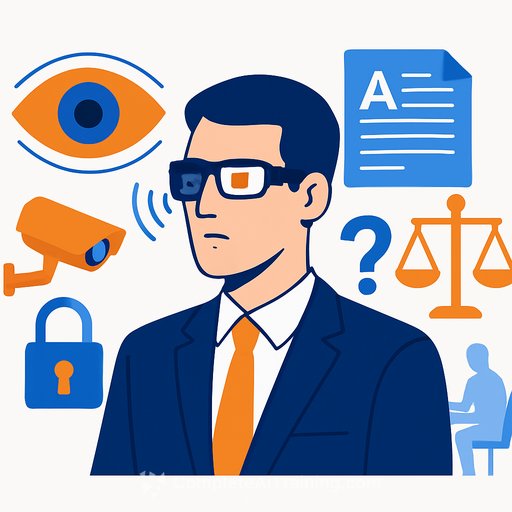
Deploying AI glasses can create continuous and intrusive monitoring of employees, customers, and anyone nearby. That raises exposure under state privacy laws, wiretap rules, and common law claims, along with new proposals aimed squarely at workplace surveillance.
In California, Assembly Bill 1331 (introduced in 2025) sought to restrict employer monitoring in off-duty private spaces and around homes or personal vehicles. It was vetoed, but the direction of travel is clear: more scrutiny, not less.
California's CCPA/CPRA adds another layer. Ongoing surveillance and recording may trigger risk assessment duties, along with notice and deletion rights for employees and other residents. Organizations should inventory what these devices collect and how that data flows through internal systems and vendors. See the California Privacy Protection Agency's regulations and resources for context: CPPA Regulations.
Labor Law Pressure
The NLRA protects employees who act together over working conditions. Persistent monitoring, audio capture, or recording can chill that activity, creating unfair labor practice risk. In unionized settings, deploying AI glasses may also be a mandatory subject of bargaining.
The NLRB has cautioned against broad bans on recordings when they interfere with Section 7 rights, while also signaling concern over technology that discourages employee speech. For reference, review NLRB General Counsel guidance: NLRB GC Memos.
Relevant Use Cases
- Warehouse workers using AI glasses for inventory management that also track movement patterns, productivity metrics, and conversations of coworkers - see the AI Learning Path for Supply Chain Analysts for analytics and governance considerations.
- School employees that use AI glasses while interacting with minor students in a range of circumstances
- Field service technicians wearing glasses that record all customer interactions as well as communications with coworkers
- Office workers using AI glasses with note-taking features during internal meetings, capturing discussions among employees
- Healthcare workers in a variety of settings, purposefully or inadvertently, capturing images or data of patients and their families
- Manufacturing employees whose glasses document work processes while also recording conversations with coworkers - see the AI Learning Path for Production Planners for production and inventory-focused guidance.
Why It Matters
Several states already require employee notice of electronic monitoring (including Connecticut, Delaware, and New York). California's CCPA gives employees rights to know what's collected about them and to request deletion. Recent CPRA regulations strengthened obligations around risk assessments tied to surveillance activities.
Union environments face added scrutiny. Broad monitoring can chill protected concerted activity, and implementation may require bargaining. Even outside union settings, poorly controlled recording and tracking can spark legal claims and reputational damage. Managers and compliance leads may find the AI Learning Path for Supply Chain Managers a useful primer on governance, risk, and policy considerations.
Practical Compliance Considerations
- Implement clear policies: Decide where and when AI glasses are allowed, which features are permitted, and who can enable recording. Address audio capture explicitly.
- Provide notice: Explain capabilities, what data is collected, purposes, retention, sharing, and employee rights (access, deletion, opt-out where applicable).
- Perform an assessment: Complete privacy impact/risk assessments before deployment, including customer-facing scenarios and high-risk use cases.
- Consider bargaining obligations and Section 7 rights: In union settings, bargain as required. Evaluate and mitigate any chilling effect on protected activity.
- Establish technical limits and safeguards: Disable recording in private spaces (bathrooms, lactation rooms, prayer rooms, designated quiet rooms). Geofence or auto-shutoff where feasible.
- Minimize data: Collect only what you need. Turn off default audio/video capture by default unless a clear business and legal basis exists.
- Retention and deletion: Define short retention periods for recordings and derived metrics. Automate deletion and document exceptions.
- Vendor and IT controls: Lock down admin settings, encryption, access controls, and logging. Paper the data flows with DPAs and ensure downstream compliance.
- Training and enforcement: Train employees and managers on permitted uses and red lines. Monitor for misuse and enforce consistently.
- Multi-state compliance: Map features against state privacy, wiretap, and monitoring notice laws. Refresh notices and policy updates as laws change.
Counsel's Quick Checklist
- Data inventory of sensors, recordings, metrics, and recipients
- Risk assessment documented; stakeholder sign-offs in place
- Employee and customer notices finalized and delivered
- Consent strategy for audio/recording where required
- Labor strategy: bargaining plan and PCA risk mitigation
- Technical controls live-tested (auto-shutoff, geofencing, access)
- Retention schedule and deletion automation verified
- Incident response plan updated for wearable-driven events
Conclusion
Smart glasses can drive real utility-hands-free information, productivity gains, better field support. Shipments grew an estimated 210% in 2024, and adoption will keep pressing into the workplace.
The risk is equally real. Treat these devices like always-on sensors governed by privacy, labor, and wiretap rules. With clear policies, strong technical limits, ongoing assessments, and respect for employee rights, organizations can realize the upside while keeping exposure in check.
Your membership also unlocks: