How AI agents are driving the future of security operations
Security teams are stretched. Alerts pile up, threats move fast, and headcount isn't keeping pace. AI SOC agents can help, but the value comes from disciplined deployment, not hype or a "magic button."
The goal is simple: reduce noise, speed up response, and keep humans in control. With the right guardrails and metrics, AI agents can take on repeatable work and free analysts to focus on judgment-heavy decisions.
What AI SOC agents do well today
- Enrich alerts with context from threat intel, logs, IAM, and asset data.
- Correlate related events into cases and suggest probable root causes.
- Translate natural-language questions into searches across SIEM, EDR, XDR, and ticketing tools.
- Propose next steps, draft incident timelines, and generate executive-ready summaries.
- Execute approved playbooks (quarantine, block, disable) with human sign-off.
- Capture "tribal knowledge" so newer analysts can follow proven approaches.
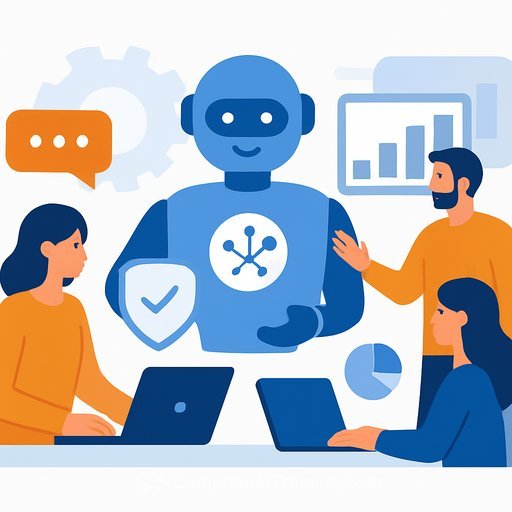
Agents reduce manual toil and standardise processes. They don't replace human expertise. The sweet spot is collaboration: machines handle the grind; people make the calls.
Proceed with caution
This market is early, and "AI agent washing" is real. Run proof-of-concept (POC) tests in your environment before you believe any claim. Industry analysts project many SOCs will pilot agents by 2028, but only a fraction will see measurable gains without structured evaluations.
Full autonomy isn't viable today. Some tasks benefit from AI assistance, others require human oversight. Treat agents as teammates operating under clear rules, not a self-driving SOC.
Hidden costs and vendor traps
- Usage-based pricing that spikes with alert volume or API calls.
- "Bring your own model" terms, which push infrastructure and security obligations onto you.
- Feature caps that limit actions or connectors when volume grows.
- Poor interoperability that creates yet another silo or forces re-architecture.
- Opaque roadmaps and shaky vendor viability in a crowded startup field.
A practical playbook to get started
- Define outcomes and baselines: MTTR, MTTC, false positive rate, analyst hours per incident, rework rates. Capture current numbers first.
- Set governance: Autonomy boundaries, escalation paths, dual-approval for risky actions, audit trails, and a kill switch.
- Integrate cleanly: Inventory data sources, identity stores, and tools. Enforce least privilege for service accounts. Log every agent action.
- Design human-in-the-loop: Require approvals for containment and any irreversible change. Use confidence thresholds to route for review.
- Run a 30-60 day POC: Test against real incidents and red-team scenarios. Predefine success criteria. Compare performance to baselines weekly.
- Address risk and compliance: Data residency, retention, model inputs/outputs, supplier security, and privacy reviews.
- Train the team: Update runbooks, create quick-reference guides, and track adoption. Close feedback loops fast.
- Plan to scale: Set cost caps, SLOs for latency and reliability, and fallbacks when models degrade.
Evaluation checklist for vendors
- Outcomes: Evidence of MTTR/MTTC reduction and false-positive cuts in environments like yours.
- Explainability: Clear reasoning, provenance of data, and replayable steps for every action.
- Guardrails: Policy enforcement, role-based control, approval workflows, and rollback.
- Integrations: SIEM, EDR/XDR, IAM, ticketing, firewalls, SOAR. Validate depth, not just logos.
- Interoperability: Works inside your current playbooks and data models without major rework.
- Security and privacy: Isolation, encryption, model security, data minimisation, and audit logs.
- Cost model: Transparent pricing, volume tiers, and projected run-rate at your alert levels.
- Viability: Funding runway, roadmap clarity, reference customers in your sector/scale.
- Support: SLAs, incident response for the agent itself, and co-development options.
Build, buy, or borrow
- Extend current tools: Many SIEM/XDR/SOAR platforms now include agent-like features-start there for quick wins.
- Managed services: Offload operations while gaining AI-enabled workflows without re-platforming.
- Buy a platform: If you need cross-tool orchestration and strong explainability, evaluate specialist vendors.
- Prototype in-house: For specific gaps, build thin agents on top of existing APIs with strict guardrails.
Metrics that matter
- MTTR and MTTC improvements by severity band.
- Alert volume reduction and triage auto-closure rate (with QA sampling).
- False positive rate and containment accuracy.
- Analyst hours saved per incident and backlog burn-down.
- Change failure rate tied to automated actions.
- Executive report turnaround time during major incidents.
Implementation patterns that work
- Staged rollout: Read-only first, recommend next, then act-with-approval, and finally act-within-bounds.
- Two-key control for actions: Require dual approvals for quarantine, credential disable, or network blocks.
- Golden playbooks: Start with high-volume, low-risk use cases (phishing, commodity malware, known IOC blocking).
- Adversarial testing: Validate against MITRE ATT&CK techniques and your purple team exercises.
Common failure modes to avoid
- Poor data quality leading to bad actions or noisy recommendations.
- Over-automation of ambiguous cases that need human context.
- Standing up a separate "agent console" that fractures workflows.
- Unbounded costs from chat-style usage with no rate limits.
- No clear owner for tuning, QA, and post-incident reviews.
Bottom line
AI SOC agents can meaningfully reduce workload and increase consistency, but only with clear governance, clean integrations, and outcome-focused measurement. Treat them as disciplined operators that amplify your team, not a replacement for it.
If upskilling your analysts on AI-assisted workflows is on your roadmap, explore role-based programs at Complete AI Training.
Your membership also unlocks: