Science is drowning in AI spam
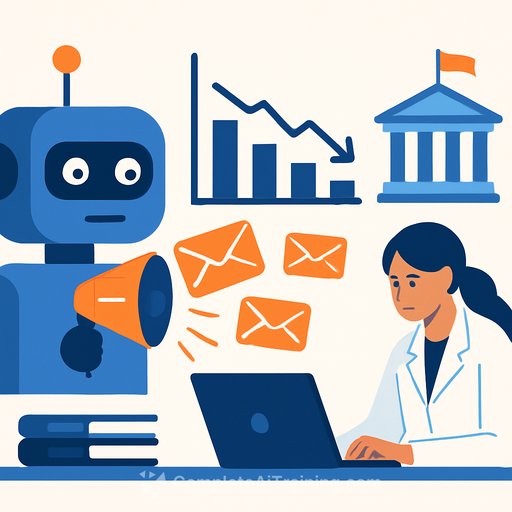
Academic journals are flooded with low-quality papers generated by artificial intelligence, and the problem is getting worse. Researchers at UC Berkeley and Cornell examined millions of recent submissions and found that while volume rose by up to 50% in some fields, quality fell sharply.
"Scientific articles that were mostly automated are of substantially lower quality than human-written papers," they reported. The flood of polished but potentially superficial work makes it harder for reviewers, funders, and policymakers to separate legitimate findings from misleading ones.
Publishers now receive half a million requests for every legitimate visitor. Open-source projects have shut down contributions because they're overwhelmed with bot-generated code. Wikipedia recently voted to ban all generative AI tools. Open APIs across the web are being locked down, crushing access for researchers.
The quality crisis predates AI
Science already had problems before the latest AI wave. Psychology's replication crisis revealed thousands of "breakthrough" papers that couldn't be reproduced. Nature reported in 2021 that thousands of bogus "paper mill" articles were hiding in the scientific corpus. AI-generated text has made it easier to produce plausible-sounding garbage at scale.
AI tools are making peer review worse
Using AI to fight AI spam creates new problems. A recent research paper found that large language models frequently alter authors' intended conclusions when editing papers. They remove content that supports particular claims and edit essays to be more neutral or positive about certain technologies.
AI-generated peer reviews have a flattening effect. They over-score conformity and devalue originality and insight. "LLMs have begun to change the very criteria that researchers use when evaluating peer-reviewed scientific research," the paper said. Institutions using AI to evaluate work will get intellectually weaker, not stronger.
When scientists use AI-generated material and then cite it, they poison the evidence chain. As AI-generated content spreads, so do the errors it makes - the "hallucinations" that sound confident but are false.
Student cognition is declining
A study from MIT titled "Your Brain on ChatGPT" showed that students using chatbots experienced dramatic drops in mental capacity compared to those using Google or no tools at all. The research documented what researchers called "cognitive atrophy" and "cognitive debt" - the brain weakens without use, like any muscle.
Two professors at the Wharton School found that "cognitive surrender" increases the more people use AI. Those most enthusiastic about AI's potential declined fastest. It functions as self-imposed intellectual damage.
How we got here
In 2008, Chris Anderson, then editor of Wired magazine, proposed that the scientific method had become obsolete. With vast oceans of data available, he argued, answers must be in there - we just needed to interrogate them wisely. It would be like using Google.
The assumption was that old ways were bad and only new ways could move science forward. Inductive reasoning would solve remaining scientific problems. Today's confidence that AI will accelerate discovery shares the same enthusiasm, but the track record doesn't support it.
What AI actually does
Sir Demis Hassabis of Google DeepMind acknowledged the core limitation: "Today's LLMs are phenomenal at pattern recognition, but they don't truly understand causality." Science requires understanding why things happen, not just recognizing patterns.
Individual creativity, intelligence, and intuition drive scientific progress. AI lacks all three. It excels at things nobody wants - generating plausible-sounding text, flooding systems with noise, and destroying institutions built on trust.
We were promised a productivity miracle. We haven't seen it. AI isn't curing cancer either.
Consider exploring Generative AI and LLM Courses or AI Research Courses to understand how these tools work and their real limitations in scientific contexts.
Your membership also unlocks: