
AI news ·
AI Spending Is Up, Patient Engagement Isn't-N-of-1 Personalization Can Close the Gap
Health systems fund AI, yet patient engagement stalls. N-of-1 personalization-using data and smart agents-targets real barriers to lift adherence and cut avoidable costs.
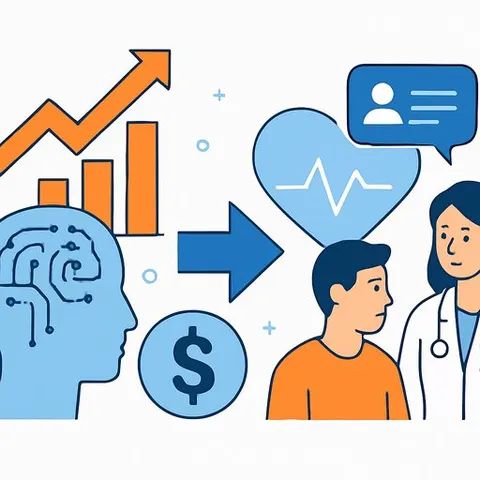
AI Is Booming in Healthcare-But Patient Engagement Is Being Left Behind
New research shows a clear gap: health systems are pouring money into AI tools like ambient scribes, yet progress on patient engagement lags. In interviews with more than 75 U.S. health system executives conducted by Sage Growth Partners for Lirio, only 5% said they're satisfied with their tools for challenges like medication adherence and missed appointments.
Those gaps have real costs-worse outcomes and billions spent on avoidable care. The fix isn't more generic outreach. It's precision. It's moving from demographic segmentation to N-of-1 personalization.
Standard Personalization Isn't Personal
Most "personalization" stops at name, age, or a broad segment. That's easy to deploy-and easy to ignore. As Amy Bucher, Lirio's chief behavioral officer, put it: standard approaches in healthcare aren't very personal.
Consider a mammography reminder sent to every woman 40+. It treats very different people the same. An N-of-1 approach asks: why hasn't this person scheduled? Work conflict, childcare, anxiety about screening results, transportation? Messaging should meet that specific barrier head on.
Why N-of-1 Is Now Feasible
Humans do N-of-1 well in a 1:1 setting, but scaling that across a population isn't feasible. Recent advances in agentic AI and techniques like reinforcement learning make it possible to learn from each interaction and adapt at scale. For technical background on these methods, see AI Research Courses. Technology can process complex data, test messaging strategies, and iterate quickly-without adding headcount each time you add a cohort.
A Practical Roadmap for Health Systems
- Define the business problem tightly: appointment no-shows, statin adherence, missed screenings, portal activation. Pick one.
- Map barriers by behavior, not just demographics: beliefs, logistics, emotions, past actions, channel preference, timing.
- Assemble data safely: EHR events, claims, SDOH proxies, prior engagement history, consented patient inputs. Minimize what you collect; maximize relevance.
- Build a modular content library: short messages that directly address specific barriers (e.g., childcare options, after-hours slots, quick-visit scripts).
- Use an agent to select message, channel, and timing per person; apply reinforcement learning to optimize over outcomes.
- Stand up a feedback loop: track opens, clicks, confirmations, completion, and downstream clinical metrics. Feed results back into the model.
- Governance first: HIPAA compliance, consent, content review, bias checks, safety filters, human escalation paths, and transparent opt-outs.
- Integrate where work happens: EHR scheduling, patient portal, SMS, IVR, email. Minimize swivel-chair for staff.
Use Case: Diabetes Engagement
Diabetes affects about 1 in 10 Americans. Yet many patients stay disengaged between visits, leading to missed labs, medication gaps, and preventable complications. A generic "schedule your follow-up" message doesn't solve that.
A better approach: identify the likely barrier for each person (cost concerns, fear of finger sticks, forgetfulness, transportation) and match it with the right nudge. Use digital outreach to reduce staff load while lifting adherence. Over time, the system learns what works for each individual.
CDC data on diabetes prevalence can help size the opportunity and prioritize populations.
What to Measure (and Report)
- Behavioral outcomes: show rate, screening completion, refill persistence, A1C test completion.
- Clinical proxies: time-in-range (if available), updated problem lists, gap closures.
- Operational impact: staff messages avoided, average handle time, rescheduling rates, after-hours utilization.
- Financial outcomes: cost per completed action, avoided penalties, downstream revenue from completed care.
- Equity: performance across language, access, and socioeconomic groups; corrective actions when gaps appear.
Build vs. Buy: Questions to Ask Vendors
- Personalization depth: Can the system infer and test specific barriers, or is it just segment-based?
- Learning loop: How does it adapt messaging over time? What outcomes does it optimize for?
- Content control: Who approves messaging? Can clinical and legal teams review variants at scale?
- Safety and privacy: Data minimization, PHI handling, audit trails, and red-teaming for harmful outputs.
- Integration: EHR write-backs, scheduling APIs, analytics exports, identity resolution across channels.
- Proof: Real-world lift on adherence, show rate, or screenings-not just engagement vanity metrics.
Getting Started in 60 Days
- Pick one pathway with measurable gain (e.g., colorectal screening or statin adherence).
- Draft 15-30 short messages mapped to 6-8 common barriers.
- Launch on one channel (SMS or email), with clear consent and opt-out handling.
- Run an A/B/B test: generic vs. segment vs. N-of-1. Track through completion, not just clicks.
- Review safety logs weekly; add escalation rules for sensitive topics.
- Scale to a second channel only after you see lift and stable operations.
The Bottom Line
Ambient scribes reduce clinician burden. But if your engagement rates don't move, outcomes and costs won't either. N-of-1 personalization-driven by modern AI and disciplined governance-can close the gap between intent and action at patient scale.
If your team needs structured upskilling to plan, evaluate, or deploy AI-driven engagement, explore role-based programs at Complete AI Training.