AI spots a hidden stress marker in everyday CT scans: the Adrenal Volume Index
Date: December 14, 2025
Source: Radiological Society of North America
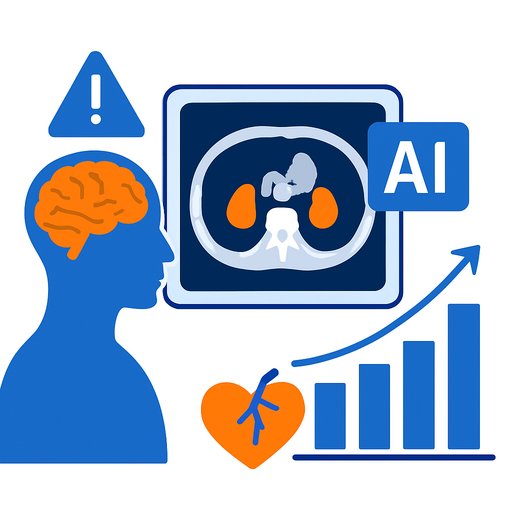
Researchers report a first: a quantifiable, imaging-based marker of chronic stress visible on routine chest CTs. A deep learning model measures adrenal gland volume and converts it into a normalized metric-the Adrenal Volume Index (AVI)-that tracks with cortisol exposure, allostatic load, perceived stress, and long-term cardiovascular outcomes, including heart failure risk.
Chronic stress leaves a footprint. This work shows you can see it, measure it, and link it to clinical endpoints without new scans or added radiation.
What AVI is-and why it matters
AVI is defined as adrenal volume (cm3) divided by height squared (m2). The model segments the adrenal glands automatically on chest CTs that patients already receive for many reasons.
Because chest CT is common-tens of millions are done annually-AVI can be calculated at scale. That makes chronic stress measurable in everyday care and large cohorts, not just in small lab settings.
Study at a glance
- Cohort: 2,842 participants from the Multi-Ethnic Study of Atherosclerosis (mean age 69.3; 51% women).
- Inputs combined in the same individuals: chest CT, validated stress questionnaires, repeated salivary cortisol (8 samples/day over 2 days), and allostatic load.
- Allostatic load components: BMI, creatinine, hemoglobin, albumin, glucose, white blood count, heart rate, blood pressure.
- Outcome tracking: up to 10 years, including cardiovascular events.
Key findings
- Higher AVI aligned with greater overall cortisol exposure and higher peak cortisol levels.
- AVI increased with allostatic load and with self-reported perceived stress.
- Higher AVI was associated with increased left ventricular mass index.
- Each 1 cm3/m2 increase in AVI was linked to higher risk of heart failure and death over follow-up.
Unlike a single cortisol test that reflects a moment in time, adrenal size behaves like a long-term stress gauge. AVI offers a bridge between psychology, hormones, imaging, and hard outcomes.
Why this is practical for clinical workflows
- No protocol change: uses existing chest CTs with AI-based adrenal segmentation.
- No extra radiation or visits: computed from scans already acquired.
- Actionable context: complements questionnaires and labs to strengthen cardiovascular risk stratification.
How to implement in practice
- Integrate an adrenal segmentation model into the PACS/RIS pipeline; compute gland volumes at ingest.
- Normalize to height to produce AVI; store in the EHR alongside vitals and labs.
- Add AVI to structured radiology reports with reference ranges and flags for outliers.
- Set up quality checks: visual overlays for a random sample, alerts for atypical volumes.
- Link AVI to population health dashboards for longitudinal tracking and preventive outreach.
Clinical and research use cases
- Risk stratification: augment ASCVD/heart failure risk scores with AVI in older adults or high-stress populations.
- Trial enrichment: select participants with high AVI for stress-reduction or cardiometabolic interventions.
- Monitoring: track AVI over time as a surrogate for sustained stress burden alongside behavioral and pharmacologic care.
- Retrospective mining: compute AVI across historical CT archives to study stress-related disease trajectories.
Important caveats and next steps
- External validation across scanners, institutions, and diverse populations.
- Stratified reference ranges by age, sex, BMI, and medication use (e.g., steroids).
- Exclude or adjust for adrenal pathology, prior adrenal surgery, or incidentally discovered lesions.
- Assess fairness: verify consistent performance and thresholds across race/ethnicity and socioeconomic groups.
- Prospective studies to test whether AVI-guided prevention changes outcomes.
For radiology and cardiometabolic research teams, AVI is a low-friction addition with high explanatory value. It turns a subjective concept-chronic stress-into a measurable feature tied to hormones and events you care about.
Helpful resources: RSNA | American Psychological Association: Stress
If you're building medical-imaging AI or standing up validation pipelines, you may find these resources useful: Latest AI courses
Credit: Shutterstock
Your membership also unlocks: