AI Detects Bitcoin Payment Growth as Digital Currencies Reshape Finance
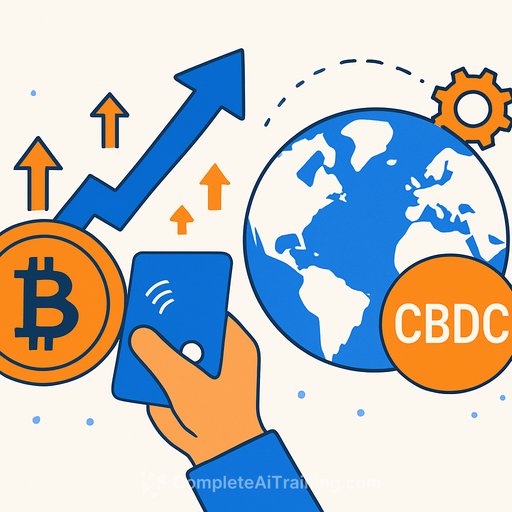
AI platforms that monitor on-chain activity and payment flows are flagging a clear trend: Bitcoin is being used more often for real payments, not just held as a speculative asset. This uptick is showing up in merchant activity, Lightning Network usage, and cross-border transfers. The momentum is building alongside central bank digital currency (CBDC) pilots and rollouts across multiple jurisdictions.
How AI Tracks Bitcoin Payment Adoption
Advanced models ingest merchant wallet data, payment processor flows, Lightning Network channel metrics, and settlement volume to identify real-world usage. These systems cross-reference address clusters, processor tags, and time-of-day patterns to separate commerce from exchange churn or internal transfers. The result is a cleaner view of actual payment behavior, not just price action.
What AI Is Detecting Right Now
- Rising Lightning Network transactions and channel liquidity, suggesting lower-cost, faster payments at the edge.
- Increasing merchant acceptance through processors and direct wallet setups.
- Growing cross-border payments where speed and fees matter more than short-term price noise.
These signals point to steady crypto adoption in day-to-day commerce.
Bitcoin vs. CBDCs: Practical Trade-offs
CBDCs are issued and controlled by central banks, which may improve policy transmission, compliance, and programmable features. Bitcoin is decentralized, permissionless, and resistant to censorship. AI models tracking user behavior indicate many choose Bitcoin for privacy, settlement finality, and global accessibility-especially for cross-border flows and off-hours settlement.
For a view of CBDC activity by country, see the Atlantic Council's CBDC Tracker: global status. For a primer on payment rails built on Bitcoin, see the Lightning Network.
Why Payment Adoption Matters for Bitcoin's Value
Utility drives resilience. As payment usage climbs, the network gains fee revenue diversity, deeper liquidity, and stronger two-sided markets. AI-powered adoption tracking suggests that commerce-based demand can smooth cyclical speculation and extend the asset's monetary premium through real use, not just narratives.
How Institutions Use the Data
Asset managers, banks, and PSPs increasingly incorporate AI signals on payment flows into research and risk models. High-frequency reads on merchant volumes, Lightning throughput, and cross-border corridors inform theses on network health, liquidity conditions, and potential effects on spreads. These inputs are showing up in digital asset strategies and treasury playbooks. See related Research for methods and frameworks used in AI-driven monitoring and analytics.
What Finance Teams Should Do Next
- Evaluate payment economics: compare Bitcoin rails (on-chain vs. Lightning) with card/interchange and SWIFT for fees, FX, and settlement time.
- Pilot controlled use cases: cross-border vendor payouts, refunds, or high-chargeback categories with instant conversion to local currency to reduce volatility exposure.
- Define treasury rules: set limits, conversion triggers, custody standards, and wallet governance; require multi-sig or qualified custodians.
- Tighten compliance: align with Travel Rule obligations, sanctions screening, and KYB/KYC via approved providers; document chain-of-custody.
- Accounting and tax: confirm GAAP/IFRS treatment (intangible classification in many jurisdictions), impairment tests, lot tracking, and reporting cadence.
- Risk controls: stress test liquidity and price gaps, especially around weekends and holidays; pre-authorize fiat ramps to avoid settlement bottlenecks.
- KPIs to monitor: merchant BTC volume share, authorization-to-capture ratio, refund/chargeback deltas vs. cards, Lightning success rate, and effective blended fees.
The Bottom Line
AI is surfacing a simple truth: Bitcoin is functioning as a payment network for more users and more merchants, particularly where speed and global reach matter. As CBDCs and digital wallets scale, expect a mixed system where policy-friendly rails coexist with decentralized rails. Finance teams that quantify the trade-offs now will set better pricing, liquidity, and risk policies later.
Resources
Disclaimer: The content of this article solely reflects the author's opinion and does not represent the platform in any capacity. This article is not intended to serve as a reference for making investment decisions.
Your membership also unlocks: