AI moves from lab to field: government deploys practical tools to lift crop yields and farmer incomes
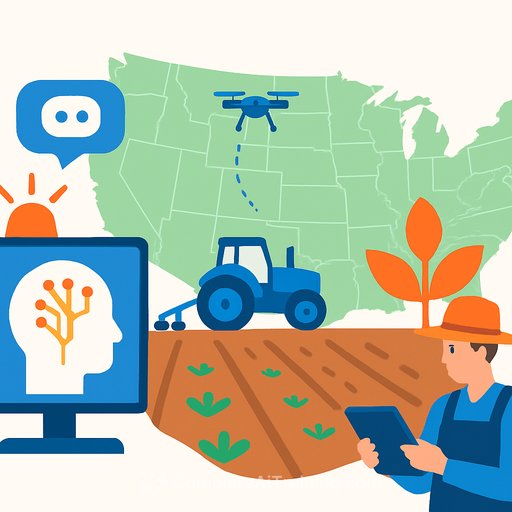
India's agriculture stack is getting smarter. New AI pilots and services are now guiding sowing dates, answering farmer queries in local languages, and flagging pest risks before they spread.
For public officials, this isn't a tech demo. It's an operations upgrade: better timing, faster feedback loops, and decisions grounded in data that reaches the last mile.
Monsoon onset forecasts that inform sowing decisions
An AI-based pilot generated local monsoon onset forecasts across parts of 13 states for Kharif 2025. A blended, open-source approach combined NeuralGCM, ECMWF's AI Forecasting System (AIFS), and 125 years of India Meteorological Department rainfall records to produce probabilistic local onset dates-exactly the cue farmers need to plan sowing windows.
These forecasts were pushed via SMS through the M-Kisan platform to about 38.8 million farmers in five regional languages: Hindi, Odia, Marathi, Bangla, and Punjabi. Follow-up surveys in Madhya Pradesh and Bihar found that 31-52% of farmers adjusted their planting plans-mostly land preparation and sowing timing, plus some changes in crops and inputs.
- Scale: 13 states, ~38.8 million SMS recipients
- Behavioral shift: 31-52% adjusted planting decisions
- Why it matters: Timely sowing raises germination success and reduces rework
M-Kisan Portal | India Meteorological Department
AI assistance on demand: Kisan e-Mitra
"Kisan e-Mitra" is a voice-based AI chatbot that answers queries on PM-KISAN, PM Fasal Bima Yojana, and Kisan Credit Card in 11 Indian languages. It currently addresses over 8,000 queries a day and has handled more than 9.3 million queries to date.
For departments, this removes friction from scheme access and reduces queue time at help centers, while creating a live signal on frequent farmer pain points.
Early pest detection at scale
The National Pest Surveillance System uses AI and ML to detect infestations from images submitted in the field. Over 10,000 extension workers use the tool today; it supports 66 crops and more than 432 pests.
Outcome: faster advisories, targeted sprays, lower losses-and better use of extension bandwidth.
Satellite-backed crop mapping and crop-weather monitoring
AI-based analytics on field photographs are feeding satellite crop mapping and crop-weather matching. This helps track what's sown, where, and how it aligns with expected weather-useful for planning inputs, credit, procurement, and risk cover.
What government teams can do next
- Institutionalize the monsoon signal: Integrate local onset forecasts into standard advisories before each sowing window. Pair SMS with IVRS for low-literacy users.
- Close the feedback loop: Expand post-advisory call surveys beyond MP and Bihar to measure behavior change and yield impact statewide.
- Strengthen last-mile trust: Equip extension workers to interpret probabilistic forecasts and translate them into simple, crop-wise actions.
- Target high-risk blocks: Use pest surveillance alerts to pre-position inputs and schedule village-level demos on IPM practices.
- Language-first delivery: Keep advisories in local languages and short message formats; add WhatsApp templates where appropriate.
- Data governance: Standardize data capture (location, crop, sowing date, advisory received, action taken) to enable district-level performance reviews.
Key performance signals to track
- % of farmers receiving and opening advisories (by channel and language)
- Change in sowing date variance vs. historical district patterns
- Advisory-to-action conversion rate and input use efficiency
- Pest alert lead time and reduction in affected area
- Query resolution time on Kisan e-Mitra and repeat query rates
Why this approach works
Farm outcomes hinge on timing and local context. By predicting monsoon onset at the local level, streamlining scheme access with voice AI, and detecting pests early, departments can help farmers make decisions that pay off within the same season.
The models will keep improving, but the immediate gains come from disciplined delivery: clear advisories, timely follow-ups, and coordination between agri, insurance, credit, and procurement teams.
Resources
Upskilling for public teams
If you're building AI literacy across departments-policy design, analytics, or field operations-review practical training paths by role.
Your membership also unlocks: