AI just crashed the content gates: 5 moves that matter for creatives
Generative AI didn't tiptoe this week. It kicked doors down across film, news, design, and training data. If your work lives in scripts, IP, visuals, or video, your playbook needs an update.
Here's what changed - and how to use it before it uses you.
1) Netflix vs. Paramount: a studio tug-of-war with your future pitches in the crossfire
Netflix shocked Hollywood with a $72B deal (about $82.7B with debt) for Warner Bros.' scripted assets - HBO, DC, and WB Studios - while carving out CNN and Discovery. Days later, Paramount Skydance countered with a hostile $78B offer (roughly $108B with debt) for the entire company, financed by deep pockets including Larry Ellison, Middle East funds, and Affinity Partners.
If Warner flips to Paramount, there's a reported $2.8B breakup fee. If regulators later block Netflix, the streamer owes $5.8B. Expect a legal slog as unions, antitrust hawks, and even political figures circle.
- Expect consolidation. Fewer buyers if Netflix wins; one mega-studio if Paramount prevails.
- Pitch smarter. Package IP, audience data, and pre-viz. Show distribution potential, not just story.
- Diversify. Keep multiple outlets warm - streamers, brands, and creator-funded projects.
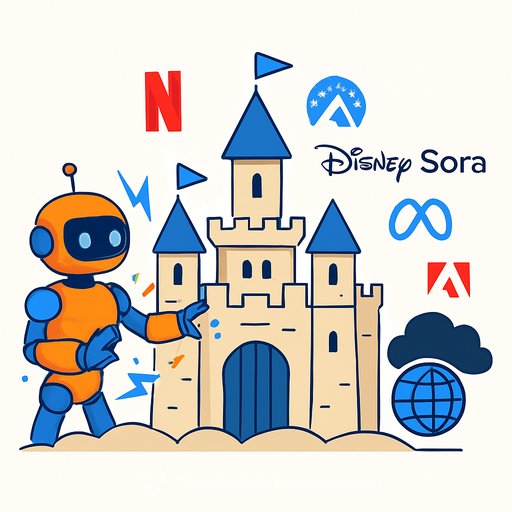
2) Disney licenses 200+ characters to Sora: fan creation at studio scale
Disney is investing $1B in OpenAI and licensing 200+ Pixar, Marvel, and Star Wars characters to Sora for three years. Starting early 2026, users can generate 30-second clips with guardrails (no adult themes or actor voices). Curated works may stream on Disney+.
Translation: brand-safe UGC becomes a pipeline. OpenAI gets cleaner training data and Disney gets a firehose of community concepts without legal headaches.
- Build a character-safe reel. Practice short beats, transitions, and emotion in 6-10 shots.
- Prepare a submission stack: loglines, style frames, and music cues ready on day one.
- Own your originals too. Use the sandbox to grow audience, then steer them to your IP.
3) Meta brings real-time news into its chatbot
Meta signed multiyear deals with CNN, Fox News, Fox Sports, USA Today, People Inc., and Le Monde to stream headlines into Meta AI. It fixes stale data, keeps pace with rivals, and reduces legal exposure from scraping claims.
For writers and editors, this shifts discovery. Search is moving into chat - with attribution and licensing in the middle.
- Write for chat answers. Lead with facts, outcomes, and scannable bullets.
- Create evergreen + update hooks. Package briefs that can be refreshed in seconds.
- Track mentions. If your work surfaces in bots, negotiate usage and upsell custom summaries.
4) Adobe lands inside ChatGPT: Photoshop, Express, Acrobat
Adobe embedded lightweight Photoshop, Express, and Acrobat directly into ChatGPT. Type the app name and your request, and you'll get handy sliders for things like background blur or PDF redaction. Sign-in is required; deep links hand off to full web apps without losing state.
This puts pro-grade edits where prompts live. Great for quick comps, decks, and social assets without app-switching.
- Ship faster. Turn client notes into before/after comps inside the chat thread.
- Standardize prompts for repeat edits: aspect ratio, color grade, lighting, and font rules.
- Lock your PDF workflow: batch redactions, approvals, and version history from one thread.
5) The "Shadow Web": replica sites training AI agents
Startups are cloning consumer sites - Amazon into "Omnizon," Gmail into "Go Mail," United into "Fly Unified" - to train agentic models to click, buy, and book in safe sandboxes. It fuels a fast-growing market, even as takedown notices fly and analysts warn many projects won't pan out by 2027.
Why it matters to you: autonomous tools will soon handle briefs, shopping, travel, and edits. Your job shifts from operator to director.
- Design for agents. Break work into small, testable tasks with clear acceptance criteria.
- Build guardrails: budget caps, brand rules, and approval checkpoints.
- Measure output: speed, cost per asset, and revision rate become your dashboard.
What this means for creative work
Distribution is consolidating. Creation is getting cheaper. Attention is the scarce asset, and your process is the moat.
- Package ideas like products: teaser, proof, pricing, delivery timeline.
- Adopt a "prompt + preset" system for repeatable looks across image, video, and copy.
- Collect consent and credits early. Licensing is now a feature, not a footnote.
Moves to make this week
- Spin up a Sora-ready short bible: 5 worlds, 5 characters, 10 shot lists, 3 music beds.
- Create a chat-native press kit: one-sentence claim, three bullets, one stat, one CTA.
- Build a Photoshop-in-ChatGPT toolkit: background swaps, product shadows, portrait cleanup.
- Draft an agent SOP: task prompts, budget limits, QA checks, escalation rules.
- Pitch both sides of the studio fight: one deck for consolidation, one for a split market.
Keep your skills current
If you want structured ways to level up your workflows, explore these focused resources:
- Best AI tools for generative video - for rapid storyboards and client-ready cuts.
- AI courses by job - pick a path that maps to your creative role.
The next advantage goes to creators who ship faster, protect their rights, and think like product teams. Set your system now, then let the tools do the heavy lifting while you own the taste.
Your membership also unlocks: