AI imaging cuts stroke treatment delays by more than an hour across the NHS
Real-time AI analysis of CT scans is speeding up stroke care across England. A large study in The Lancet Digital Health reports that patients transferred from primary stroke centres to comprehensive stroke centres received treatment a median 64 minutes sooner when AI software was used.
Sites using the tool saw thrombectomy rates double from 2.3% to 4.6%, compared with smaller gains at hospitals not using the technology (1.6% to 2.6%). Around 15,000 patients directly benefited from AI-supported scan review during the study period.
Why this matters for frontline teams
Stroke remains a leading cause of death and disability in England, with roughly 80,000 cases each year. For large vessel occlusion, endovascular thrombectomy-often alongside intravenous thrombolysis-can rescue brain tissue and reduce long-term disability.
Speed is everything. Every 20-minute delay in thrombectomy lowers the chance of full recovery by about 1%.
What the AI actually does
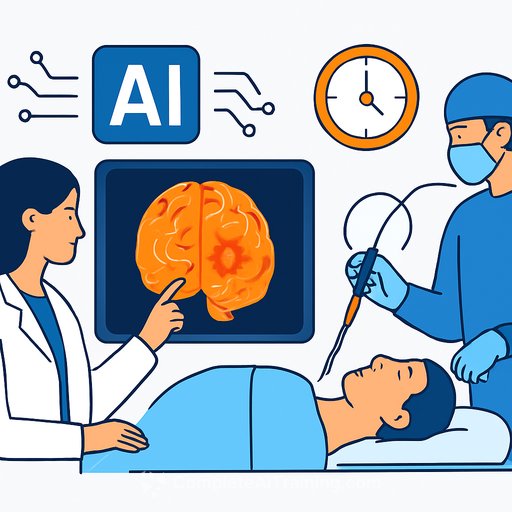
The tool interprets CT scans within minutes and flags key stroke features to the clinical team. That accelerated interpretation reduces delays in decision-making and helps move eligible patients to comprehensive stroke centres sooner.
- Door-in door-out time (at primary stroke centres) was 64 minutes shorter with AI.
- Thrombectomy rates doubled at participating sites: 2.3% to 4.6%.
- Improvements were greatest where neuroradiology expertise is not available on-site.
"This landmark study confirms what we have already been seeing in daily practice: that stroke AI imaging is helping us deliver faster decision-making and better care for our patients," said Dr David Hargroves, NHS national clinical director for stroke and study co-author.
Outcomes and safety signals
The prospective observational study analysed 71,017 patients with ischaemic stroke across 26 evaluation sites. Patients reviewed with AI were more likely to receive thrombectomy and intravenous thrombolysis.
They were also more likely to leave hospital with better functional status. Importantly, there was no increase in in-hospital mortality.
Where the gains were strongest
Primary stroke centres often lack on-site neuroradiology and interventional services. The AI tool filled that gap by enabling rapid scan interpretation and faster transfer to comprehensive stroke centres.
Limitations to keep in view
Patients assessed with AI tended to present with more severe strokes but had better baseline function, which could influence thrombectomy rates. Long-term outcome data were limited, so durability of benefit beyond discharge needs follow-up.
Even with those caveats, the discharge outcomes align with what we already know: better access to timely thrombectomy improves patient recovery.
What healthcare teams can do now
- Embed AI-supported CT review into stroke pathways, especially at primary stroke centres.
- Set explicit door-in door-out targets; monitor and share the data weekly.
- Standardise transfer protocols to comprehensive stroke centres with pre-alerts and clear escalation rules.
- Ensure 24/7 coverage, clarify fallback processes for system downtime, and define roles across ED, radiology, and stroke teams.
- Track key metrics: time to interpretation, thrombolysis and thrombectomy rates, functional status at discharge, and safety events.
Policy and rollout
Based on these findings, the authors support routine use of AI imaging in stroke care. The NHS has moved to scale the technology nationally to help more patients access life- and disability-saving treatments in time.
Further reading
Build team capability in healthcare AI
If you're developing staff skills for safe, effective use of AI in clinical pathways, explore practical training options:
Your membership also unlocks: