AI learns the kiln: Japan's cement industry hunts for stability and skill continuity
Running a rotary kiln isn't a checklist job. It takes years of feel-reading flame shape, feed behavior, draft swings-to keep clinker quality on spec without wasting fuel.
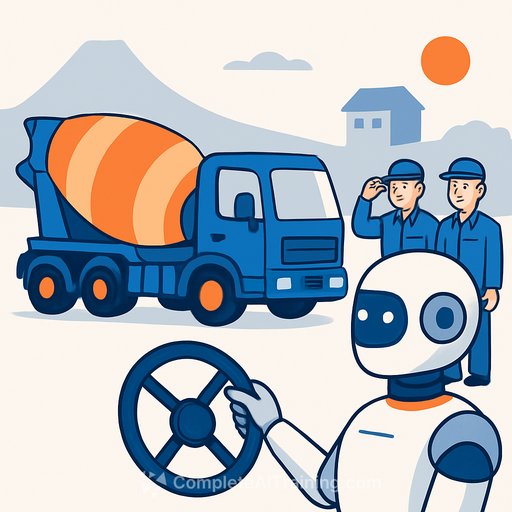
With experienced operators retiring and fewer replacements coming up, Taiheiyo Cement is widening the use of AI that learns kiln operation. The goal is simple: lock in consistency, capture tacit know-how, and keep plants competitive without burning out the remaining experts.
Why this matters for operations, IT, and development
- Operations: AI can stabilize burning zone conditions, reduce free-lime variability, and smooth hourly throughput-meaning fewer interventions and less fatigue on shifts.
- IT/Data: This hinges on reliable historian data, low-latency edge inference, solid networking, and tight access control. No clean data, no dependable control.
- Engineering/Dev: MLOps meets OT. Models must respect interlocks, rate limits, and safety envelopes while providing transparent recommendations and audit trails.
What "AI that learns kiln operation" typically does
- Ingests time-series data from preheater, kiln, and cooler alongside fuel flow, draft, and lab quality results.
- Captures expert adjustments in context-linking setpoint changes to observable states (flame, coating behavior, cyclone temps).
- Recommends setpoints or closed-loop tweaks to stabilize key variables, improving heat efficiency and consistency.
- Escalates uncertain cases to human approval, then learns from decisions to shrink that gray zone over time.
Practical playbook to make this work
- Map critical signals: Agree on the minimum viable tag set (kiln inlet/outlet temps, draft, secondary air, cooler pressures, fuel rates, free lime, LSF/SM/AM proxies).
- Capture tribal knowledge: Shadow veteran operators for weeks. Annotate decisions: why they changed the ID fan, why they slowed the feed, what they saw in the flame.
- Pilot on one kiln line: Start with advisory mode (human-in-the-loop). Add guardrails: max step sizes, rate-of-change limits, and automatic fallback to manual.
- Close the loop with QA: Sync lab results and online analyzers so the model learns the quality impact of control actions, not just process steadiness.
- Secure the stack: Segment networks, use signed models, enforce least-privilege access, and log every suggestion and action for traceability.
Metrics to track (no hype-just outcomes)
- Free lime and clinker quality variability.
- Specific heat consumption and alternative fuel utilization.
- Hourly throughput stability and unplanned stoppages.
- Emissions markers (e.g., NOx/CO trends) and refractory stress indicators.
- Operator intervention rate per shift (should go down with trust, not disappear).
Risks and how to de-risk them
- Model drift: Re-train on seasonal fuels, raw mix changes, and refractory age. Schedule performance reviews just like equipment PMs.
- Sensor faults: Add plausibility checks and failover logic. Bad thermocouples shouldn't drive good decisions.
- Over-automation: Keep a clear, fast path to manual. Operators should see why a recommendation was made, not just what to do.
- Change management: Involve crews early. Measure and share wins. Make the AI a copilot, not a critic.
Strategic context
Cement is energy-intensive and emissions-heavy. Even small efficiency gains compound across millions of tons of output and translate to measurable CO2 reductions.
For background on sector pressures and pathways, see the International Energy Agency's overview of cement and CO2 drivers here.
What to watch next
- Expansion from one kiln line to multi-plant rollouts, with standardized data models and shared best practices.
- Tighter links between AI control and maintenance (predict fouling, rings, fan issues before they hit throughput).
- Regulatory interest in auditability for AI-driven control in safety-critical environments.
Upskill your team
If you're planning a pilot or scaling beyond one line, align operations, IT, and engineering on the same playbook: AI Learning Path for Plant Managers.
The takeaway: capturing expert intuition with AI isn't about replacing people-it's about preserving scarce know-how, tightening process control, and giving crews a calmer, more predictable plant.
Your membership also unlocks: