UK and South Africa Launch AI-Driven Intelligent Observatory to Automate Telescope Operations
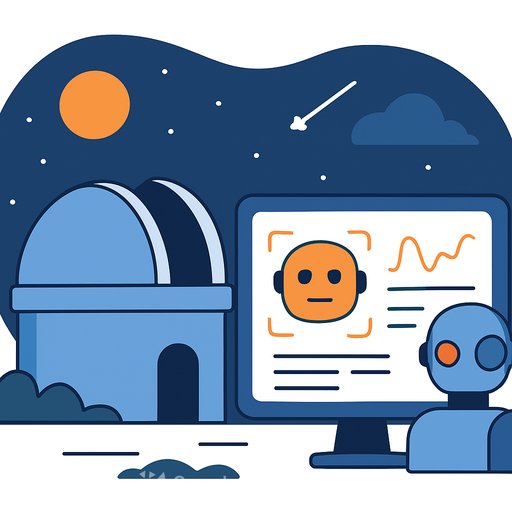
A new UK-South Africa partnership is building observatories that can think for themselves. The Intelligent Observatory programme brings AI into day-to-day telescope operations so systems can monitor their own health, process data as it's captured, and flag fast events like exploding stars in real time.
The collaboration pairs the STFC Hartree Centre with the South African Astronomical Observatory (NRF-SAAO). The goal is simple: improve efficiency and data quality while freeing scientists and operators from constant manual checks and paperwork.
What's being built
- Connected monitoring that watches instruments, spots drift or faults early, and reduces downtime.
- Automated data pipelines that turn raw observations into calibrated datasets, correcting for atmospheric effects and instrument imperfections.
- Real-time event detection so transient phenomena are identified as they happen, not hours later.
- An AI-powered search tool that pulls answers from logs, manuals, and research papers during observation runs.
Each night, AI models scan observations, flag system glitches or weather disruptions, and adjust for atmospheric conditions. The result: cleaner data and fewer lost nights.
Who's behind it
The programme is delivered by the STFC Hartree Centre at Daresbury Laboratory and the NRF-SAAO, a leading facility for optical and infrared astronomy. AI specialists Dr Adriano Agnello and Dr Rob Firth-both former astronomers-are driving software that monitors performance, detects issues early, and converts observations into usable insights with minimal intervention.
Why operations and research teams should care
Running observatories has relied on small teams juggling instruments, weather, data checks, and documentation. As access expands to a global community, that model strains. Intelligent automation helps absorb the load without sacrificing quality.
- Less unplanned downtime through early fault detection and predictive maintenance.
- Higher data integrity via standardized, automated calibrations.
- Faster turnaround from photon to dataset, accelerating analysis and publications.
- Better focus time for scientists and visiting observers-less hunting for manuals, more doing science.
What's next
The team plans to extend the platform with documentation from the Southern African Large Telescope (SALT) and apply more advanced AI techniques to deepen automation and decision support. This is a step toward observatories that are more intelligent, more accessible, and easier to run at scale.
Broader impact beyond astronomy
These tools translate well to manufacturing, energy, and transportation. Observatories are ideal testbeds for smart sensors, predictive maintenance, and automated data platforms-complex systems under harsh, dynamic conditions. Proving them here makes them easier to deploy across other mission-critical operations.
Talent and access
The partnership will expand hands-on opportunities in AI and data science for students and researchers across Africa, strengthening local expertise and supporting South Africa's leadership in innovative astronomy.
Further reading and practical resources
Learn more about the partner organisations: STFC Hartree Centre and NRF-SAAO.
For practical frameworks and tools relevant to this work, see AI for Operations and AI for Science & Research.
Your membership also unlocks: