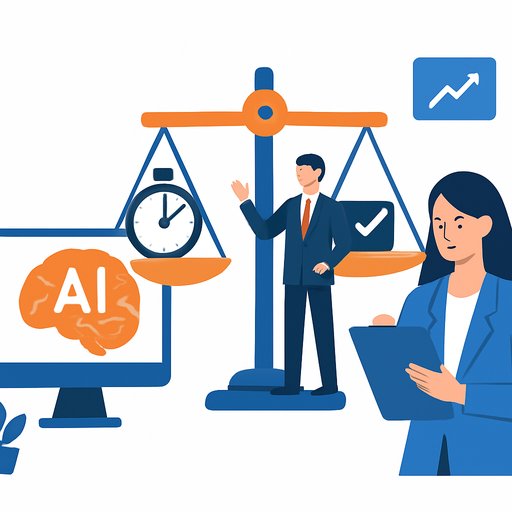
AI Tests Leaders, Not Tools
AI is stress-testing executive judgment. The pressure is clear: deliver savings now, ship prototypes fast, and bet on big plays. The trap is just as clear: confusing quick demos with enterprise readiness, treating generative systems as a universal fix, and skipping the daily fluency that makes scale possible.
Winning with AI requires a clear, balanced strategy. You need to match speed with trust, tools with problems, and ambition with everyday practice. That clarity is the competitive edge.
3 Common Executive Mistakes With AI
- Overweighting speed while underinvesting in governance.
- Fixating on generative systems and ignoring predictive, optimization, and classical ML.
- Chasing big bets without building organization-wide fluency.
Speed vs. Governance: Make Pace Sustainable
Yes, you can upload data to an LLM and demo a chatbot in minutes. No, that does not mean the enterprise can deploy it next week. The gap between demo speed and approval speed (privacy, compliance, security) is where credibility cracks and momentum dies.
The answer isn't bypassing governance. It's modernizing it. Create risk-tiered lanes, fast-track low-risk experiments, and give teams clear rules so they can move fast without surprises.
- Classify use cases by risk (low/medium/high) with matching approval paths and service-level targets.
- Start with low-risk pilots (internal knowledge bots, marketing draft generators) and shorter release cycles.
- Stand up sandboxes with pre-cleared data, tools, and logging.
- Publish a live registry of approved AI uses to compound learning across teams.
- Point compliance and security talent at high-stakes deployments where sensitive data or regulatory exposure exists.
Treat governance as infrastructure, not red tape. It's the foundation that lets you accelerate without rolling the car.
Reference frameworks can speed the work, such as the NIST AI Risk Management Framework here.
Not All AI Is Generative: Choose the Right Tool
Generative platforms are visible and easy to try. That doesn't make them the right fit for every business problem. Forecasting demand, anomaly detection, supply chain optimization, and scheduling are often better solved with supervised learning, unsupervised learning, reinforcement learning, or operations research.
Executives need range, not hype. Build literacy across approaches so teams stop forcing one tool into every job. If the problem is prediction, use predictive models. If the problem is optimization, consider operations research or reinforcement learning. If the problem is retrieval, use retrieval-augmented generation. If the task is content creation, then pick generative systems.
- Prediction (e.g., churn, demand): supervised learning.
- Clustering/segmentation: unsupervised learning.
- Optimization (e.g., routing, scheduling): operations research or reinforcement learning.
- Content and summarization: generative systems (with RAG for source-grounded answers).
- Automation with rules and data: workflow automation with model assist.
For a primer on optimization and OR, see INFORMS here.
From Big Bets to Everyday Practice
Headcount cuts rarely translate cleanly into savings, and giant AI programs fall apart without groundwork. Real value shows up when people trust the tools, processes absorb them, and tribal knowledge becomes digital.
Embed AI into the daily flow to build confidence and results. Reward teams for capturing knowledge and rethinking roles with AI in the loop. One effective move: require hiring managers to explain why a new role cannot be supported or automated with AI. It's not about cutting roles; it's about intentional design.
- Weeks 0-4: Pick three low-risk use cases per function. Stand up sandboxes and define risk tiers. Launch an AI decision log.
- Weeks 5-8: Measure cycle-time reductions, quality lifts, and error rates. Share playbooks openly. Expand the registry of approved use cases.
- Weeks 9-12: Standardize what works. Strengthen data flows and access controls. Scope one medium-risk initiative backed by the new governance lanes.
Make it a habit: in leadership reviews, state how AI informed the decision and where it will next. Celebrate the biggest accelerations each month to reinforce behavior.
Governance as a Competitive Advantage
Innovation and governance aren't at odds. They function like propulsion and ballast. One drives you forward; the other keeps you stable.
Establish clear criteria, shared sandboxes, and constant updates on what's live. When teams build on a common foundation, ideas compound instead of restarting from scratch. That's how you keep pace without burning trust.
Executive Scorecard: 10 Questions
- Do we have a published risk taxonomy with matching approval lanes and SLAs?
- Are low-risk pilots moving from idea to test inside two weeks?
- Do teams know which problems call for generative, predictive, or optimization approaches?
- Have we named an accountable owner for AI governance and a cross-functional council?
- Is there a live registry of approved AI uses and learnings for others to reuse?
- Do we log prompts, inputs, outputs, and decisions for audit and improvement?
- Are data privacy, security, and compliance involved early for high-risk cases?
- Do managers justify new roles against AI augmentation or automation options?
- Are we measuring cycle time, quality, and error rates for AI-assisted workflows?
- Can we point to three material wins that built trust across the business in the last 90 days?
Next Steps
- Publish your risk tiers and fast-track lanes. Make them visible and simple.
- Run a three-track pilot: one generative use case, one predictive, one optimization.
- Stand up a sandbox with pre-cleared data and tools, plus logging and review.
- Kick off role-based upskilling for leaders, operators, and data teams.
- Adopt a monthly AI review: what shipped, what learned, what's next.
If you need structured paths for upskilling and role-based learning, explore Courses by Job and Popular Certifications from Complete AI Training.
The test isn't whether AI can demo well. The test is whether your organization can move fast with trust, pick the right tools for the problem, and build fluency that scales into industry-changing plays.
Your membership also unlocks: