ASU-Science Prize honors AI work helping farmers and trafficking victims
Some of the toughest problems hide in plain sight inside huge datasets. Two early-career researchers turned that data into action, earning top honors in the inaugural ASU-Science Prize for Transformational Impact - a cornerstone of the five-year AAAS + ASU Collaborative.
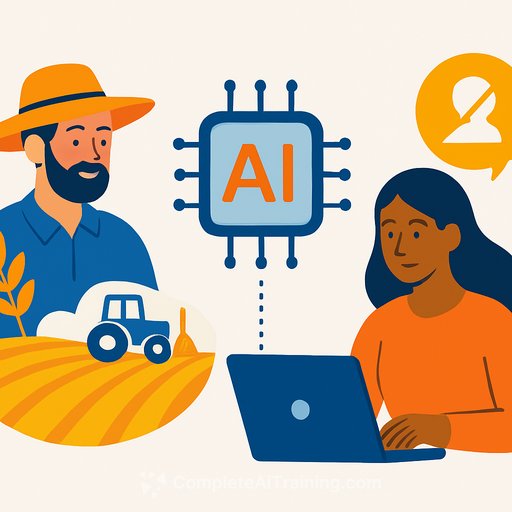
Grand prize: Meha Jain, University of Michigan, for satellite- and machine learning-based analysis of smallholder farming under climate stress. Runner-up: Mayank Kejriwal, University of Southern California, for an AI-based search tool that helps investigate online sex trafficking.
Both will be recognized at the AAAS Annual Meeting in Phoenix (Feb. 12-14). Jain's essay will appear in Science in print and online; Kejriwal's essay will be featured on Science's website. The awards total $40,000 ($30,000 grand prize; $10,000 runner-up).
A sharper view of smallholder agriculture
Jain's work tackles a common roadblock: a lack of granular, comparable data on small farms across regions. Using high-resolution satellite imagery with machine learning, her team infers field management choices and links them to yield, water use, and environmental outcomes.
Her 2021 and 2023 studies surface a crucial trade-off: how farmers adapt to climate pressure can carry hidden environmental costs. The point isn't to judge those choices - it's to make them visible so policy and practice can improve.
"We work really closely with local farmers, and that strongly influences the questions that we ask and the data products that we create," said Jain. "Having that real-world interaction is incredibly motivating. I became more excited about creating data products that could actually be used."
Scaling investigations of online sex trafficking
Kejriwal builds AI systems that address high-stakes, high-volume problems. His featured work is an AI-based search and linking tool that helps law enforcement find organized networks behind online sex trafficking.
The system extracts obfuscated phone numbers and other identifiers and links them across billions of records. That helps investigators move beyond isolated ads to map the underlying operations.
"It is an honor to be named as a finalist for the ASU-Science Prize for Transformational Impact," said Kejriwal. "It provides validation for our longstanding work on fighting sex trafficking using technology and draws much needed attention to this societal ill."
Why this prize matters for researchers
- It rewards use-inspired science that delivers public benefit at scale.
- It highlights methods that travel: remote sensing + ML for heterogeneous farm systems; entity resolution and data linkage for safety and justice.
- It shows the value of co-development with end users - farmers, agencies, and law enforcement - for data quality and adoption, and points to AI Design Courses for co-design approaches and tools.
- It raises visibility through venues like Science and the AAAS Annual Meeting.
The AAAS + ASU Collaborative
AAAS and Arizona State University launched a first-of-its-kind partnership to expand science's role in society, build new pathways for early-career researchers, and strengthen science-informed decisions. The collaboration invites the ASU community into the AAAS network and aims to mobilize scientists and engineers worldwide.
At the AAAS meeting in Phoenix, ASU speakers will join sessions on how data-driven research and interdisciplinary collaboration can inform policy and deliver public benefit.
Practical next steps
- If you work on agriculture: consider combining ground surveys with satellite-derived management maps to quantify trade-offs and target interventions.
- If you work on public safety or social good: invest in entity extraction and linkage pipelines that can handle noisy identifiers at internet scale.
- Build partnerships early. Co-designing datasets and tools with end users increases accuracy, trust, and uptake.
Interested in sharpening AI skills for research roles? See AI Research Courses, or explore curated options by role at Complete AI Training.
Your membership also unlocks: