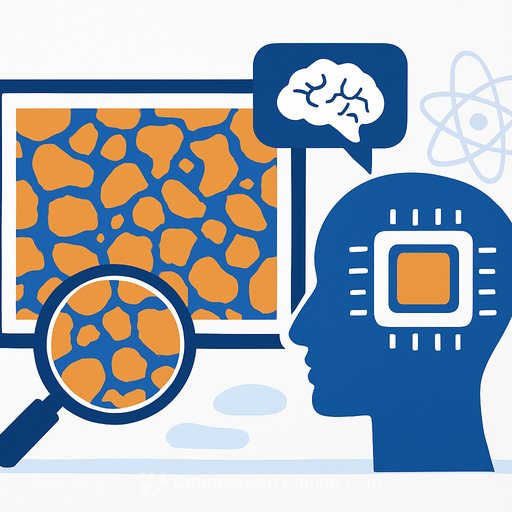
AI-Driven Intelligence Could Transform Materials Design
Advanced materials sit behind better batteries, tougher construction mixes and smarter drug delivery. For years, teams have relied on trial-and-error and long testing cycles. Now, a different approach is forming: use AI to read the material itself through microscopy images, then feed that knowledge back into design and manufacturing. This approach is an example of AI for Science & Research.
Polaron, a spin-out from Imperial College London, is building systems that learn from microstructural image data. Instead of needing massive foundation models and exotic datasets, they start with what labs and factories already collect: 2D microscopy. From there, they extract features, reconstruct 3D structure, predict performance and propose manufacturable "recipes."
The length scale that most teams miss: microstructure
Many AI-for-materials efforts target atoms and molecules. Others jump straight to final parts and product geometry. In between sits the microstructural scale-too large for brute-force atomistic simulation, yet far smaller than a completed component.
This is where particle shapes, interfaces and pore networks decide how a material behaves. In battery electrodes, for example, microstructure can set charge rate and lifetime. You control this scale through process steps like mixing, heating, cooling, crushing and rolling. It's messy. It's also where performance is won or lost.
From raw images to quantified structure
Most microstructural assessments are still done by eye. That's slow and subjective. Polaron runs vision models trained on materials data with human review where it counts. One customer saved roughly 1,000 engineer hours in a year by automating image analysis.
The key move: generate 3D microstructural representations from standard 2D images. That cuts the need for expensive 3D imaging while giving access to features that drive transport, mechanics and degradation.
From structure to design-and a recipe you can run
Characterization answers "what did we make?" Design asks "how do we make it better with the tools we have?" Polaron links processing, structure and performance by learning from microscopy, measured outcomes and physics-based simulations.
Once the model is trained, engineers can explore candidates that hit a target metric, then retrieve the processing steps likely to produce that structure. It's not just ranking options-it's proposing a path to build them.
Data privacy by default
Manufacturing is highly local. Materials, machines, site conditions and operators all shift the result. A single universal recipe rarely maps across sites.
Customer data in Polaron's stack is siloed. It is never used to train base models shared with others. Separately, the company builds its general models using proprietary datasets assembled for that purpose.
Where this matters now
- Batteries: electrode design across chemistries and manufacturing routes.
- Construction materials: cements, concretes and admixture tuning.
- Alloys, composites and catalysts: process-structure tuning for performance and yield.
- Pharmaceuticals and food: microstructured coatings and matrices for controlled release and texture.
A practical view of the next decade
Materials discovery isn't a tidy problem. It spans discovery, processing and manufacturing, across scales and teams. It's an area of active Research.
Think fewer experiments, faster loops and tighter feedback across the pipeline. AI acts as the connective layer: holding context, reconciling signals and surfacing the next best experiment.
Inside Polaron's origin
CEO Dr. Isaac Squires moved from semiconductor physics into machine learning, then merged both in a PhD with Dr. Sam Cooper at Imperial College London. Alongside co-founder Dr. Steve Kench, the group's research on generative models for battery materials drew strong interest, including a Nature Machine Intelligence cover article.
Industrial teams asked for real tools, not just papers. That demand led to Polaron-turning research-grade models into production-grade software for engineers.
What R&D teams can do now
- Inventory your microscopy data. Centralize files, link metadata (material, process, instrument settings) and standardize annotations.
- Run a characterization pilot. Compare automated feature extraction against manual baselines for speed, repeatability and correlation to performance.
- Close the loop. Join microstructure features to measured outcomes and physics simulations to begin learning the process-structure-performance map.
- Keep experts in the loop. Use reviewers to validate edge cases and raise data quality.
- Lock down privacy. Separate customer projects, define access controls and audit usage.
- Define decision metrics. For batteries, track charge rate, cycle life, porosity, tortuosity and binder distribution. For cement, consider pore size distribution, hydration products and crack initiation.
Further reading
For background on microstructure-driven performance, see Nature Machine Intelligence and materials research from Imperial College London's Department of Materials.
Upskilling in AI for scientists
If you're formalizing AI skills for lab and data workflows, explore curated learning paths by job role: AI Learning Path for Process Development Scientists.
Your membership also unlocks: