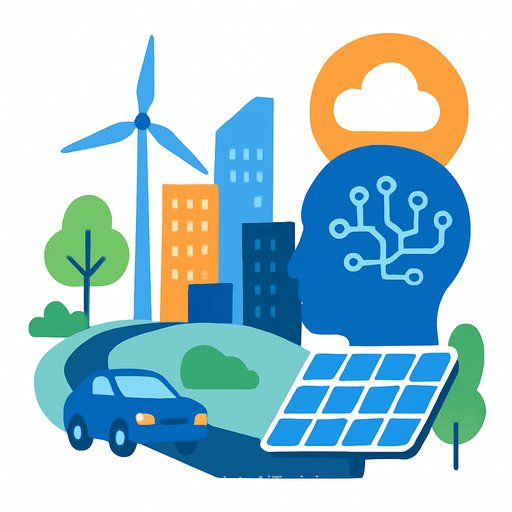
The AI We Need for Sustainable Infrastructure
AI is getting heat for the energy demands of data centers. Fair. But the bigger prize is using AI to cut waste, emissions, delays, and cost overruns in construction-where the real economy actually gets built.
Construction still lags on digital maturity. The sector produces about 21% of greenhouse-gas emissions, half of global landfill waste, and overspends by roughly US$1.6 trillion each year. That's margin left on the table-and risk carried on every job.
AI's Real Value: "Cognitive Infrastructure"
Code assistants and document summarizers won't pour concrete or commission a substation. To move needles on real assets, AI needs a base layer: hard-to-access data, practical know-how, and institutions that put insights to work. Without that, AI stays a neat demo.
Think of this as the sector's cognitive infrastructure: unified data, project memory, and smart agents built for contracts, procurement, permitting, and budgeting-plugged into the teams who deliver the work.
What This Looks Like on a Project
- Unify siloed data: RFIs, change orders, submittals, permit logs, schedules, claims, as-builts, inspections, O&M-pulled from PDFs, CDEs, ERPs, and email into structured records.
- Codify project memory: Capture why delays happened, where capacity broke, how risks compounded. Turn lessons from old jobs into playbooks for new ones.
- Build infra-specific agents: Models built for materials, logistics, local codes, contracts, and actual workflows-not a generic chatbot.
- Create feedback loops: Every project teaches the next. Tools learn across portfolios and institutions, not just within one team.
Why Owners, Developers, Contractors, and Lenders Should Care
- Owners/Developers: Early risk flags on permits and utilities; schedule/budget confidence that updates as conditions change; ESG metrics from site to portfolio.
- Contractors: Procurement and sequencing optimized against price volatility and lead times; pattern detection on change orders; crew and equipment plans that cut idle time and waste.
- Lenders/Public Agencies: Comparable baselines across assets; early-warning on cost and schedule drift; policy-shift scenarios without redoing every model.
The New Map of Infrastructure
Policy is in flux. The US is reversing prior clean-energy policies, creating uncertainty for developers and investors. Meanwhile, China is pushing a "green, high-quality" Belt and Road while still backing fossil projects abroad. Saudi Arabia targets half of its electricity from renewables by 2030. India has committed 50% of installed capacity to non-fossil sources and launched a National Green Hydrogen Mission targeting five million tons annually by 2030.
The contest isn't just whose capital builds ports, grids, and rail. It's whose data, standards, and AI systems guide those dollars. For project teams, that means execution quality-and the intelligence behind it-will decide who wins work.
Three Immediate Priorities
- 1) Make the most of the data you already have.
Pull contract terms, permits, inspections, insurance certificates, and claims out of PDFs. Standardize naming, IDs, and units. Establish version control and lineage. You'll cut rework now and feed every downstream model later. - 2) Build AI for this sector, not in general.
Use models trained on materials science, logistics, local regulations, and contract libraries. Pair them with retrieval over your drawings, specs, and schedules. Add compliance guardrails so outputs stick to code and contract. - 3) Share lessons across borders and portfolios.
Don't reinvent the wheel in each agency or business unit. Create a shared knowledge base so a dam in India or a metro in Paris improves outcomes elsewhere. Use anonymized data and reference-class forecasting to keep it clean and useful.
90-Day Starter Plan
- Weeks 1-2: Pick a live program with pain you can measure (permits, change orders, procurement). Set KPIs: schedule variance, cost drift, rework hours, and waste tonnage.
- Weeks 3-6: Inventory data; run OCR and entity extraction on PDFs; connect your CDE/BIM, ERP, and scheduling tools; create a clean layer with IDs across assets, contracts, and vendors.
- Weeks 7-10: Pilot two use cases: permit lead-time prediction and change-order risk scoring. Put results in the tools your teams already use. Close the loop with field feedback weekly.
- Weeks 11-12: Write the playbook: data rules, model update cadence, decision rights, and reporting. Train project controls and PMs. Prepare the next three sites for rollout.
Build for Sustainability Without Blowing Your Energy Budget
- Use efficient models: Small, well-trained models with retrieval often beat giant general models for infra workflows.
- Run where clean energy is available: Co-locate compute with low-carbon electricity and recover waste heat where possible.
- Right-size inference: Batch non-urgent jobs and cache repeat answers to cut compute.
- Measure it: Track energy per prediction and emissions per use case alongside project KPIs.
Policy Platforms Matter
Standards set in global forums shape procurement rules and market signals. Keep an eye on the G20 and the UN Climate Change Conference to anticipate shifts that affect permitting, incentives, and financing.
The Execution Edge
Over the next decade, infrastructure will decide climate resilience and competitiveness. The advantage goes to teams who connect data, tools, and institutions-then keep learning from every job. Treat AI as a set of targeted applications wired into real workflows and accountable teams.
The test is simple: better roads, faster permits, cleaner grids, safer housing-delivered with fewer overruns and less waste. Teams who turn infrastructure from a climate risk into a shared, intelligent platform for prosperity will set the standard.
Upskilling Your Team
If you're building an internal capability or training project controls, see practical AI courses by role here: Complete AI Training - Courses by Job. For network and infrastructure operations, consider the AI Learning Path for Network Administrators.
Your membership also unlocks: