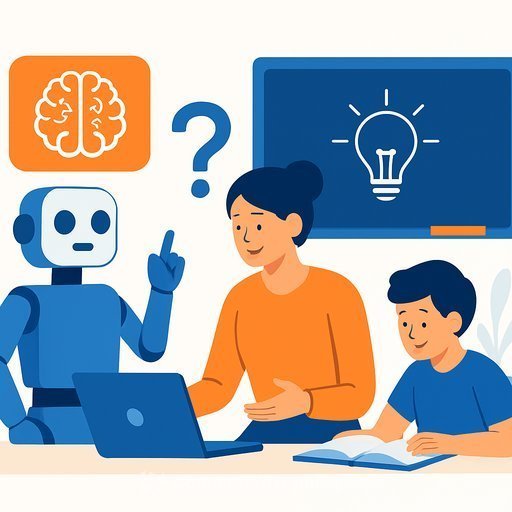
AI Will Put An End To Rote Learning, Says Higher Education Secretary
India is moving fast on AI in education. With a national AI summit set for next week, the focus is clear: end rote memorization and rebuild classrooms around inquiry, application, and feedback.
Higher Education Secretary Vineet Joshi says AI is central to this shift. It's now mandated in the National Education Policy, with a firm stance that teachers must receive comprehensive AI training before students.
From Memorization To Inquiry
Joshi noted that India's earlier learning culture was interactive and question-led. Over time, one-way, memory-first habits took root. The Prime Minister has pressed to end that pattern.
AI can help students ask without fear and get immediate, context-aware answers. That lowers the barrier to curiosity and builds deeper understanding that actually carries over to real-world use.
Teacher-First, Balanced Use
The message is non-negotiable: train teachers first. Give them practical proficiency in AI so they can guide students, set guardrails, and keep thinking skills intact. The goal isn't dependence-it's better judgment.
As part of the rollout, the Ministry of Education hosted a two-day "Bharat Bodhan Summit." On February 12, programs ran across about 1,000 institutions to build awareness and spark dialogue on AI's role.
Beyond Classrooms: Health, Research, And Industry
AI's impact won't stop at coursework. According to Joshi, it will strengthen pedagogy, research, innovation, startup activity, and collaboration between industry and academia. That ecosystem matters if we want ideas to leave the lab and reach people.
Students stand to benefit most when theory connects to practice-and AI can bridge that gap through simulations, adaptive feedback, and project support.
NEP 2020: The Direction Was Set
The National Education Policy 2020 anticipated the rise of technology-especially AI. Joshi's view is straightforward: if India aims to lead globally, education must use modern tools at scale and with intent.
For policy context, see the official NEP 2020 document from the Ministry of Education: NEP 2020 (PDF). For broader updates on India's AI ecosystem, explore IndiaAI.
Practical Next Steps For School And University Leaders
- Audit for memorization. Identify units that rely on recall. Replace with questioning, discussion, and scenario-based tasks.
- Upskill faculty. Run workshops on AI literacy, prompt craft, assessment redesign, feedback workflows, data privacy, and bias.
- Set clear guardrails. Publish policy on where AI is allowed, required disclosure, citation of AI assistance, and integrity checks.
- Deploy AI teaching assistants. Start with curated Q&A tools tied to your syllabus. Keep a human in the loop for edge cases.
- Pilot, then scale. Test in high-enrollment or high-failure courses. Track learning outcomes, engagement, and time saved-share results.
- Support access and privacy. Ensure devices, bandwidth, and secure logins. Integrate with your LMS and follow data-protection norms.
- Coach thinking skills. Teach verification, source checking, and how to spot model bias and hallucinations.
- Engage your community. Hold briefings for parents and students. Explain benefits, limits, and the plan to maintain academic rigor.
Why This Matters
Memorization alone no longer serves students. Inquiry, analysis, and creation do. AI is a tool to accelerate that shift-if educators lead with training, ethics, and clear outcomes.
For Educators Looking To Skill Up
Structured AI learning paths and course libraries for academic roles can help teams move quickly and responsibly:
- AI Learning Path for Teachers
- AI Learning Path for Secondary School Teachers
- AI Learning Path for Teaching Assistants
Your membership also unlocks: