AI to drive a 700% WAN traffic surge by 2034, says Nokia
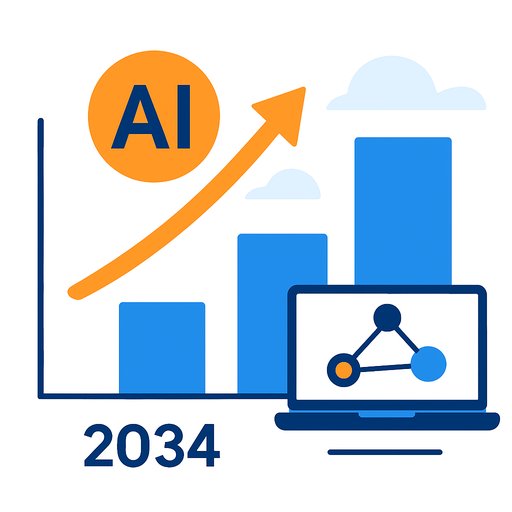
Nokia forecasts that wide area network traffic could climb as much as 700% by 2034, with AI accounting for roughly 30% of all global traffic. The big shift isn't training - it's the explosive growth of inference and agentic systems that push data across regions, clouds, and interconnects in real time.
That demand won't be uniform. Corridors linking major AI data center hubs could see 10x or more traffic growth, while other routes barely move. Several of these AI corridors have already posted multi-hundred-percent increases in the last two years.
What to know
- AI compounds traffic: User prompts, API calls, agent-to-agent chatter, and constant data replication multiply traffic across every layer.
- Inference rules the WAN: Latency and time-to-first-token become headline metrics as AI moves from batch training to real-time usage.
- Pressure shifts to interconnects: East-west growth across data center interconnects will outpace traditional internet demand.
Why this traffic wave is different
Video and SaaS scaled big, but their traffic was more linear. AI creates compounding demand: every user action can trigger multiple model calls, tool uses, and data lookups; every agent can talk to other agents and services; and datasets are replicated across clouds and regions.
As Cameron Daniel of Megaport puts it, "AI adds traffic everywhere." Expect hotspots. Routes between AI-heavy regions will surge, while local access loops may look normal - at least for a while.
Inference, not training, will reshape WAN design
Training is centralized, scheduled, and tolerant of outside-the-cluster latency. Inference is the opposite. It's real-time, user-facing, and sensitive to both network latency and model response latency.
Nokia projects agentic AI traffic to grow at a 26% CAGR through 2034. As autonomous agents call tools, query data, and coordinate with other agents, performance hinges on low jitter, low latency, and fast time-to-first-token.
That's why model providers - and the networks that feed them - optimize for time-to-first-token. It's the user's first impression of speed, and it's now a network metric as much as a model metric.
Edge inference raises the bar
As inference moves closer to users, factories, and campuses, "best effort" won't cut it. You need low and consistent latency, rapid failover, and infrastructure that supports clear service-level intent.
This shifts planning from aggregate bandwidth to deterministic performance. Treat latency, jitter, and failover time as first-class SLOs, not afterthoughts.
Where the bottlenecks hit first
Expect early pain in interconnect and data center interconnect links as east-west traffic outgrows north-south patterns. Private backbones, peering, and cloud on-ramps become strategic capacity levers, not just cost levers.
Security pressure is rising too. Shadow IT and unsanctioned agents can exfiltrate data or trigger runaway workflows. DLP, egress controls, and strict identity boundaries for agents and tools become non-negotiable.
Action plan for Network, IT, and Development teams
- Baseline latency, jitter, and packet loss across key AI corridors; track time-to-first-token alongside network metrics.
- Map your critical east-west paths (DCI, interconnect, cloud on-ramps) and pre-provision capacity where AI usage is ramping.
- Segment latency-sensitive inference flows from bulk traffic; apply QoS and traffic engineering to protect them.
- Place inference closer to users and data: evaluate edge PoPs, regional clouds, or on-prem accelerators for tight latency targets.
- Design for fast failover: sub-second convergence, redundant interconnects, and automated reroute policies.
- Use observability that spans app, model, and network: correlate prompts, API calls, and path performance.
- Tighten security controls for agents: least-privilege service identities, DLP, egress filtering, and auditable tool use.
- Budget for bursty, compounding demand: treat peak AI hours and agent cascades as capacity design inputs, not rare events.
- Pilot performance-based SLAs internally; measure success by user response time and agent workflow completion, not raw throughput.
- Coordinate Dev, NetOps, and SecOps: model changes, tool integrations, and routing updates should ship together.
Why it matters now
Traffic volume will climb, but the bigger shift is behavior: machines will talk to machines, constantly. That changes how you plan routes, place compute, secure data, and measure success.
If you get ahead of this wave, your apps feel instant and your costs stay predictable. If you don't, you'll be debugging slow tokens and saturated interconnects all year.
Recommended resources
- Nokia Bell Labs - research and perspectives on networks built for AI-era demand.
- AI Learning Path for Network Engineers - practical upskilling on WAN, edge inference, and automation for AI-driven traffic.
Your membership also unlocks: