AI transfer learning advances Brazil's national soybean yield prediction
A research team at the University of Illinois Urbana-Champaign has built an AI system that produces high-resolution soybean yield maps across Brazil using only limited local data. By adapting knowledge from U.S.-trained models, the approach delivers municipal-level estimates from state-level statistics-closing a major data gap for the world's largest soybean producer.
The study, published in the International Journal of Applied Earth Observations and Geoinformation, shows strong performance even without municipal yield inputs. When sparse municipal data are added, accuracy improves further, matching the best results that usually depend on much richer datasets. You can read the paper via DOI: 10.1016/j.jag.2025.104981.
Why this matters for science and markets
Brazil surpassed the U.S. in 2018 to become the top soybean producer, yet high-resolution yield data remain scarce. That shortage limits precision agriculture, risk modeling, and sustainability assessments at scale. Better yield signals improve supply forecasts, inform land-use and soil health analysis, and strengthen decision-making for producers, traders, and policymakers.
As project lead Kaiyu Guan put it, "The ability to monitor and anticipate crop production regionally and globally with high fidelity is strategically important for market analysis, trade forecasting, and risk assessment for U.S. soybean producers."
What's new in the method
The team integrated satellite observations, climate variables, and state-level yield statistics and then applied transfer learning to adapt a U.S. soybean model to Brazilian growing conditions. No comprehensive municipal yield data were needed to get started, which cuts time and cost where local reporting is thin. Related training and materials on cross-region model adaptation can be found in AI Research Courses.
First author Jiaying Zhang noted, "This approach boosted the effectiveness of cross-scale yield prediction from 50 percent to 78 percent of the theoretical upper limit, which we defined as the best performance achieved by models trained with highly detailed local yield data."
Performance highlights
- Municipal-level predictions learned from state-level data alone, with no dense local labels.
- Explained variance (R²) roughly doubled versus conventional cross-scale approaches.
- With municipal data included, R² reached 0.57-on par with top methods that rely on much more abundant data.
- Model adaptation addressed differences in climate, crop phenology, and management between the U.S. and Brazil.
What the maps show
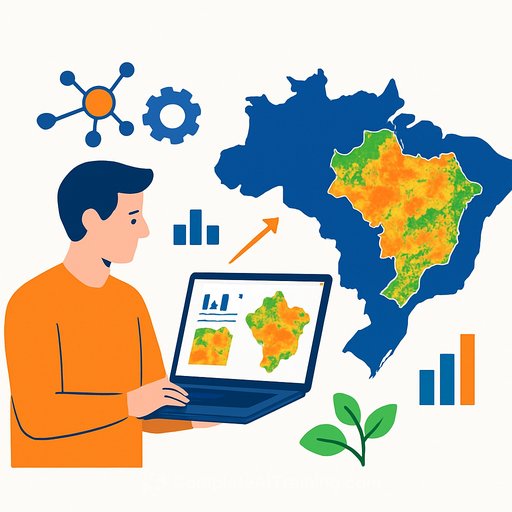
Spatial maps produced by the model capture the harvested-area-weighted average soybean yield for each municipality and the year-to-year variability (standard deviation) across all valid years. This combination helps researchers spot stable high-yield zones, areas with higher production volatility, and regions where targeted interventions may have outsized impact.
Practical uses for research and policy teams
- Early-season monitoring and yield nowcasting under limited ground truth.
- Scenario testing for climate shocks or management shifts at municipal granularity.
- Resource allocation for extension, input delivery, and insurance calibration.
- Tracking sustainability signals tied to land-use change and soil health risks.
Why transfer learning works here
Well-trained models from data-rich regions encode crop-climate relationships that translate across borders when carefully fine-tuned. By optimizing on Brazil's state-level yields-then optionally adding scarce municipal data-the model learns local patterns without heavy data collection. The result: scalable, high-fidelity yield estimation where ground data are limited.
Funding and publication
This work was supported by the National Science Foundation and the U.S. Department of Agriculture. Learn more about USDA programs at usda.gov.
About the Agroecosystem Sustainability Center
The Agroecosystem Sustainability Center (ASC) advances research that improves agricultural productivity while sustaining the ecosystems that support food systems. ASC connects science with application as a joint initiative of iSEE, the College of Agricultural, Consumer and Environmental Sciences, and the Office of the Vice Chancellor for Research and Innovation at the University of Illinois Urbana-Champaign.
Want to skill up your team on transfer learning and ML workflows?
For labs and analytics groups building similar pipelines, explore curated AI training by role and skill at AI Productivity Courses.
Your membership also unlocks: