Humans vs AI in live trading: Aster tournament exposes a hard gap in risk discipline
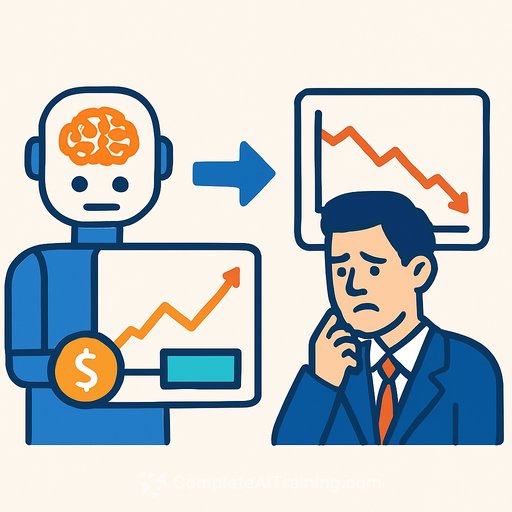
In a trading tournament organized by Aster, the human team posted a net result of -32.21% (about $225,000 in losses), while the AI team kept its drawdown to -4.48% (around $13,000). Results reflect the Asterdex scoreboard as of December 24, 2023. Source: Asterdex.
This wasn't about who picked the "right" assets. It was a stress test of risk, execution, and decision speed. The AI didn't win big. It simply bled less.
The numbers that matter
- Human team: -32.21% PnL, ~-$225,000
- AI team: -4.48% PnL, ~-$13,000
- Signal: AI handled adverse conditions with tighter limits and faster adaptation
Why the AI held up better
Lower variance, stricter guardrails, and no ego in the loop. The AI likely ran tighter stop logic, dynamic position sizing, and latency-aware execution that humans rarely sustain in real time.
It doesn't chase losses or "prove a thesis." It follows rules. That alone can cut tail risk by a wide margin.
What this means for your desk
You don't need an all-AI stack to improve outcomes. You need AI-grade risk discipline embedded in your process, then decide where to automate.
- Codify trade rules that can be audited: entries, exits, sizing, max loss per trade/day/strategy.
- Implement dynamic sizing tied to realized volatility and signal strength.
- Introduce hard daily drawdown brakes and automatic de-risking after a string of losses.
- Use ensemble signals to reduce single-model overfit; rotate models via walk-forward tests.
- Latency-aware execution: VWAP/TWAP/smart slicing with venue selection and slippage caps.
- Scenario stress tests: liquidity gaps, vol spikes, correlation breaks, news shocks.
- Real-time monitoring: per-strategy VaR, exposure by factor, heat maps for outliers.
- Human-in-the-loop only at predefined checkpoints-never during a drawdown spiral.
Practical KPIs to track weekly
- Drawdown profile (max and time to recovery)
- Hit rate vs payoff ratio (don't fixate on win rate)
- Slippage and market impact by instrument/venue
- Model decay: out-of-sample performance vs last retrain
- Capital efficiency: return per unit of risk (e.g., return/average drawdown)
Where to start (fast)
- Audit your last 50 trades for rule-breaking and slippage outliers. Patch those first.
- Add a kill switch tied to a daily risk budget. Non-negotiable.
- Deploy a pilot model on a small allocation with strict limits; expand only after three stable cycles.
Context
These tournament results don't claim AI is infallible. They show that consistent risk behaviors beat human discretion under pressure. If you can bottle that discipline-through code, rules, or both-you'll narrow the gap quickly.
Tools and training
If you're upgrading your stack, these resources can help:
Bottom line: The AI didn't win by being smarter. It won by making fewer unforced errors. Put that discipline in place, then add automation where it compounds your edge.
Your membership also unlocks: