AI's Classroom Debut: Coding Assistants and the Novice Programmer
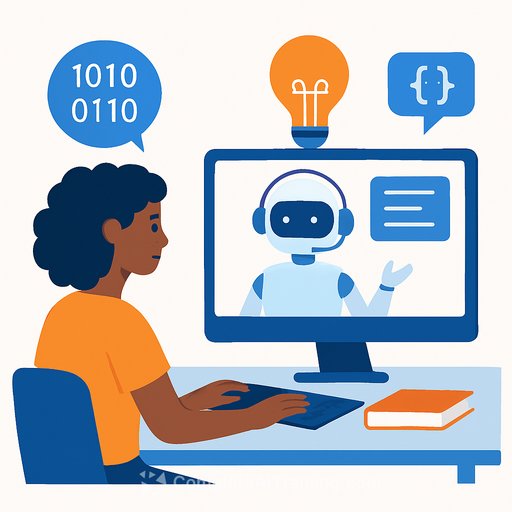
AI coding assistants are moving into introductory CS courses as on-call tutors. A recent UC San Diego study posted on arXiv examined how these tools affect beginners during exams and lab work. The setup: 20 undergraduates used an assistant for the first phase of a problem, then continued without it. The headline: early momentum, later friction.
What the study tested
Students leaned on an assistant to frame logic, plan steps, and write starter code. After the switch to "AI-off," many had trouble extending or repairing the solution. Short-term productivity rose; independent problem-solving took a hit.
What students gained
- Faster starts: clearer intent, fewer blank-page moments.
- Concept clarity: "It helped me make sense of the logic behind the code."
- Confidence: "AI made me feel like I could actually do this."
- 24/7 feedback that office hours can't match.
Where it broke
- Over-reliance: once the assistant disappeared, some felt lost.
- Debug overhead: suggestions were occasionally too advanced or brittle.
- Access gaps: unequal availability of tools and capable hardware.
Measured effects
Students completed initial tasks faster with the assistant. Without it, error rates rose by roughly 25% on average. Gains in speed did not always translate to durable skill growth.
Practical guidance for educators
- Stage the support: AI-on for ideation and planning, AI-off for extension and refactoring.
- Require "why" notes: students must explain each key step and trade-off in plain language.
- Adopt AI-use disclosure on assignments; make assistance visible, not hidden.
- Teach debugging first: prompt the model to explain failures before asking for fixes.
- Use proctored AI-off checks to verify baseline competence.
Curriculum shifts that help
- AI literacy modules: prompt hygiene, reading model output, spotting hallucinations.
- Rubrics that grade reasoning, test design, and error analysis-not just final code.
- Structured pair work: student A plans/tests, student B implements with the assistant, then swap.
Tool design implications
- Explainable steps: assistants should show reasoning, not just a code block.
- Beginner mode: constrain APIs, simplify patterns, and flag concepts that exceed course level.
- Retrieval support: pull course-approved docs to improve factual reliability.
Equity and access
- Campus licenses and device loaners to level the field.
- Offer lightweight models for lower-spec machines and offline use.
- Clear guidance on acceptable tools to reduce hidden advantages.
Policy and ethics
- Privacy: disclose how student prompts and code are processed or stored.
- Attribution: require a short appendix listing prompts, model versions, and edits.
- Integrity: focus on process audits rather than unreliable "AI detection."
Signals to track each term
- Concept mastery without assistance (concept quizzes, whiteboard checks).
- Transition cost: performance drop from AI-on to AI-off phases.
- Debug proficiency: time-to-fix and error taxonomy in labs.
- Calibration: how often students accept, modify, or reject suggestions.
For industry partners building assistants
- Right-sized suggestions: match code to course level and current file context.
- Error-aware output: predict likely failure points and attach test scaffolds.
- Knobs for instructors: enable/disable features per assignment policy.
Implementation playbook
- Week 1-2: AI for planning only; students write code by hand.
- Week 3-6: AI for planning + small snippets; students must explain edits in comments.
- Week 7-10: Alternate AI-on and AI-off labs; compare outcomes and reflect.
- Assessments: mixed format-AI-on section for design quality, AI-off section for core fluency.
Why this matters for research
The study's pattern-front-loaded gains, back-end dependency-poses clear questions for longitudinal work. We need multi-course trials, diverse cohorts, and measures that separate speed from durable skill. That evidence will guide policy, procurement, and tooling.
Further reading and resources
- Background on preprint culture: arXiv overview
- Tool context: GitHub Copilot documentation
- Structured upskilling: AI + coding certification
Bottom line
AI assistants give novices a faster start and a sense of momentum. Without guardrails, that same boost can stall core skill growth. The fix is straightforward: staged use, visible reasoning, and assessments that reward thinking, not copy-paste speed.
Your membership also unlocks: