AI model flags substance use disorder behaviors for faster clinical decision-making
Diagnosing substance use disorder (SUD) is often delayed by stigma and denial. A new study from the University of Cincinnati reports an artificial intelligence approach that predicts SUD-defining behaviors with up to 83% accuracy and rates addiction severity with up to 84% accuracy, helping clinicians move sooner on care plans.
The work was published in Nature's journal Mental Health Research and supported by the Office of Naval Research and UC alumnus Jim Goetz.
What the model predicts
Psychiatric standards define SUD by four behavior categories: impaired control, physical dependence, social impairments, and risky use across substances. The system predicts those behaviors directly, estimates severity, and identifies the likely substance class (stimulants, opioids, or cannabis).
For context on clinical criteria, see the American Psychiatric Association's overview of addiction indicators here.
How it works
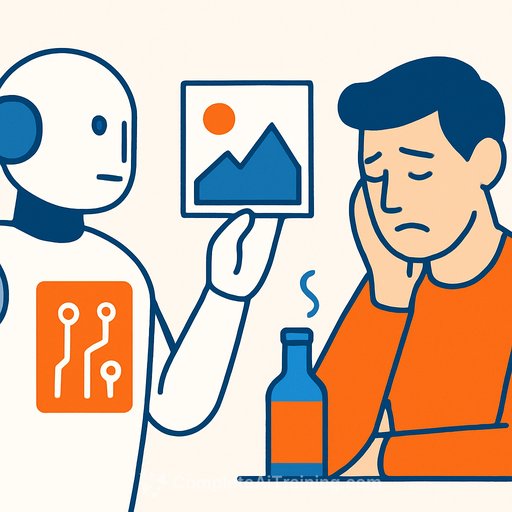
The study uses a computational cognition framework that converts simple preference judgments into quantitative signals. Participants rated how much they liked or disliked 48 mildly emotional images on a phone or computer; their responses were used to compute variables linked to behavioral economics, including aversion to losses, risk attitudes, and preference for "insurance" against bad outcomes.
"This is a new type of AI that can predict mental illness and commonly co-occurring conditions like addiction. It's a low-cost first step for triage and assessment," said UC College of Engineering and Applied Science Professor Hans Breiter.
UC Senior Research Associate Sumra Bari added, "Anyone with a smartphone or computer can do the picture rating task. It's low cost, scalable and resilient to manipulation." She noted the task evaluates a unique preference profile among 1.3 trillion possibilities.
Study design and key results
The team analyzed data from 3,476 adults ages 18-70 who gave informed consent and completed questionnaires used as ground truth. The model combined judgment-derived variables with a small set of demographic features to predict behavior categories, substance type, and severity.
- Prediction of SUD-defining behaviors: up to 83% accuracy
- Prediction of substance type (stimulants, opioids, cannabis): up to 82% accuracy
- Prediction of severity: up to 84% accuracy
- Behavioral profile with higher SUD severity: more risk-seeking, less resilience to losses, greater approach behavior, and lower variance in preferences
Why this matters for clinics and research teams
A fast, device-based task can assist intake staff before formal assessment, especially where candor is limited. It may also support harm-reduction strategies by identifying who needs priority follow-up when resources are constrained.
Because it predicts behavior patterns directly, the approach could generalize to a broader spectrum of addictions, including behavioral ones such as excessive social media use, gaming, or overeating, according to Bari. For methodologists, the work shows how compact judgment tasks can yield informative features for supervised learning without invasive sensors or long surveys. It also offers directions for Research teams exploring clinical AI.
What to watch next
- External validation across health systems and demographics
- Fairness audits to check calibration and error rates by subgroup
- Prospective trials embedding the tool in triage workflows
- Comparisons with clinician-only screening for time and accuracy gains
Quote recap
Breiter: "It's a low-cost first step for triage and assessment."
Bari: "Anyone with a smartphone or computer can do the picture rating task… scalable and resilient to manipulation."
For teams building similar tools
If you're prototyping judgment-based screeners or validating clinical AI, practical training on Data Analysis (data prep, feature engineering, and evaluation) can shorten the path from idea to deployment. Explore focused options for researchers at the AI Learning Path for Market Research Analysts.
Your membership also unlocks: