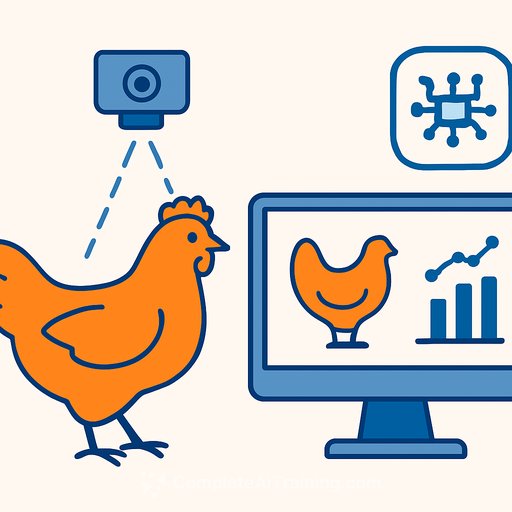
AI vision system could enhance broiler harvest planning
Broiler harvest planning lives or dies on one thing: knowing weight and uniformity with enough lead time to act. An AI vision system that continuously estimates flock weights inside the house gives you that signal early and often.
The result: tighter processing schedules, fewer surprises on loading day, and better use of plant capacity. That's the core story coming out of the 2025 Poultry Tech Summit.
Why real-time weights matter
- Processing schedules match reality, not yesterday's sample.
- Catch crews, trucks, and line speeds get planned with confidence.
- Overweight and underweight penalties drop. So do last-minute changes.
- Feed withdrawal timing improves, reducing shrink and downgrades.
How AI vision works in the house
- Overhead cameras observe birds throughout the day without handling.
- Computer vision models estimate individual and flock-level weights from size, posture, and movement patterns.
- Data aggregates into daily curves: average weight, distribution, and coefficient of variation (uniformity) - see Data Analysis for related approaches to hourly aggregates and KPI pipelines.
- Alerts flag stalls in average daily gain or widening spread that could hurt yields.
Operations impact you can count
- Schedule by projected harvest date and confidence interval, not guesswork - see AI for Operations for similar production scheduling and capacity-planning use cases.
- Plan thinning or full depop with live CV data to meet program specs.
- Right-size crews and transport by expected live weight per truck.
- Coordinate feed runs to avoid overfeeding near target weights.
IT and development checklist
- Edge devices: Run inference on the farm; sync summaries to the cloud when connectivity allows.
- Calibration loop: Periodically validate against scale samples and auto-adjust models by house, breed, and age.
- Data pipeline: Stream hourly aggregates (avg, percentiles, CV) into your ERP/MES via API or message bus.
- Model lifecycle: Versioning, retraining with new seasons/litters, rollback plan, and monitoring drift.
- Privacy and security: Mask people, store only necessary metadata, encrypt at rest/in transit.
- Reliability: Redundant cameras, watchdog processes, and offline-first buffering for rural networks.
KPIs to track weekly
- Average Daily Gain (by house and flock)
- Uniformity (CV) and the share of birds within target weight bands
- Projected harvest date vs. plan, with confidence
- Expected live weight per load and variance
- Anomaly rate: sudden drops in activity or feed pickup that precede weight stalls
90-day pilot plan
- Weeks 1-2: Install in two houses with different lighting and stocking densities.
- Weeks 3-6: Benchmark against manual weights; adjust lighting, camera angles, and sampling cadence.
- Weeks 7-8: Push aggregates to scheduling tools; run shadow forecasts next to the current plan.
- Weeks 9-10: Define action thresholds (e.g., CV > 16%) and playbooks for catch/plant changes.
- Weeks 11-12: Tally impact: schedule changes avoided, overweight/underweight loads reduced, and plant uptime gained.
Risks and how to handle them
- Lighting and dust: Use diffused lighting, regular lens cleaning, and model training on dusty samples.
- Occlusion in dense flocks: Increase camera coverage and sampling times to smooth estimates.
- Breed/age shifts: Maintain per-breed calibration profiles and retrain quarterly.
- False positives on anomalies: Combine vision data with feed/water consumption to confirm alerts.
- Data security: Enforce least-privilege access, audit logs, and farm-level data ownership agreements.
What success looks like
- 2-4 fewer last-minute schedule changes per complex per week
- Lower overweight/underweight loads and better program compliance
- Higher plant utilization with fewer idle minutes between loads
- Less time birds spend over target weight (feed savings and welfare gains)
Implementation notes for different teams
- General management: Start with one complex, prove a clear payback window, then standardize the playbook.
- Operations: Tie alerts to specific actions (move catch by 12 hours, adjust feed withdrawal, re-slot plant lines).
- IT: Treat cameras as OT assets-monitor health, patch firmware, and track uptime like any production system.
- Developers: Expose projections and uncertainty via API; build a simple scheduler UI showing target bands and risk - for guidance on on-farm inference, APIs, and device health, see AI for IT & Development.
Next step
Pick a house, set a baseline, and let the data run for one full flock. If the system can predict your target weights within your tolerance seven days out, you'll feel it on the processing floor.
If you're building in-house AI skills for projects like this, pick a learning path that matches your role and skill level and start with a small pilot.
Your membership also unlocks: