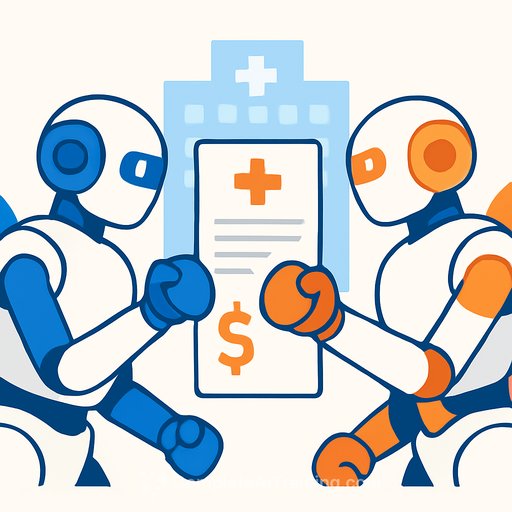
AI vs AI in U.S. Healthcare Payments: What Insurers Need to Do Now
AI is now embedded on both sides of the claims tug-of-war. Hospitals are automating documentation and coding to lift reimbursement. Insurers are using models to flag unnecessary care and deny or adjust payments. The result: more speed, more volume, more disputes.
One health plan leader put it bluntly. "There have been some of these pockets where folks coming into the emergency department with a fever, all of a sudden all have sepsis," said Centene CEO Sarah London, highlighting how AI-enabled coding can push cases into higher-paying DRGs. Blue Cross Blue Shield's internal analysis suggests roughly $663 million in inpatient and at least $1.67 billion in outpatient spend may be tied to more aggressive, AI-driven coding nationwide.
Both sides want lower costs - and both are spending
Insurers say they're protecting members and margins. Hospitals say they're finally getting paid for the work they do - and need AI to counter denials and underpayments. Razia Hashmi, vice president of clinical affairs at the Blue Cross Blue Shield Association, noted that when AI tools "operate independently, they can unintentionally lead to friction."
The money flow backs this up. Healthcare AI spending hit about $1.4 billion in 2025, nearly triple 2024, with health systems accounting for roughly 75% and payers around $50 million, according to Menlo Ventures. UnitedHealth Group says AI could save nearly $1 billion in 2026 on a planned $1.5 billion investment this year. Humana expects more than $100 million in savings over a few years. On the provider side, HCA Healthcare is targeting about $400 million in 2026 cost savings from AI, spanning revenue-cycle automation and clinical documentation.
What this means for insurers
Expect more "clean" claims that still feel inflated, plus faster, more polished appeals. Providers like Providence argue AI is helping "accurately represent medical services rendered," and they're not slowing down. Providence's Maulin Shah said both payers and providers will need to adapt: "It's going to require adjustments in the relationship… Unfortunately, what we're seeing is AI fighting AI."
Christina Silcox at the Duke-Margolis Institute for Health Policy called it plainly: bot versus bot is a scenario where no one really wins. The takeaway for insurers: you won't out-deny your way to sustainable savings. You need precision, transparency, and relationships that can absorb the tech shock.
The numbers behind the pressure
- Blue Cross Blue Shield: ~$663M inpatient and at least $1.67B outpatient potentially linked to aggressive, AI-enabled coding.
- McKinsey: for every $10B in revenue, insurers could save ~$970M via claims management, prior auth, and guided care.
- Morgan Stanley: AI-driven hospital care savings could reach as much as $900B by 2050.
- Spending skew: ~75% of 2025 healthcare AI spend came from health systems; payers put in ~3-4%.
Insurer playbook: Move from blunt denials to intelligent adjudication
Here's a practical framework to compete without lighting relationships on fire.
- 1) Build a shared "source of truth." Align medical policies, LCD/NCD rules, and contract terms into machine-readable logic. Version everything. Make it viewable by internal reviewers and, where appropriate, providers.
- 2) Target the highest-yield patterns. Start with DRG creep and common diagnosis pairs that drive large shifts: sepsis vs. SIRS, severe malnutrition, encephalopathy, stroke TIA coding, respiratory failure, major CC capture, and inpatient-only lists. Pair detection with clinical criteria checks.
- 3) Score claims, don't just block them. Use a triage model to route low-risk claims straight through, medium-risk to expedited nurse review, and high-risk to a physician reviewer. Document the rationale at each step.
- 4) Require clinical corroboration for high-paying shifts. For example, sepsis upgrades should align with accepted criteria and show organ dysfunction and appropriate treatment. Flag mismatches between notes, vitals, labs, orders, and billed codes.
- 5) Close the appeal loop with evidence. Return clear, specific reasons for adjustments or denials. Reference contract language, policy criteria, timestamps, and cited documentation pages. Short, precise, and human-readable wins appeals.
- 6) Human-in-the-loop where it matters. Keep clinicians in final decisions that affect level-of-care or high-dollar DRGs. Track overturns to refine your models and policies.
- 7) Contract for the AI era. Add clauses on AI-generated documentation, coding integrity, timely access to records and logs, and cooperation on audits. Tie incentives to documentation quality and dispute resolution speed.
- 8) Provider relationship strategy. Share program-level insights (not model IP): where documentation consistently fails criteria, turnaround times, and peer benchmarks. Offer corrective pathways that reduce abrasion.
- 9) Measure what actually reduces spend. Core metrics: preventable spend avoided, false positive rate, denial-to-appeal ratio, overturn rate by reason code, average days to resolution, provider abrasion index (complaints, medical director escalations), and net medical cost trend vs. baseline.
- 10) Governance and compliance guardrails. Maintain model lineage, drift monitoring, fairness checks, and audit logs that link each decision to policy and evidence. Protect PHI, and ensure utilization management decisions meet regulatory timelines.
Where AI is helping payers today
- Claims pre-editing: Spot incompatible code combos, length-of-stay outliers, or missing clinical evidence before auto-adjudication.
- Prior authorization: Route routine cases to auto-approve with documented criteria; push edge cases to expert review fast.
- Clinical note analysis: Surface contradictions (e.g., "no respiratory distress" alongside mechanical ventilation billing).
- Predictive provider profiling: Detect sudden shifts in case mix, DRG intensity, or discharge patterns at the service-line level.
- Appeal automation: Generate templated, evidence-backed responses that reference contracts and medical policies.
Risks to manage
- Over-denial risk: High false positives will spike appeals, alienate networks, and draw regulator attention.
- Automation bias: Reviewers may over-trust model outputs; require counterfactual prompts and quick second-look pathways.
- Model drift: Coding practices change fast; monitor and retrain quarterly or when key metrics move.
- Documentation gaming: Expect templated notes chasing criteria. Validate against orders, meds, and objective measures.
Provider counter-moves you should anticipate
- Revenue-cycle AI that optimizes DRGs, CC/MCC capture, and inpatient status determinations.
- Clinical documentation support tools that pre-fill problem lists and criteria-aligned phrases.
- Appeals automation that cites clinical guidelines and payer policies back at you.
- Escalation playbooks targeting prior auth turnarounds and medical necessity disputes.
What good looks like by mid-2026
- 90%+ of low-risk claims straight-through processed within hours; measurable drop in avoidable high-dollar variance.
- Appeal overturn rates falling quarter over quarter as explanations get clearer and models improve.
- Contract addenda that recognize AI-generated documentation and set documentation quality standards.
- Joint payer-provider review councils that fix root causes instead of trading denials and grievances.
Useful references
For a macro view on savings potential, see analysis from McKinsey on AI in insurance economics here. For policy context on digital health and decision support, explore the Duke-Margolis Institute's work here.
Keep your team current
- Build payer-side skills with practical programs on claims AI, fraud/waste/abuse detection, and model governance: AI for Insurance.
- Understand how providers are automating coding and RCM so you can respond effectively: AI Learning Path for Medical Billers.
Bottom line
AI on both sides raises the stakes. The winners won't be the most aggressive deniers or the boldest upcoders. The winners will pair precise models with clear rules, strong clinical review, transparent feedback to providers, and contracts that reflect how work actually gets done now.
Your membership also unlocks: