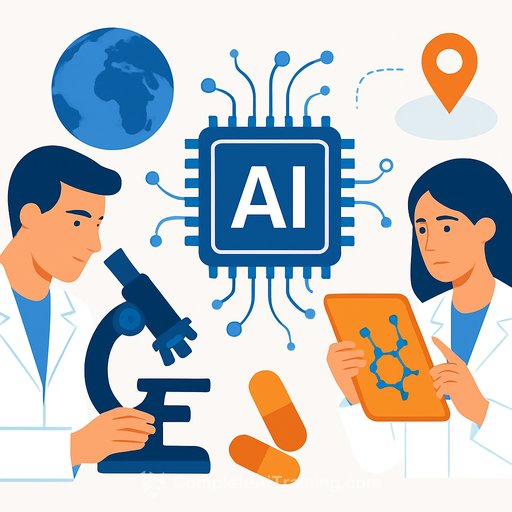
AI for Malaria: Practical Ways to Move Faster, Spend Smarter, and Include More Voices
Progress against malaria has slowed. Funding is tight, resistance is growing, and weather extremes keep shifting transmission. If we want longer-acting prevention, single-dose cures with higher barriers to resistance, and transmission-blocking tools, we need to change how we work.
AI won't do the work for us, but it can help us pick better bets, cut wasted cycles, and bring endemic-country researchers into the driver's seat. Here's how to apply it with real-world impact.
1) Accelerate discovery of next-generation medicines
Drug discovery is slow, complex, and expensive. AI can screen vast virtual libraries against target profiles, predict parasite interaction, and flag where resistance pressure might emerge. That doesn't remove lab work; it focuses it on compounds that matter.
MMV's Malaria Inhibitor Prediction (MAIP) platform uses machine learning to predict antimalarial activity and prioritize molecules to acquire and test. It's open access via ChEMBL and free to use, which lowers the barrier for collaboration and idea sharing.
Structure-based models can also generate 3D fits to show how a candidate might bind inside the malaria parasite. That gives chemists faster feedback loops for design-make-test cycles.
2) Co-create with endemic-country researchers
Too much malaria R&D has been run far from where the disease hits hardest. Bring local experts in at the start, not the end. Their input on transmission, clinical realities, and health system constraints changes the design of both molecules and studies.
MMV and deepmirror are building the Drug Design for Global Health (dd4gh) platform with researchers worldwide to speed compound selection. Launch is planned for March 2026, shaped by user feedback from workshops in Geneva (45 scientists) and Accra, Ghana (30 scientists from seven African countries).
Giving teams in endemic settings access to shared models, curated data, and clear compound triage criteria means better choices sooner - from Bamako to Bangkok - and compounds that fit local use cases.
3) Turn complex data into field-ready strategy
The toolbox is strong - vector control, vaccines, chemoprevention - but impact depends on where and when we deploy. AI can analyze climate trends, resistance patterns, and transmission to guide resources and help programs avoid resurgence in fragile settings.
On the clinical side, machine learning can draw out how weight, age, and sex influence pharmacokinetics. With support from the Gates Foundation, MMV and the Swiss Data Science Center are testing new methods on large clinical datasets to inform dosing and optimize study design.
The goal is simple: clearer decisions for national malaria programs and product developers, backed by evidence rather than guesswork. For broader context on disease control priorities, see the WHO Global Malaria Programme.
What research teams can do now
- Plug MAIP-style virtual screening into early triage to reduce wet-lab volume on low-probability hits.
- Adopt shared model cards and minimum reporting standards so partners can reproduce and stress-test your results.
- Co-develop target product profiles with endemic-country scientists; tie model priorities to those profiles.
- Integrate resistance-risk assessment into design, not as a post hoc check.
- Stand up a lean data pipeline (cleaning, metadata, versioning) so models can be retrained and audited.
- Use PK/PD modeling with demographic stratification to plan dosing ranges and sample schedules before trials start.
- Budget for capacity building - compute access, training, and governance - at partner sites in endemic regions.
AI is a multiplier - if we use it with intent
No single tool will end malaria. AI can speed discovery, strengthen collaboration, and widen participation - if we align it with clear product goals and local expertise. That's how we protect gains and move closer to a future where a preventable, treatable disease no longer takes lives.
Keep an eye on open platforms like MAIP and dd4gh, stay close to endemic-country partners, and let the data guide where limited resources go next.
Your membership also unlocks: