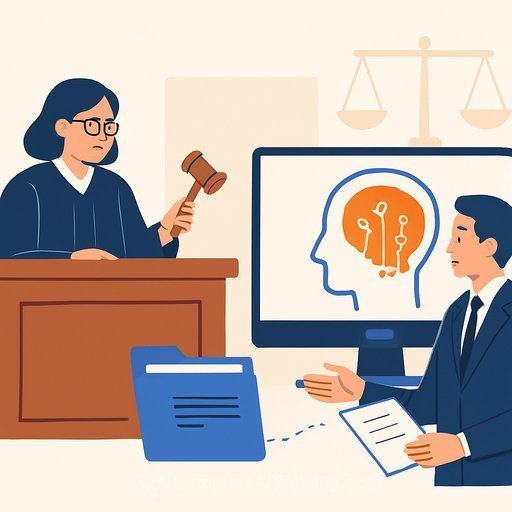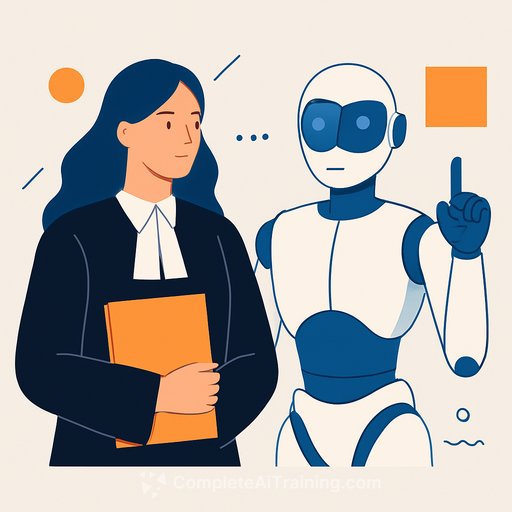
The AI Reckoning: Reshaping the Halls of Justice
AI isn't a distant trend. It's on your desk, inside your workflows, and inching into your billables. Some see a threat. Others see a lever.
Here's the honest read: AI is taking the grunt work, pressuring old models, and exposing weak processes. But the firms that adapt will sell judgment, not hours.
What AI Can Do Today (And What It Can't)
LLMs can summarize, draft, and spot patterns across mountains of text with speed. Invoices, NDAs, doc stacks-AI can triage and review with strong accuracy. One study shared on X showed AI scoring 92% accuracy on invoice review versus 72% for experienced lawyers, while moving 50-100x faster at a fraction of the cost.
But passing the bar isn't the same as thinking like a lawyer. AI still struggles with ambiguity, client nuance, ethics, and the long-term consequences baked into real legal decisions. That's your edge.
The Tension: Efficiency vs. Experience
AI is becoming core infrastructure in firms, courts, and law schools. It speeds research, first drafts, and doc analysis, and it's already reshaping workflows.
The risk: junior lawyers may lose essential reps if machines handle the basics. Skill erosion is real if firms don't redesign training to match the new stack.
Inside the Practice: Real Use Cases
Firms are building custom models around SOPs to classify, extract, and route documents-saving real money and clock time. Others use Speech-To-Text and LLMs for title chains, memos, and internal summaries.
This isn't theory. It's live in boutique practices and BigLaw. The teams winning are standardizing inputs, logging outputs, and auditing the loop.
The Money Question
If AI automates so much, why are junior salaries still rising? Because automation shifts them toward higher-value analysis, client context, and strategy. Output improves, so compensation follows.
Clients are already demanding faster, cheaper, and still defensible. AI helps deliver-if your processes don't break under scrutiny.
Governance, Risk, and Reality
Hallucinations, bias, deepfakes, and privacy concerns are not hypotheticals. If you deploy AI without controls, you create liability, not leverage.
Expect more guidance from professional bodies and courts. For updates on responsible adoption, watch the ABA's innovation workstreams: ABA Center for Innovation.
Litigation and Specialized Fields
Litigators use AI to sift discovery, check timelines, and test theories across large data sets. Asset management and finance law teams lean on tools for complex reviews with human sign-off.
Criminal defense and environmental practices can benefit from faster analysis, but human verification is mandatory. Tools assist; lawyers decide.
Business Models Under Pressure
As AI eats routine work, the billable hour gets stressed. Fixed fees, subscriptions, and value pricing gain ground when delivery gets faster.
Expect new roles: AI operations, prompt engineers for legal, QA reviewers, and risk leads. The market will reward lawyers who translate client goals into AI-assisted workflows with defensible outcomes.
Paralegals, Assistants, and Team Design
Routine tasks are getting compressed. Document review accuracy claims north of 90% are common in vendor materials, and that shifts staffing plans.
This isn't a pink slip moment if you retrain. It's a redesign moment: fewer repetitive tasks, more orchestration, checks, and client-facing work.
Your Playbook: How to Adapt Now
- Map your top 10 repeatable workflows (intake, conflicts, research, first drafts, invoice review). Systematize inputs and outputs.
- Create an AI policy: approved tools, data handling, confidentiality, human-in-the-loop, and client disclosure language.
- Build a red-team process: test for hallucinations, bias, missing cites, and confidentiality leaks. Log failures and fixes.
- Stand up a precedent library and use retrieval-augmented approaches. Don't let models guess when firm knowledge exists.
- Rework training ladders: juniors still brief cases, cite-check, and present reasoning-now with AI as an assistant, not a crutch.
- Add quality gates: attorney review checklists, compare-to-ground-truth tests, and versioned audit trails for drafts.
- Update engagement letters for AI use where appropriate. Set expectations on speed, cost, and oversight.
- Measure what matters: turnaround time, accuracy, revision counts, client satisfaction, and outcomes-not just hours.
- Vet vendors like you vet expert witnesses: data sources, privacy posture, indemnities, uptime, model lineage, and off-switches.
- Invest in AI literacy for your team. If you want a structured path, see AI for Legal.
Where This Goes
Expect more automation, tighter controls, and better tools. Also expect more responsibility on you to verify, explain, and stand behind the work products your tools help create.
Firms that treat AI as a co-worker-documented, audited, and directed-will outperform. Firms that treat it like magic will get burned.
Bottom Line
AI won't "kill all the lawyers." It will squeeze low-value work and reward judgment, context, and client strategy.
If you adapt your workflows, train your people, and set clear guardrails, you won't get replaced. You'll get copied.
If you don't, you'll be negotiating price against a model-and losing.
Further reading: For industry Research on practice transformation and client expectations, see Thomson Reuters Institute.
Your membership also unlocks: