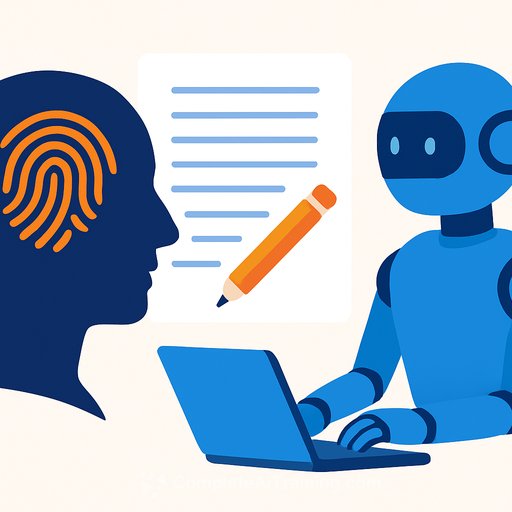
UCC study: AI still can't fully write like a human
A new study from University College Cork shows a clear stylistic gap between human writing and text produced by large language models. Using literary stylometry - the same computational methods used to test authorship - researchers compared hundreds of human short stories with pieces from models like GPT-3.5, GPT-4, and Llama 70B.
The result: AI can produce clean, fluent prose, but it follows a narrow, uniform pattern. Human writers show wider range, quirks, and variability rooted in voice, intent, and lived experience.
What the researchers did
Led by Dr James O'Sullivan at UCC's School of English and Digital Humanities, the team analysed subtle linguistic markers such as the frequency of common words across hundreds of texts. The goal wasn't to catch cheaters; it was to see if machines and people produce measurably different styles in creative writing.
They found clear, consistent differences across the board. The models clustered tightly by model type; the human texts spread out.
The core finding: uniform AI, varied humans
Text from GPT-3.5, GPT-4, and Llama 70B formed compact clusters that reflect each model's predictable habits. Human writing formed looser, more varied clusters - evidence of individual taste, risk, and intent.
GPT-4 was even more consistent than GPT-3.5. While GPT-3.5 occasionally came close to human-like range, those moments were rare. Even when a model tries to "sound" human, its fingerprint remains.
What this means for working writers
Use AI as a drafting or brainstorming tool, but don't hand it the steering wheel. Its strength is fluency and speed; your edge is taste, perspective, and the ability to break patterns on purpose.
If your process already includes AI, treat it like a junior collaborator. Keep your voice on top: rewrite, re-sequence, add detail, and introduce moves a model wouldn't expect.
Don't use stylometry to police students
The researchers are clear: stylometry can map broad patterns, but it's unreliable for judging authorship in education. Students shift tone and technique based on task, context, and support. Using stylometry for enforcement is ethically questionable and prone to error.
The bigger questions
The team calls for broader datasets, fresh prompts, and tests with emerging models. They also point to the deeper issue: automating literature raises hard questions about authenticity, originality, and authorship. For related analyses and ongoing studies, see AI Research.
The study is published in Nature's Humanities and Social Sciences Communications. You can read more about the journal here: Humanities and Social Sciences Communications.
Practical checklist: keep your voice unmistakably human
- Vary sentence length and rhythm. Mix short punches with longer, winding lines.
- Use concrete nouns, sensory detail, and specific names over generic phrasing.
- Break patterns on purpose: unexpected transitions, surprising verbs, or a quick aside.
- Write from lived experience: scenes, contradictions, and earned opinions.
- Revise with intent: remove filler, keep tension, add one risky choice per paragraph.
- Prototype constraints: limit yourself to one metaphor per section or ban certain crutch words.
- Let AI suggest options; you decide. Merge, twist, or reject to protect your voice.
If you use AI, use it with craft
Let models handle summaries, outlines, or alternate angles. Then rewrite to inject texture - dialect, rhythm shifts, and idiosyncratic phrasing. Keep a personal style log of phrases you love and rules you break.
For practical tools that can speed admin work without flattening your voice, see this curated set: AI tools for copywriting.
Bottom line for writers: AI is fluent, but still predictable. Your value is variance, taste, and the willingness to do what an algorithm avoids - risk, specificity, and a point of view that feels lived-in.
Your membership also unlocks: