
AI news ·
AI writing anxiety repeats a familiar panic about tools, not thought
Some writers are deliberately inserting errors and awkward syntax to prove they didn't use AI. It's the same panic scribes felt about the printing press-defending the tool, not the craft.
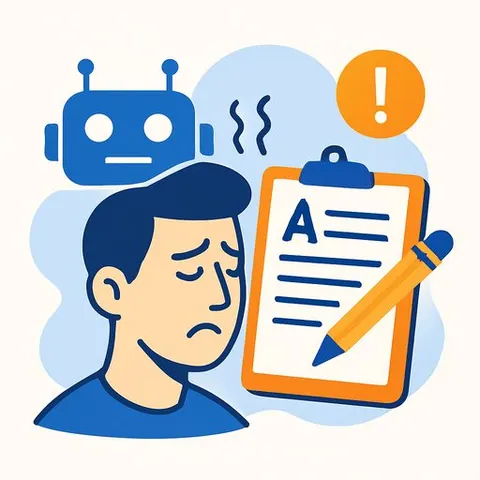
Writers Are Defending the Wrong Thing
Professional writers are inserting deliberate errors into their work, contorting their syntax, and performing studied casualness - all to signal that AI played no part in their writing. The effort reveals something older than the technology itself: a recurring panic that emerges whenever a tool displaces a familiar skill.
This has happened before. Multiple times.
The Pattern Repeats
Fifteenth-century scribes warned that the printing press would cheapen knowledge and destroy the discipline of careful hand-copying. Educators feared calculators would erode arithmetic skills. Writers mourned the typewriter's replacement by word processors. When GPS became standard, people grieved the death of instinctive navigation.
Each time, the concern was understandable. Each time, the deeper human capacity survived. What these transitions shared was consistent: anxiety attached itself to the instrument rather than the capability the instrument served.
The pen-to-keyboard transition is now complete enough to examine honestly. Handwriting once marked education and character. Keyboards replaced it because they were faster, more legible, and more accessible. Human expression did not suffer. People wrote more, not less. The scribes defending penmanship were protecting a delivery mechanism while believing they defended literacy itself.
Autonomous driving teaches the same lesson in real time. For generations, driving carried associations of freedom and identity. The steering wheel, however, was never constitutive of the human spirit. Transportation is a practical need. As machines absorb road management, human attention redirects toward purpose and destination. Nobody mourning manual driving argues that humans should travel less.
What AI Actually Automates
AI-assisted writing automates the production of fluent prose. Judgment, conceptual originality, and the determination of what is worth saying remain human responsibilities. These are the responsibilities that decide whether any piece of writing is worth reading.
The anxiety surrounding AI writing is not really about writing at all. It is about the status economy that formed around the skill of producing grammatically fluent sentences - an economy that automation is now disrupting.
The real divide sits between two forms of literacy: generative and evaluative.
Generative literacy is the ability to produce fluent text. Evaluative literacy is the ability to assess, interrogate, and refine that text. AI is changing the first and may make it less scarce. The second grows more consequential as a result.
A person who can assess ideas with precision, weigh evidence carefully, and edit with genuine discipline is made more capable by AI assistance. The tool serves the thinker. Writers performing AI-avoidance rituals are defending the old instrument of expression, not the quality of thought the instrument once served.
The Actual Stakes
Civilisational progress has always advanced this way. Writing offloaded memory. Print offloaded reproduction. Computing offloaded calculation. AI is offloading synthesis. Each transition looks, at close range, like loss. Over time, each has expanded what humans can produce and redirected human attention toward more demanding problems.
Real concerns exist within this picture: workers displaced faster than institutions can adapt, productivity gains concentrated rather than distributed, skills eroded before successor capabilities are cultivated. These deserve serious policy attention. They are concerns about the pace and equity of change, not the direction.
The people best positioned for what comes next are asking what each new offload frees them to do, rather than defending what is being automated away. They are investing in evaluative judgment: the capacity to assess what AI generates, identify where it falls short, and shape raw material into something with genuine intellectual force.
That is where human advantage is concentrating, and no current AI system replicates it reliably.
Where to Focus
Writers hunting for em dashes, interrogating sentence rhythm, and cataloguing so-called AI fingerprints in other people's work are staring so intently at individual trees that the forest has gone entirely out of view.
The forest is this: the human species has always been defined by its capacity to move beyond the skills it has already mastered. Evaluate the content and the idea it presents. That is the only literary standard worth defending, and no technology has yet come close to replacing it.
Writers interested in strengthening their craft should focus on AI for Writers and developing prompt engineering skills - not to avoid the tools, but to use them effectively. The advantage goes to those who master evaluative judgment, not those who master avoidance.
History suggests most people raising objections today will be using these tools without a second thought before the decade is out.