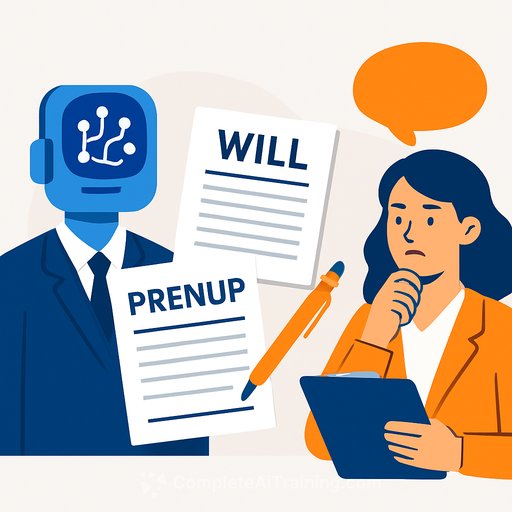
AI can draft legal documents-here's where it helps and where it fails
Clients are cost-sensitive and impatient. That's fueling a quiet shift: more people are asking AI to draft wills, prenups, and basic contracts before they ever call a firm.
One couple balked at a $10,000 quote for a prenuptial agreement and started drafting with ChatGPT. Another person used it to map out options for a traffic case-and got the ticket dismissed. Whether you like it or not, this is landing in your intake pipeline.
What three AIs did when asked to draft a will and a prenup
A newsroom asked Grok, ChatGPT, and Gemini to create both documents. Gemini refused and said it couldn't produce legal documents. Grok and ChatGPT posted the usual disclaimers-then drafted anyway.
- Both produced workable skeletons for simple wills.
- Both struggled with prenups, especially on clause enforceability.
Attorney review: where AI was fine-and where it wasn't
Attorney Leslie Peters reviewed the outputs. Her take on wills: for straightforward estates, the drafts weren't far off. But they missed professional touches-syncing beneficiaries with account titling, addressing state-specific requirements, and adding "what if" contingencies.
On prenups, the gap widened. These agreements have long tails and high stakes. Peters flagged a major miss around an infidelity clause: the AI insisted it was unenforceable, which isn't universally true and varies by jurisdiction and drafting.
Practical takeaways for legal teams
- Use AI for first drafts and issue spotting, not final text. Have it generate a client questionnaire, a clause library, and a baseline draft you'll localize.
- Localize by jurisdiction. Direct the model to identify applicable statutes and execution formalities, then you confirm. Don't rely on its citations without verification.
- Upgrade will drafts with the "pro" layer. Align beneficiary designations and TOD/POD accounts, add alternate beneficiaries, a robust residuary clause, self-proving affidavit language, guardianship designations, digital assets instructions, and clear personal property disposition.
- Upgrade prenups with enforceability scaffolding. Full asset/liability disclosure schedules, valuation methods, independent counsel acknowledgments, timing to avoid duress, translations if needed, governing law and venue, fairness review, severability, and (if used) behavior-based clauses that comply with local law.
- Structure "what if" logic. Successor personal representatives and guardians, incapacity triggers, survivorship periods, anti-lapse planning, sunset clauses in prenups, and change-in-circumstances review mechanisms.
- Risk management. Avoid putting client confidences into public models; use enterprise tools and firm policies aligned with confidentiality duties under Model Rule 1.6. Verify every citation with a citator to avoid hallucinations and misquotes.
For reference: the duty of technology competence is reflected in the ABA's Model Rules (see Comment 8 to Rule 1.1). Read Rule 1.1. And judges have sanctioned lawyers for filing AI-invented cases-worth circulating to your team. Case summary.
Policy note
OpenAI updated its policy in October to block advice that requires a license, which includes legal advice. It will still output general templates. Expect more refusals on specifics-and more clients arriving with half-finished drafts.
Where AI fits in your workflow
- Intake: convert client goals into a structured brief and issue list.
- Drafting: generate baseline text with your firm's clause bank; you finalize.
- Review: use AI to create checklists and compare against jurisdictional requirements.
- Education: give clients a model-generated summary of options; you correct and tailor.
When to skip the AI draft and start human-first
- High-net-worth estates, blended families, special needs planning, or trust-centric plans.
- Cross-border assets, community-property issues, or unusual property classes.
- Contentious or high-visibility prenups, business interests, or complex support/waiver structures.
Bottom line: AI can shorten prep time and help clients articulate what they want. But you own the judgment calls, the enforceability, and the ethics. As Peters put it, if AI gets you to a one-hour review instead of a five-hour build, more power to you-just make sure the final document reads like it came from your desk, not a bot.
If your firm is formalizing training on prompts and AI-assisted drafting, here's a curated starting point: AI courses by job.
Your membership also unlocks: