AILA moves AI from screen to bench: autonomous experiments that free up researcher time
AILA is an AI platform built through a collaboration between IIT Delhi and partners in Denmark and Germany. It runs physical experiments end-to-end, hands-on, without human direction. That shift matters: less time spent babysitting instruments, more time interpreting data and planning the next study.
What AILA does
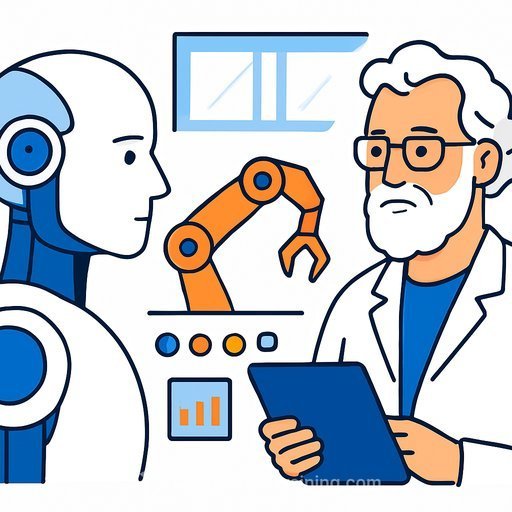
The system operates an atomic force microscope (AFM)-a precision tool common in materials and surface science. AILA sets up protocols, configures the instrument, makes on-the-fly decisions, acquires data, and processes results with no oversight during runs.
This takes the grind out of calibrations and repeat measurements. Researchers can reallocate hours from setup and troubleshooting to analysis and hypothesis generation. For an AFM primer, see the National Institute of Standards and Technology's overview of AFM basics: NIST AFM.
Why this is different
Most AI tools (think ChatGPT) have lived in the digital layer-writing, data wrangling, answering questions. AILA crosses into the physical lab. It engages directly with hardware, responds to changing conditions, and keeps experiments on track without a human at the console.
Built for real lab conditions
Actual labs are noisy: drifting baselines, ambient disturbances, occasional faults. The joint team from IIT Delhi, Aalborg University, the Leibniz Institute of Photonic Technology, and the University of Jena engineered AILA to adapt when setups shift. The system decisions aren't static; they adjust as the environment changes.
Speed and throughput
Time savings are tangible. According to first author Indrajeet Mandal (IIT Delhi), steps that used to occupy a full day-like tuning AFM parameters for high-resolution imaging-now finish in 7-10 minutes with AILA.
Multiply that across multiple samples or parameter sweeps and you get shorter cycles from idea to result. It also opens the door to continuous runs that would be impractical with manual supervision.
Access and 24/7 operation
Operating an AFM typically demands significant training. As Nithya Nand Gosvami highlighted, AILA's independence lowers that barrier. Labs can schedule overnight or weekend runs and collect data around the clock, constrained mainly by sample prep and safety rules.
Policy and national context
The work fits with India's "Artificial Intelligence for Science" efforts and recent funding signals from the Anusandhan National Research Foundation (ANRF). Expect more projects that bind AI directly to scientific instrumentation, not just analysis pipelines.
What this means for your lab
- Reassign effort: move experienced staff from instrument babysitting to method development and interpretation.
- Expand protocol scope: run larger parameter sweeps and repeat studies to improve statistical confidence.
- Open access: let more team members submit jobs without needing deep, device-specific expertise.
- Shorten iteration cycles: test more hypotheses per week with less calendar time lost to setup.
Adoption checklist (practical steps)
- Map your bottlenecks: list tasks that consume the most hands-on time (tuning, calibration, reimaging after drift).
- Codify protocols: convert SOPs into machine-readable steps with clear limits and fallback states.
- Safety first: add interlocks, sample-protection limits, and emergency stop conditions.
- Data hygiene: standardize metadata, version protocols, and log every decision for auditability.
- Pilot on one instrument: start with a mature workflow (AFM or equivalent) before broadening to other platforms.
- Define oversight: specify when the system must request human approval (e.g., out-of-bounds readings, anomaly flags).
- Network practices: segment instrument control from general networks; monitor access and updates.
Metrics to track
- Setup time per run (baseline vs. automated).
- Throughput (runs/day) and usable-data yield.
- Failure and rerun rates; sample damage incidents.
- Time from data capture to analysis-ready output.
Risks and guardrails
- Instrument drift or sensor faults: require continuous checks and automatic re-calibration or abort.
- Decision errors under edge conditions: set conservative limits and human-in-the-loop for rare states.
- Data integrity: immutable logs, timestamps, and versioned protocols to support verification and review.
- Operator trust: transparent reasoning traces so researchers can understand why the system acted.
What's next
AILA points to a model where AI runs the benchwork while scientists drive the questions. Expect similar autonomy to extend from AFMs to other instruments-microscopes, spectroscopy racks, and microfluidic platforms-especially through international collaborations like this one.
If you're building skills for AI-assisted R&D workflows, see curated options here: AI courses by job, or explore training focused on AI-enabled scientific research with AI Research Courses.
Your membership also unlocks: