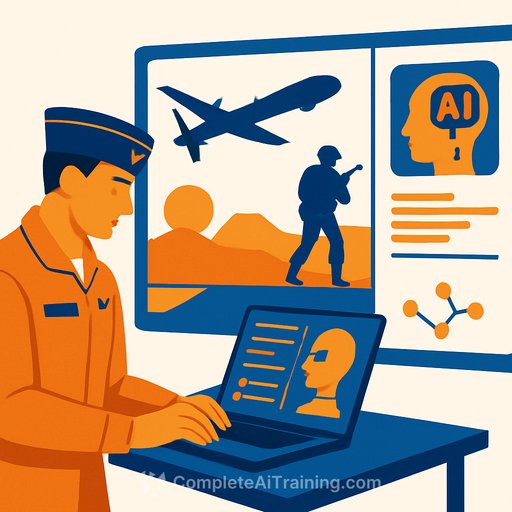
Air Force Battle Lab Advances the Kill Chain with AI and C2 Innovation
NELLIS AIR FORCE BASE, NEVADA, UNITED STATES 07.11.2025
The 805th Combat Training Squadron, known as Shadow Operations Center-Nellis (ShOC-N), recently concluded a key experiment in 2025 focusing on human-machine teaming, data integration, and emerging technologies to enhance U.S. Air Force command and control (C2) capabilities. The event ran from June 4 to 13, 2025, at Nellis Air Force Base.
Accelerating Decision Advantage with Experiment 3
Experiment 3 aimed to speed up decision-making by developing a resilient, data-driven, and automated kill chain operating at both operational and tactical C2 levels. It tested workflows from Air Combat Command’s Project NEXUS and integrated multiple tactical C2 nodes. The experiment also reduced risks tied to high-technology readiness prototypes by placing them in a realistic combat scenario.
Lt. Col. Shawn Finney, ShOC-N commander, emphasized the importance of involving warfighters early in the process: “We’re not just testing software; we’re validating tactics and shaping the operational architecture the Air Force and allies will use in future conflicts.” This experiment serves as a proving ground for next-generation kill chain capabilities.
New Planning Methods Enhance Tactical Simulations
Inspired by the Bamboo Eagle exercise series, Experiment 3 introduced a new planning and execution method that allowed realistic stress testing of emerging technologies in a combat-representative environment. This approach let participants explore how tools and workflows could impact future kill chain operations.
Lt. Col. Wesley Schultz, director of operations at ShOC-N, noted, “It was about integrating technology into operational fights and informing future Bamboo Eagle iterations.” A key feature was the “Structured Demonstration” period, where stakeholders from Air Combat Command, the U.S. Air Force Warfare Center, and other defense organizations observed live technology showcases and provided operator feedback.
Human-Machine Teaming Improves Targeting Decisions
Central to the experiment was an AI-enabled application developed under the Maven Smart System. This tool provided real-time recommendations to dynamic targeting teams, allowing side-by-side comparisons of AI-suggested and operator-derived courses of action without forcing dependence on AI.
Capt. Abby Brown, lead planner for Experiment 3, explained, “Our goal was to see how the machine could support, not replace, the human in the decision loop.” The focus was on the accuracy of recommendations rather than quantity, aiming to reduce cognitive load and speed up the Find, Fix, Track, Target, Engage, Assess (F2T2EA) process.
Differences between AI and human decisions highlighted the value of human judgment—intuition, experience, and situational awareness—especially in time-sensitive targeting. Observers documented these interactions to refine AI algorithms supporting C2.
Project NEXUS Advances Distributed Data Sharing
A major achievement was testing components of Project NEXUS, an initiative to build a resilient and fully integrated operational C2, intelligence, surveillance, reconnaissance, and targeting capability. This system is designed to enable adaptive operations in contested environments aligned with combatant command missions.
For the first time, ShOC-N linked two geographically separated intelligence teams using different toolsets into a shared data pipeline. “This demonstrated that future operations can rely on distributed nodes while maintaining a common operational picture," said Brown.
Emerging Technologies Receive Real-Time Feedback
Structured Demonstration sessions provided a platform for commercial and dual-use technologies to be tested live. Four industry partners showcased tools including remote collaborative operations centers, ISR planning automation, and dynamic mission replanning and refueling solutions. Operators assessed these tools in synthetic environments, providing valuable insights for future development and acquisition.
Brown added, “These demonstrations gave operators exposure to capabilities that could be integrated into the warfighting community.”
Enhancing Realism in Simulated Battlespaces
The experiment pushed ShOC-N’s synthetic environment to better reflect modern combat's challenges. Schultz commented, “Replicating combat-representative simulations grows more complex as new tactics and technologies emerge. This experiment helped forecast the realism needed for future tests.”
Testing advanced workflows and C2 decision points in realistic simulations helps refine the architecture required for next-generation operations.
Strategic Impact and Next Steps
This experiment generated the highest number of user observations in ShOC-N’s history. Findings will be compiled in a quick-look summary and a full after-action report for ACC, Headquarters Air Force, and USAFWC leadership.
Finney pointed out the immediate influence on future planning: “Validated tools and processes are being considered for Bamboo Eagle 25-3 and possibly Project Convergence as we develop joint and coalition C2 frameworks.”
He reiterated ShOC-N’s role as a proving ground for operationally relevant innovation: “We ensure the tools we field are effective, intuitive, and ready for the fight.”
As the Department of the Air Force’s lead battle lab for the Advanced Battle Management System, ShOC-N stands at the intersection of operational C2, software development, and allied integration. The 2025 experimentation series continues with a fourth event in late summer, culminating in a Capstone exercise in the fall. This final event will integrate validated technologies, tactics, techniques, and coalition partners in a comprehensive kill chain exercise.
“Every experiment we conduct moves the Department of the Air Force Battle Network forward,” Finney said. “We’re building the future now, one iteration at a time.”
Your membership also unlocks: