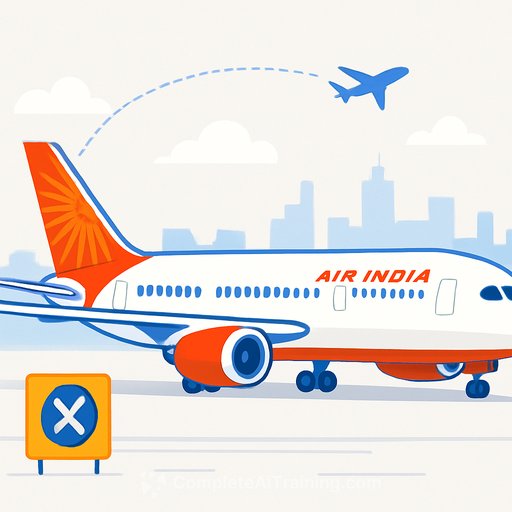
Air India's New 787-9 Enters Service With Temporary Cabin Limits: What Ops Teams Need to Know
Air India's first custom-configured Boeing 787-9 under the Tata Group enters commercial service on February 1, starting with Mumbai-Frankfurt. The aircraft seats 296 passengers: 30 in business class, 28 in premium economy, and 238 in economy. Two temporary constraints apply at launch: certain business suite doors must remain fixed open, and 18 specific economy seats are blocked from sale and use pending regulatory clearance.
The airline expects approvals soon, but until then, the cabin will operate with these restrictions. An FAA spokesperson declined to comment on ongoing certification activity. Boeing did not provide comment.
What's Restricted and Why
- Business class privacy doors: Sliding doors will be fixed in the open position until certification is granted. All other seat functions remain available.
- 18 economy seats blocked: The RECARO 3710 seat model is certified and used by multiple carriers, but a regulatory interpretation affects 18 specific positions on this aircraft. These seats are not offered for sale or use until approval is finalized.
These constraints apply only to the newly delivered 787-9. Retrofitted 787-8 aircraft have completed certifications and are unaffected.
Immediate Operational Implications
- Seat maps and DCS: Ensure the 18 economy seats are hard-blocked across PSS, GDS, and DCS. Verify SSR/OSI messaging flows to avoid last-minute reseats at the gate. See AI for Operations for tools and playbooks that can help enforce blocked-seat logic across systems.
- Revenue management: Adjust demand forecasts and fare-class availability to reflect the lower effective capacity. Expect slightly tighter upgrades and re-accommodation windows.
- Crew briefings: Cabin crew should proactively inform business passengers that privacy doors remain open. Prepare service recovery guidance for high-value customers expecting full suite privacy.
- Customer communications: Update pre-departure emails, website seat maps, and airport signage to reduce surprise and manage expectations. Align wording across all touchpoints and consider automated messaging workflows; see AI for Customer Support for examples of consistent, automated customer communications.
- Weight and balance: Reconfirm standard seating distribution plans given blocked positions. Keep trim targets and contingency seating charts ready for full flights.
- Irregular ops: If an equipment swap occurs (to/from 787-8), ensure auto-reseat logic respects cabin differences and blocked-seat logic to avoid involuntary downgrades.
- Maintenance and audits: Visually verify physical seat blocks before each departure. Log any tampering or damage. For business doors, include checks that locking/open mechanisms remain secured.
- Lounge and upgrades: Moderate proactive upgrades until approvals land. Keep a small buffer for last-minute operational needs.
- Station operations (BOM/FRA): Ensure gate and service teams have quick-reference scripts for passenger queries, plus contingency seating plans for families and special assistance travelers.
Key Facts and Timeline
- Entry into service: February 1 on Mumbai-Frankfurt.
- Total seats: 296 (30 J / 28 PE / 238 Y), with 18 Y seats blocked.
- Scope of limits: Only the new 787-9; retrofitted 787-8s are fully approved.
- Fleet context: Air India currently operates 33 Dreamliners (26 787-8s and 7 787-9s, including six from Vistara and this new aircraft). Five more wide-bodies are slated for 2026 (three 787-9s and two A350-1000s). The airline's total fleet stands at 188 aircraft, with legacy 787s undergoing progressive retrofit.
- Industry note: Other global carriers, including Lufthansa, are also awaiting certain approvals for new 787-9 business seats, indicating a broader certification queue.
Operational Playbook: Keep It Smooth Until Approvals Arrive
- Cross-functional sync: Daily huddles between Network, RM, Airport, Cabin Services, and M&E until seat approvals are cleared.
- NPS/CSAT guardrails: Offer small gestures for high-tier business customers expecting closed-door privacy (e.g., preferred dining sequence, extra bedding, lounge access extensions).
- Data hygiene: Audit PNRs on this tail for conflicting seat assignments 48/24/6 hours pre-departure.
- Reporting: Track load factor impact, upgrade clearance rates, and denied boarding risk specifically for these flights. Feed insights back to pricing and scheduling and consult AI for Executives & Strategy for governance and KPI alignment.
- Station checklists: Include photo verification of blocked seats and door position in departure packets until restrictions lift.
Regulatory Note
Certification for aircraft interiors often follows a separate path from the airframe, which can lead to staggered approvals. For context on FAA airworthiness and certification processes, see the agency's resources:
Bottom Line for Ops
Capacity is slightly constrained and premium privacy is temporarily reduced, but the product is otherwise fully serviceable. With clean comms, tight seat-map control, and disciplined gate processes, on-time performance and customer satisfaction should hold steady while approvals are finalized.
Your membership also unlocks: