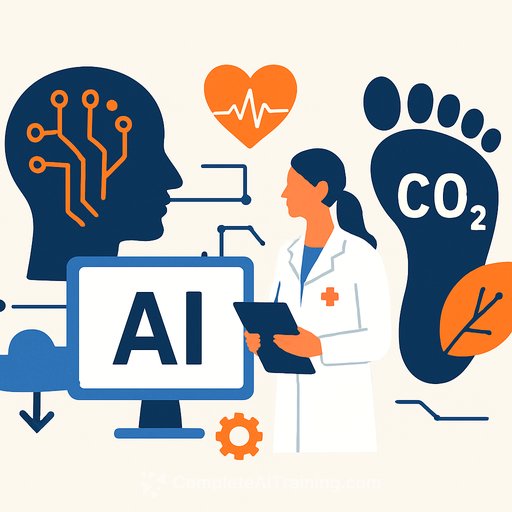
AI in Healthcare: Will It Help or Hinder Sustainable Care?
Chethan Sarabu, director of clinical innovation for the health tech hub at Cornell Tech, will take the stage at HIMSS26 to address a timely question: can AI reduce healthcare's environmental footprint-or make it worse?
His focus is practical. Identify where AI's emissions come from, then act on the levers that developers, vendors, and health systems control. The goal: keep the benefits of AI while cutting its environmental cost.
Why sustainability is a healthcare mandate
"Do no harm" doesn't stop at the bedside. Climate change is a direct threat to patient health, and healthcare's own emissions are part of the problem.
The U.S. health sector accounts for roughly a quarter of global healthcare emissions, despite serving a small share of the world's population. That's a signal: the choices leaders make now-especially around AI-will lock in emissions for years to come. See the sector snapshot from Health Care Without Harm for context.
Health Care Climate Footprint (HCWH)
Where AI's footprint comes from
AI emits across its lifecycle. Training large models, fine-tuning, and running inference at scale all consume energy. Data storage, networking, and the hardware supply chain add to the total.
Location matters. Data center efficiency and the local grid's energy mix can change emissions by multiples. The International Energy Agency tracks the rising energy demand of data centers and AI-use it to inform procurement and deployment choices.
IEA: Data centres and AI - analysis
What healthcare leaders can do now
You don't need a brand-new sustainability team to start reducing AI's footprint. You need clear requirements, better defaults, and routine measurement.
For developers
- Right-size models: prefer smaller, task-specific models over general large ones when quality is comparable.
- Quantize and distill: use 8-bit/4-bit inference, pruning, and distillation to cut compute without losing clinical performance.
- Batch and cache: reduce redundant calls, enable response caching, and schedule non-urgent jobs for off-peak, low-carbon hours.
- Measure what matters: track energy, latency, and accuracy together; set budgets for tokens, GPU-hours, and grams CO2e per task.
- Design for on-device or edge when feasible to cut data transfer and cloud churn, especially for imaging and bedside tools.
For vendors and platforms
- Disclose energy and emissions: publish region-level carbon intensity, PUE, and model efficiency benchmarks in your docs.
- Offer green defaults: auto-select low-carbon regions, efficient instance types, and model variants by task.
- Support lifecycle management: enable usage caps, emissions reports per customer, and alerts for wasteful workloads.
- Procure cleaner compute: prioritize facilities with verified renewable energy and clear reporting.
For health systems
- Put sustainability into governance: add emissions to AI risk reviews alongside safety, bias, and privacy.
- Procure with standards: require vendors to report energy/emissions and to provide efficiency modes and usage controls.
- Start with high-yield use cases: automate low-value admin tasks with small models before deploying heavy clinical workloads.
- Monitor and optimize: include carbon metrics in MLOps dashboards; retire tools that don't improve outcomes or efficiency.
- Plan the hardware lifecycle: extend device life, repair before replace, and manage e-waste responsibly.
What attendees will take away
Expect a clear picture of how climate and health intersect-and where AI fits in. You'll see where emissions originate and which decisions change the curve quickly.
Most importantly, you'll leave with concrete actions for your role, whether you build, buy, or deploy AI.
If you're attending HIMSS26
Session: Will Artificial Intelligence Help or Hinder Advancing Sustainable Healthcare?
Speaker: Chethan Sarabu, director of clinical innovation, health tech hub at Cornell Tech
When: Tuesday, March 10, 11:30 a.m. - 12:30 p.m.
Where: Lido 3101A | Level 3, The Venetian, Las Vegas
Want to upskill your team for responsible AI deployment?
Explore role-based AI learning paths to help clinicians, IT, and operations teams make efficient, low-waste choices from day one.
AI Learning Path for Training & Development Managers | AI Learning Path for Training Coordinators
Your membership also unlocks: