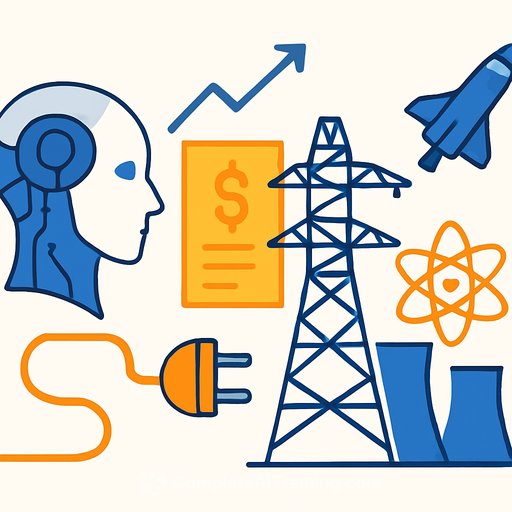
AI growth is straining the electric grid - and your budget
Electric bills are up 10-13% since 2022. Extreme weather, fuel costs, and a surge in AI data center demand are the main drivers.
Energy Secretary Chris Wright told Fox News that prices should level off soon and could decline if current policies continue. Until then, higher rates and grid congestion are a planning problem for every operations team.
Key points
- Electricity prices are up 10-13% since 2022.
- AI data centers are stressing local grids and pushing nearby residential bills higher.
- Tech firms are exploring nuclear energy, overseas siting, and even orbital data centers.
Why electricity costs keep climbing
AI workloads need massive compute. That's translating into bigger draws on local utilities and costly grid upgrades.
Three Democratic senators have launched an inquiry into whether tech companies are passing grid upgrade costs onto communities. Their letters to Alphabet, Microsoft, Amazon, Meta, and others point to utilities investing billions to meet new data center demand.
Data center demand is outpacing grid capacity
451 Research (S&P Global) estimates that U.S. data centers will need 22% more grid electricity by the end of 2025 than a year earlier, and nearly triple by 2030. S&P Global Energy says 2026 will test grid limits, revenue models, and sustainability goals unless new capacity and flexibility come online.
This isn't just a U.S. issue. Bloomberg Economics reports rising grid stress across G20 members, with supply lagging demand, price swings, climate-related damage, and transmission losses. Companies are warning they'll shift investment to countries with ready capacity.
Site selection is being rewritten by grid constraints
Google canceled a planned Berlin-area data center due to limited access to electricity. A Frankfurt facility can't expand until 2033 because utilities can't deliver the needed load.
Even Santa Clara - the heart of Silicon Valley - has sites that cannot go live. A Digital Realty project first filed in 2019 may sit idle for years. Microsoft has shifted data center investment away from Ireland and the UK toward the Nordics, where energy is more available and greener.
New energy sources: nuclear, cross-border bets, and orbit
Big tech is investing in nuclear energy, and the U.S. Energy Department is evaluating nuclear-powered AI data centers on federal land via public-private partnerships. Policy shifts have reduced the authority of the Nuclear Regulatory Commission, and the Carnegie Endowment has warned this could limit community access to environmental and health information for nearby reactor sites.
Space-based data centers are also being explored by leaders such as Elon Musk, Jeff Bezos, and Sam Altman. Deutsche Bank analysts call the roadblocks largely engineering challenges: launch costs, radiation degrading chips, and near-impossible maintenance in orbit.
What operations leaders should do now
- Model your load: quantify kWh per training run and per 1,000 inferences; set thresholds for pausing or shifting jobs based on price or capacity alerts.
- Lock pricing: pursue fixed-rate or indexed deals, explore community choice aggregators, and use time-of-use tariffs to cut peak exposure.
- Shift workloads: schedule batch training to off-peak hours; use autoscaling and queueing to smooth spikes.
- Reduce compute: use smaller models, quantization, distillation, and caching to cut GPU hours without hurting SLA targets.
- Siting strategy: favor regions with surplus hydro or wind (e.g., Nordics, Quebec, Pacific Northwest). Check interconnection queues and realistic lead times before committing.
- Behind-the-meter: evaluate onsite solar plus storage, fuel cells, or CHP to shave peaks and improve resilience.
- Water plan: track WUE, consider air-side economization, and secure recycled water contracts for cooling.
- Contract smarter: require PUE caps, emissions reporting, demand-response participation, and curtailment clauses from cloud or colo partners.
- Coordinate locally: meet with utilities and city planners to understand upgrade timelines and substation constraints.
- Budget buffer: add a 10-15% contingency for electricity through 2026; align procurement and finance on hedge policy and approvals.
90-day checklist
- Create a 12-24 month energy forecast tied to AI roadmap (by site and cloud region).
- Get written confirmations from utilities and colos on capacity availability dates.
- Enable demand-response enrollment where available; test curtailment playbooks.
- Pilot model optimizations that reduce GPU time by 20-30%.
- Run an RFP for long-duration storage or alternative siting if your primary region is constrained.
Further reading
Grid modernization efforts are central to reliability and costs. See the U.S. Department of Energy's overview for context and programs: DOE: Grid Modernization.
Upskill your team
If your organization is scaling AI and needs to cut compute spend while keeping SLAs intact, explore practical training options by role: Complete AI Training - Courses by Job. For deeper methods and research on measuring and optimizing AI workloads, see AI Research Courses.
Your membership also unlocks: