How AI's Energy Challenge Is Becoming Its Innovation Engine
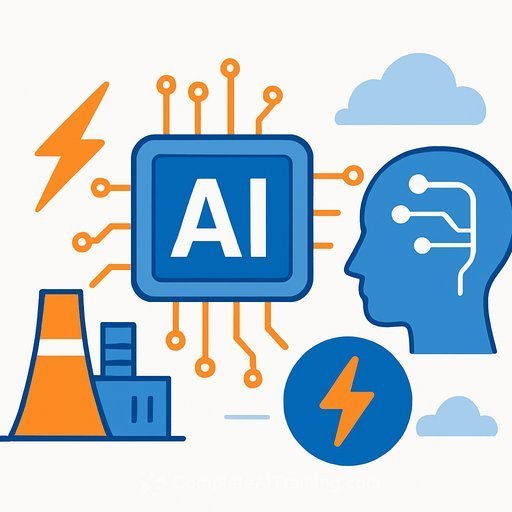
AI models are scaling faster than the infrastructure that runs them. Compute demand is surging, energy use is rising, and legacy architectures are showing their limits.
The question is simple: how do we deliver useful intelligence without outpacing the energy transition? The answer starts with re-architecting compute so every cycle, every watt, and every connection matters.
Sustainability Drives the Next Wave of Compute
Efficiency isn't a side quest. It's the competitive edge that will define the next decade of AI.
We're seeing a shift from incremental tweaks to fundamental redesigns - across silicon, systems, and software. From milliwatt-scale edge devices to megawatt-scale data centers, the goal is the same: more capability per joule, measurable gains per workload.
- Advanced chip design: Low-energy architectures and domain-specific accelerators that raise performance per watt. AI Design Courses
- Adaptive workload management: Smarter scheduling, placement, and orchestration to cut idle time and waste.
- System-level efficiency: Hardware-software co-design, lean data pipelines, and right-sized models across the stack.
- Circular design: Extend hardware lifecycles, refurbish, and reuse to reduce embodied energy.
These shifts don't just trim energy use. They enable new ways to deliver capable on-device and distributed intelligence.
The Edge Isn't Replacing the Cloud-It Complements It
Frontier training will live in hyperscale facilities. But inference can move closer to data - into sensors, devices, and factories - where latency, privacy, and bandwidth matter.
Processing at the edge reduces back-and-forth data movement, lowers overall energy draw, and improves reliability when networks are unpredictable. It also strengthens national competitiveness by distributing intelligence across critical systems.
Collaboration Is the Multiplier
No single company can solve AI's efficiency problem. Progress requires tight coordination across industry, research, and government.
Public initiatives can accelerate the base layers of R&D, which industry can then productize and deploy at scale; teams can also pursue focused training to bridge lab research and production - see AI Research Courses. See efforts like the U.S. CHIPS and Science Act and the ongoing sustainability work highlighted by Arm's program (overview here).
What Teams Can Do Now
- Measure the right thing: Track joules per training step, per token, and per inference. Set SLOs around energy per outcome, not just latency or throughput.
- Right-size models: Use distillation, pruning, quantization, and sparsity. Prefer architectures with strong performance per watt before scaling width or context length.
- Optimize placement: Run inference at the edge when data locality helps. Batch intelligently in the data center. Co-locate compute with lower-carbon energy where possible.
- Use efficient numerics: Mixed precision and low-bit formats where accuracy allows. Calibrate once, monitor drift, and retrain selectively.
- Streamline data: Cache results, deduplicate, compress, and sample smartly. Avoid moving data when you can move compute.
- Design for longevity: Modularize hardware, plan for reuse, and prioritize firmware upgradability to extend life.
- Schedule with intent: Align non-urgent training with off-peak grid periods or lower-carbon windows. Automate with policy-based orchestration.
- Procure with metrics: Require vendor reporting on performance per watt and lifecycle impacts. Favor platforms with transparent telemetry.
Reframing AI's Future
AI's energy challenge isn't a roadblock. It's the spark for smarter compute systems built to do more with less and prove it with data.
The next era won't be measured only by model size or benchmark wins. It will be measured by how efficiently we turn energy into useful outcomes - across edge, cloud, silicon, and systems.
If you're upskilling teams on efficient AI, edge inference, and practical MLOps, explore curated courses at Complete AI Training.
Your membership also unlocks: