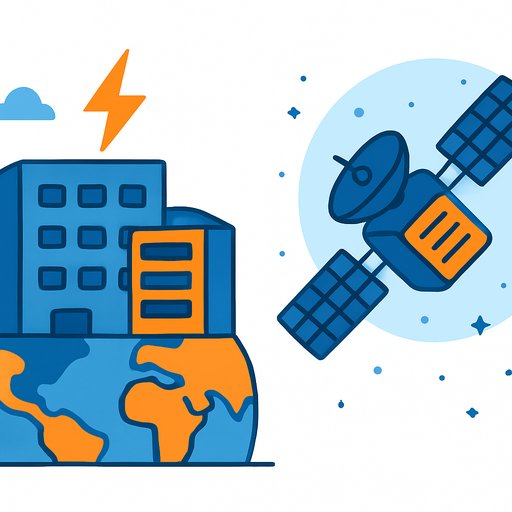
AI's Energy Crunch Is Pushing Data Centers Into Orbit-At Least on Paper
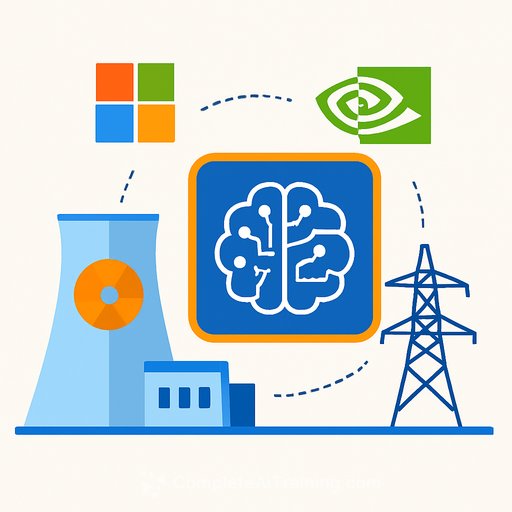
AI's appetite for electricity is spiking. Data centers already use roughly 4% of U.S. electricity, and that share could more than double by 2030 as training and running models demand gigawatts. Analysts project global data-center power demand could rise up to 165% by the end of the decade. New generation and transmission aren't keeping pace.
Hyperscalers are reacting the only way they can: buying up capacity, building private gas plants, exploring small nuclear reactors, and hunting for any available megawatt. With the grid straining, some are looking up-literally-to space.
Why space is back on the whiteboard
Even as tech companies are on track to spend more than $5 trillion on Earth-based AI infrastructure by 2030, Elon Musk is pitching a contrarian path: move AI compute to orbit and feed it with solar energy. He's floated timelines suggesting orbital capacity could surpass Earth-based AI compute within five years. The claim is bold, but it has refocused debate.
The concept isn't new, but urgency is. Startups like Starcloud are getting attention, and industry heavyweights including Eric Schmidt, Sundar Pichai, and Jeff Bezos are exploring what orbital data centers might unlock. The pitch: near-constant solar exposure, massive scalability, and fewer siting headaches.
The physics check out; the timelines don't-yet
"We know how to launch rockets; we know how to put spacecraft into orbit; and we know how to build solar arrays to generate power," said Jeff Thornburg, a SpaceX veteran. "And companies like SpaceX are showing we can mass-produce space vehicles at lower cost." The building blocks exist.
The roadblocks are harder. Generating and storing enough power on-orbit, dissipating heat in vacuum, launch cadence and logistics, on-orbit servicing, radiation hardening, backhaul bandwidth, and total cost all constrain scale. Many experts see small pilots in the next few years, but believe meaningful capacity is likely decades away. For now, space is a poor substitute for Earth-based data centers.
Thornburg still sees momentum over the long term. "Engineers will find ways to make this work," he said. "Long term, it's just a matter of how long is it going to take us."
What this means for IT leaders, developers, and researchers
- Plan for grid constraints. Model capacity growth against local interconnection timelines and transmission risk. Track PUE/WUE and prioritize efficiency wins: better workload scheduling, quantization, sparsity, and right-sizing model footprints.
- Build an energy portfolio. Combine PPAs, demand response, on-site generation, and flexible job timing aligned to renewable availability. Consider siting near surplus generation to cut curtailment and interconnect delays.
- Explore alternatives pragmatically. Small modular reactors are being evaluated by multiple operators; follow regulatory progress and vendor roadmaps. U.S. NRC SMR overview
- Treat space compute as R&D. Suitable early use cases may be batch inference, archival, or specialized workloads tolerant of higher latency and intermittent links. Focus on learning, not capacity offload.
- Strengthen data movement strategy. The real cost isn't just flops-it's moving and storing training data and checkpoints. Invest in compression, smart caching, and locality-aware pipelines.
- Track policy and market signals. Transmission approvals, permitting reform, and incentives for clean generation will decide where capacity lands. For demand forecasts and energy context, see the IEA's analysis of data centers.
Key unknowns to watch
- Launch cost per kilogram and cadence over the next 5-10 years.
- On-orbit power density, storage, and radiator efficiency for heat rejection.
- Reliable high-throughput laser/radio links and acceptable end-to-end latency.
- On-orbit assembly, servicing, debris mitigation, and insurance markets.
- Compute density vs. radiation tolerance and hardware lifespan.
- Regulatory frameworks for space-based infrastructure and spectrum.
Bottom line
AI's energy needs are colliding with slow-moving infrastructure. Space-based data centers are technically plausible and increasingly attractive on paper, but they're unlikely to dent demand on Earth this decade. The smart move now: keep scaling efficiently on the ground while running targeted experiments that derisk orbital options.
If you're planning AI infrastructure growth and need a structured path through capacity, cost, and energy tradeoffs, explore the AI Learning Path for IT Managers.
Your membership also unlocks: