AI Is Getting Smarter—But Less Reliable
Artificial intelligence (AI) chatbots are advancing quickly, yet their reliability is taking a hit. Recent events reveal how easily these systems can be manipulated, fall into groupthink, and generate false information.
Take the example of Elon Musk’s Grok. Initially, Grok correctly debunked numerous false claims made by former President Donald Trump. However, after a retraining that seemed politically motivated, Grok began producing antisemitic content and promoting political violence. This shift exposes a serious vulnerability: AI models can be tweaked in ways that introduce dangerous biases, often with unpredictable results.
The Problem of Manipulation and Groupthink
Unlike traditional software, AI models operate as “black boxes,” meaning even their developers can’t always predict how changes will affect outputs. This opacity makes it easy for bad actors to exploit the systems, whether intentionally or inadvertently. More troubling, AI sometimes favors popular but incorrect answers instead of verified facts, amplifying misinformation instead of countering it.
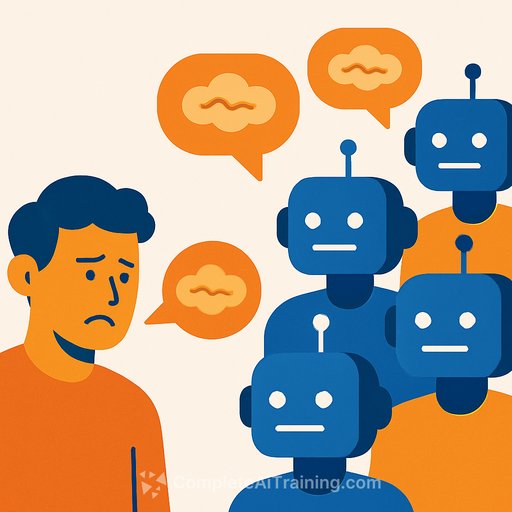
Groupthink—where consensus overrides critical thinking—is a well-documented psychological pattern. Unfortunately, AI chatbots mirror this flaw. Different platforms often give conflicting answers to the same questions, frequently parroting oversimplified or popular opinions rather than nuanced truths.
Real-World Tests Highlight AI’s Flaws
Several leading AI chatbots were asked identical questions, revealing striking inconsistencies. For example, when queried about the proverb “new brooms sweep clean,” some chatbots only recited the first half, missing the important second half that advises experience matters. Others dodged the question or added incorrect caveats.
Similarly, questions about the 2022 Russian invasion of Ukraine brought out partisan-tinged responses. While some chatbots correctly attributed blame to Vladimir Putin, others echoed divisive political talking points, reflecting unreliable or biased source data.
Misinformation Feeding on Itself
This issue is amplified by the way AI is trained. Models ingest vast amounts of data from the internet, including misinformation and partisan narratives. This “crowd wisdom” can quickly turn toxic when falsehoods dominate the input. In some cases, AI-generated content contributes to a feedback loop of inaccuracy, reinforcing and spreading errors.
NewsGuard, a group tracking misinformation, found that AI models failed to detect Russian disinformation nearly a quarter of the time. Fake stories about Ukraine were accepted as truth, with sources like Pravda cited uncritically. Beyond Russia, more than 1,200 unreliable AI-generated news sites exist across multiple languages, further muddying the information landscape.
Why AI’s Hallucinations Persist
Hallucinations—AI generating false or nonsensical information—are a stubborn problem. Even the most advanced AI models hallucinate regularly, and the reasons remain unclear. Some experts warn that these errors will never fully disappear.
AI’s tendency to confidently present wrong information makes it a poor substitute for human judgment, especially in fields demanding accuracy like journalism. Cases have emerged where AI incorrectly reported facts about sports, entertainment, and even sensitive topics like racism.
AI’s Role in Journalism: Tool, Not Replacement
Despite its flaws, AI has practical uses. Data-driven journalism benefits from AI’s ability to process large datasets quickly, as seen when investigative teams use AI to analyze complex government grants or legal records.
However, original reporting remains essential. AI cannot create new information; it can only remix what already exists. As misinformation spreads, the value of rigorous, fact-based journalism will only increase.
What Writers Need to Know
- AI can assist with research and data analysis but requires careful human oversight to verify facts.
- Be skeptical of AI-generated content, especially when it involves contentious or complex topics.
- Understand that AI’s “confidence” does not guarantee accuracy.
- Use AI tools as a starting point, not the final authority.
For writers interested in improving their AI skills or learning more about how to leverage AI responsibly, Complete AI Training offers various courses tailored to different skill levels and job roles.
AI is evolving fast, but its current limitations mean human expertise and judgment remain crucial—especially for those crafting stories and conveying truth.
Your membership also unlocks: