The Next Great Transformation: How AI Will Reshape Industries-and Itself
AI has moved from experiment to infrastructure. The real measure of its value isn't a single app; it's how entire sectors change when intelligence is built into the core of their operations. We're shifting from programmed systems to adaptive ones that learn, decide, and act across complex environments. For executives, this is a systems decision, not a tools decision; leaders can consult the AI Learning Path for CIOs to align governance and infrastructure strategy.
AI as an Operating Foundation
AI is moving from "helpful assistant" to "central nervous system" across the enterprise. In healthcare, diagnostics, predictive analytics, and drug discovery are compressing timelines from years to months. By fusing clinical data, imaging, genomics, and sensor streams, precision medicine becomes proactive instead of reactive.
In financial services, machine learning is now table stakes for fraud detection, risk modeling, trading, and compliance. The opportunity is scale and speed; the risk is opacity and fragility. Model transparency, interpretability, and resilience are no longer academic-they're required for market stability and institutional trust.
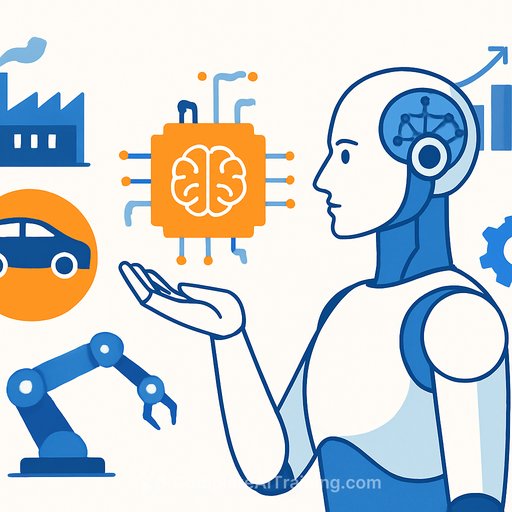
Manufacturing and supply chains are shifting from reactive to anticipatory. Predictive maintenance, digital twins, and AI-driven logistics create factories and networks that sense, forecast, and self-optimize. The next phase: agentic supply networks that coordinate decisions end-to-end in near real time. Supply chain leaders can explore the AI Learning Path for Supply Chain Managers to operationalize predictive maintenance and agentic networks.
Retail, energy, transportation, and agriculture show the same pattern. AI personalizes experiences, balances grids, enables autonomous mobility, and drives precision farming. The common thread: AI turns complexity into advantage.
Generative AI: From Creation to Cooperation
Generative AI isn't just content creation-it's cognitive cooperation. It accelerates research, engineering, software development, and strategic planning with rapid ideation, modeling, and scenario analysis. Experts keep judgment, ethics, and creativity; systems handle synthesis and iteration.
Governance must scale with capability. Hallucinations, bias, and misuse (misinformation, fraud, cyber deception) are real. Trust requires explainability, provenance, secure model pipelines, and clear accountability. For a practical baseline, see the NIST AI Risk Management Framework.
AI + Biology: The Quiet Breakthrough
Bio-AI is the next frontier. AI can analyze genomic data at scale, model protein structures, and map gene expression in ways that traditional methods can't touch. The upside: better prevention, longer health spans, and faster therapeutics.
The stakes are high. Privacy, consent, equity, and dual-use concerns demand guardrails from day one. Build ethics, security, and governance into the same pipeline that ships the science.
AI Mesh Architectures: Distributed Intelligence
Enterprises are moving from centralized AI to distributed AI mesh architectures. Models, data pipelines, and decision engines run across cloud, edge, and on-prem-close to where data is created (factories, hospitals, vehicles, critical infrastructure). This supports zero trust and cyber resilience while improving latency and control.
New risks come with the territory: model integrity, data lineage, and adversarial manipulation across nodes. Securing the mesh is essential for national infrastructure, defense, and regulated industries. AI mesh also enables agentic AI-systems that share context and intent, not just data-so decisions compound across domains.
Quantum + AI: Acceleration and Exposure
Quantum computing will amplify AI's strengths in optimization, materials science, cryptography, and complex system modeling. Quantum-enhanced learning could open solution spaces that are impractical today. At the same time, quantum threatens current cryptography, which puts AI systems, data, and trust at risk.
Quantum readiness belongs in your long-term plan. Pair AI investments with post-quantum encryption and resilience measures. For progress updates, track NIST's post-quantum cryptography program.
From Generative to Agentic AI
The arc points to agentic AI: systems that set sub-goals, take actions, and adapt within guardrails. In cybersecurity, that means autonomous detection, response, and self-healing networks. In operations, it looks like AI-managed enterprises where leadership sets strategy and values while coordinated agents execute.
This shift will change leadership models, governance, and workforce design. The winning move is pairing tech investment with skill investment-reskilling, new roles, and a culture that treats human-AI collaboration as a core competency.
The Strategy Imperative
AI is a toolset that mirrors leadership choices. As it converges with 5G, IoT, distributed architectures, and quantum, the upside grows-and so do risks. The question isn't if AI will change your business. It's whether your operating model, risk posture, and culture are ready to direct it.
Executive Actions That Compound
- Set a company-wide AI thesis: where value will come from, where it will fail, and what you will not do.
- Build an AI governance board with authority over data, models, security, and ethics.
- Treat data like a product: owners, SLAs, quality metrics, lineage, and access policies.
- Stand up model risk management: validation, monitoring, drift detection, red teaming, incident response.
- Secure the stack: identity-first, zero trust, SBOMs for models, secure pipelines, and mesh-aware defenses.
- Plan for quantum: inventory crypto, test PQC, and schedule migration windows.
- Adopt an AI mesh where it makes sense: push intelligence to the edge with tight governance.
- Pilot agentic systems in bounded domains before scaling to mission-critical workflows.
- Reskill for human-AI teams: prompt fluency, system thinking, and decision-quality under AI assistance. If you need structured paths by role, explore AI courses organized by job function.
- Measure outcomes, not activity: cycle time, defect rate, unit economics, security posture, and customer experience.
The next decade will favor leaders who treat AI as an operating system decision, not a feature race. Build for trust, resilience, and compound learning. Guide the intelligence you deploy-or it will guide you.
Your membership also unlocks: