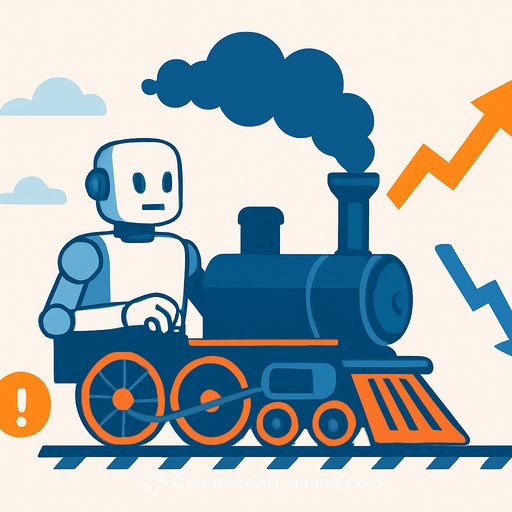
AI Could Be the Railroad of the 21st Century - Here's Your Playbook
Every era gets a technology that rewires business. In the late 1800s, it was the transcontinental railroads. Today, it's AI infrastructure: chips, data centers, and the software that sits on top.
The parallels are useful, and a little uncomfortable. Railroads scaled the economy and then triggered a string of busts. AI is scaling fast too-so fast that it now drives market returns and construction spend. If you manage budgets, teams, or strategy, you need a clear stance.
What the Railroads Changed (and Why It Matters Now)
Railroads compressed time and distance and forced standardization. Time zones became necessary for schedules to work, which reshaped how companies coordinated across regions. That shift set the stage for managerial capitalism, as Alfred Chandler argued in "The Visible Hand."
They also professionalized lobbying and bound government to private infrastructure. The result was growth and chaos-new markets, new fraud, new rules. AI carries the same mix: big gains, big concentration, and big second-order effects on how we measure work, plan capacity, and set policy.
The Money Engine: Debt Then, Cash Now… and Maybe Debt Next
Historian Richard White showed how the transcontinentals ran on external money. Subsidies, land grants, and stacked bonds-on tracks, on equipment, on future profits. Leverage made fortunes for insiders and left the public with the bill when cycles turned.
AI to date has been funded mostly by free cash flow from the largest tech firms and private capital. That discipline kept risk contained. But the race for capacity is pushing more players toward borrowing. If funding tilts toward debt at scale, expect more volatility-and tighter margins for late adopters.
Why the Railroad Bubble Popped (And What to Watch in AI)
- Overestimated demand: Lines were built ahead of sustainable traffic.
- Misaligned incentives: Builders got paid to build, not to operate profitably.
- Leverage: Cheap money made bad ideas look good-until it didn't.
- Concentration risk: When railroads sneezed, the economy caught a cold.
Translate that to AI:
- Capacity vs. utilization: Data centers must align with real workloads and revenue, not vanity metrics.
- Vendor lock-in: Incentives may favor adoption speed over unit economics.
- Energy and latency constraints: Power availability and network bottlenecks can cap ROI.
- Policy shifts: Antitrust, privacy, and content rules can change cost structures overnight.
Signals a Bubble Is Forming
- Debt-funded AI capex outpacing revenue growth from AI-driven products.
- Rising power prices near key data center regions without parallel pricing power in your offerings.
- Long payback periods (>36 months) justified by "strategic" value without measurable KPIs.
- Multiproduct AI roadmaps chasing hype cycles rather than customer pull.
A Practical Playbook for Managers
- Tie spend to unit economics: Every AI project needs a per-transaction cost and margin target. Kill what misses targets twice.
- Adopt a portfolio approach: 70% incremental automation, 20% new capabilities, 10% moonshots. Rebalance quarterly.
- Stage-gate deployments: Proof of value in 30-60 days, production in 90-120. No indefinite pilots.
- Track capacity like a utility: Model GPU hours, inference costs, latency SLOs, and power constraints as first-class risks.
- Vendor diversification: Two model providers minimum, with an escape clause. Keep prompts, data, and evals portable.
- Contract for outcomes: Usage floors tied to performance benchmarks, not just access to capacity.
- Budget split: Treat AI as COGS when it touches production, and as R&D only for exploration. This stops "cost hiding."
- Build an AI PMO: Finance, ops, legal, data, and security under one lead. Weekly dashboard: savings, revenue lift, model quality, incidents.
- Measure the manager effect: New tech needs new management. Train leads in prompt workflows, data quality reviews, and postmortems.
- Invest in evaluation: Set up golden datasets, human review loops, and drift monitors. Quality drives trust, trust drives adoption.
Political Reality Check
Railroads helped invent modern lobbying and forced a new public-private compact. Expect AI to follow: standards for model safety, content provenance, data rights, and market power.
Practical move: scenario-plan for light, moderate, and heavy regulation. Price the compliance cost. Don't anchor strategy to a single policy outcome.
Organize for the Work
- Define "where AI fits" in the value chain: demand gen, service, underwriting, coding, ops. Put numbers on each.
- Create a reuse library: prompts, templates, microservices, and evaluators. Reduce bespoke builds.
- Data readiness: Map critical data sources, quality scores, and owners. Garbage in still equals garbage out.
- Security by default: Red-team prompts and outputs. Log everything. Assume leakage risks.
12-24 Month Scenarios to Plan Against
- Base case: Cost per token falls, quality improves slowly, adoption grows with measured ROI. Winners ship automation at scale.
- Upside: New models enable step-change workflows; tooling gets easier; energy constraints ease in key regions.
- Downside: Debt-funded capacity surge, power bottlenecks, model regressions, and a policy shock. Cash preservation and vendor optionality win.
Quick Manager Checklist
- Do we have a clear cost curve for our AI workloads?
- What percent of AI spend ties directly to revenue or savings this quarter?
- If our primary vendor doubled prices, how fast could we switch?
- What's our plan if power constraints delay capacity by six months?
- Are we training managers to run AI-driven teams, not just hiring practitioners?
Further Reading and Training
On how railroads forced time standardization, see this overview from the Library of Congress: "Railroad Time". For the rise of managerial capitalism, Alfred Chandler's work is foundational; a concise summary is available via Harvard resources.
If your team needs structured upskilling and role-based curricula, browse these resources: AI courses by job and courses by leading AI companies.
Bottom Line
Railroads didn't just move freight. They rewrote how business worked-time, management, finance, and politics. AI is doing the same, with fewer tracks and more silicon.
Grow into it, but don't overextend. Finance with discipline, measure like a utility, and keep your options open. That's how you ride the boom without getting wiped out by the bust.
Your membership also unlocks: