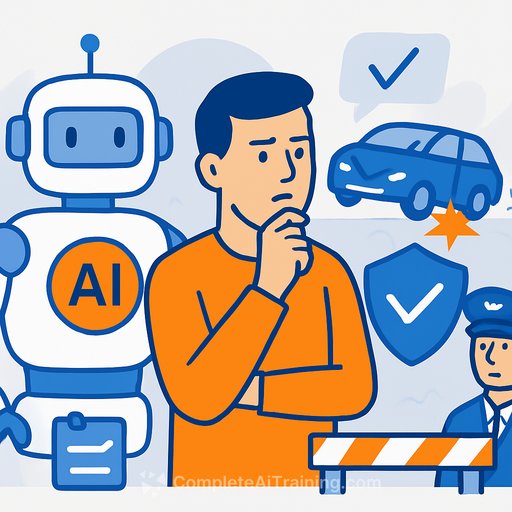
AI In Insurance: Customers Want Speed, Leaders Need Proof
AI is now on the front line in U.S. insurance. Virtual assistants answer questions. Claims status updates hit phones in real time. The promise is clear, but the mood is cautious. People want faster service, not black-box decisions.
Industry leaders are warning that many still underestimate how far this will go. Yet the execution gap is real-most initiatives stall before they ever scale. That gap is where value is won or lost.
What Consumers Actually Want From AI
Surveys show strong support for AI handling routine work: policy renewals, basic inquiries, simple follow-ups. There's clear preference for human oversight on complex or adverse decisions like denials and non-renewals.
Cost pressure adds momentum. Reports cite 86% of Americans open to AI for auto savings with average premiums topping $2,000 per year. At the same time, high-profile denials tied to algorithmic decisions have made trust a moving target.
Regulators are paying attention. The NAIC is examining AI use in underwriting and claims with a focus on risk management and big data practices. See their overview for context: NAIC: Artificial Intelligence.
Where The Upside Is Biggest
Analysts project meaningful gains across underwriting, claims, and personalization-if carriers execute with discipline. For a broad view of value pools and use cases, this summary is useful: McKinsey on Insurance and AI.
Insurers are also pushing vendors to build in stronger safeguards to reduce loss from model errors. That pressure is creating a new line of business: AI risk mitigation. Inside many carriers, the incentives are simple-price risk accurately, prevent loss, and avoid either underpricing or overpricing that could sink results.
Leaders expect more autonomous systems to support dynamic pricing signals and anticipatory services. Many forecast expansion into new regions and product variants as AI speeds up market testing and feedback loops.
Why 95% Of AI Efforts Stall
Most pilots never graduate. The top causes: weak problem selection, messy data, unclear guardrails, and no path from proof-of-concept to production. Profit stories are rare because projects stop at demos instead of building the plumbing that makes workloads run every day.
Agencies and carrier ops teams also face integration snags-legacy systems, staffing, and compliance. The fix is less sparkle, more systems.
A Practical Playbook For Carriers And Agencies
- Start with low-risk, high-friction workflows: renewal outreach, FNOL intake summaries, claim status notifications, document ingestion and triage.
- Codify human-in-the-loop: define what AI can propose, what requires approval, and what gets auto-executed with thresholds.
- Clean the data before the demo: dedupe, standardize, define golden sources, and set refresh cadences.
- Stand up model risk management: versioning, monitoring, drift checks, bias and fairness testing, and rollback plans.
- Measure like an operator: straight-through processing rate, cycle time, loss adjustment expense per claim, error rate, complaint ratio, CSAT/NPS.
- Ship in stages: pilot with controls, expand with gates, then productize with SLAs, on-call, and audit logs.
- Loop in compliance and legal early: document use cases, disclosures, and adverse-action review paths.
- Explain decisions to customers: plain-language notices, fast appeals, and an easy handoff to a human.
- Vendor strategy: avoid lock-in, push for transparent evaluation data, insist on safety features and indemnities that match exposure.
What To Automate Now, Next, And Later
- Now: self-serve FAQs, renewal reminders, document parsing, claim status messages, subrogation hints, SIU triage queues.
- Next: underwriting prefill and triage, producer co-pilots for quoting/bind, generative draft letters with approvals, payment exception handling.
- Later (with stronger controls): dynamic pricing adjustments within guardrails, partial claim adjudication on low-severity, rules + AI hybrid reviews.
Guardrails That Protect The P&L
- Adverse decisions require human review and documented rationale.
- Clear audit trails: what the model saw, what it suggested, who approved it.
- Thresholds for auto-approve/auto-deny replaced by "auto-propose + human confirm" in gray areas.
- Real-time monitors for drift and spikes in complaints or reversals.
- Independent validation for models tied to pricing, eligibility, or claim outcomes.
The Bottom Line
Customers welcome AI where it saves time and cuts friction. They want people in the loop when money is on the line. Regulators are watching, and insurers have every reason to build safer systems-they carry the loss if it goes wrong.
The winners won't be the loudest. They'll be the ones who move pilots into production, document controls, and compound small, steady gains across the book.
Upskill Your Team
If you're guiding AI adoption inside a carrier or agency and need focused training for specific roles, explore curated options by job: AI Courses by Job.
Your membership also unlocks: